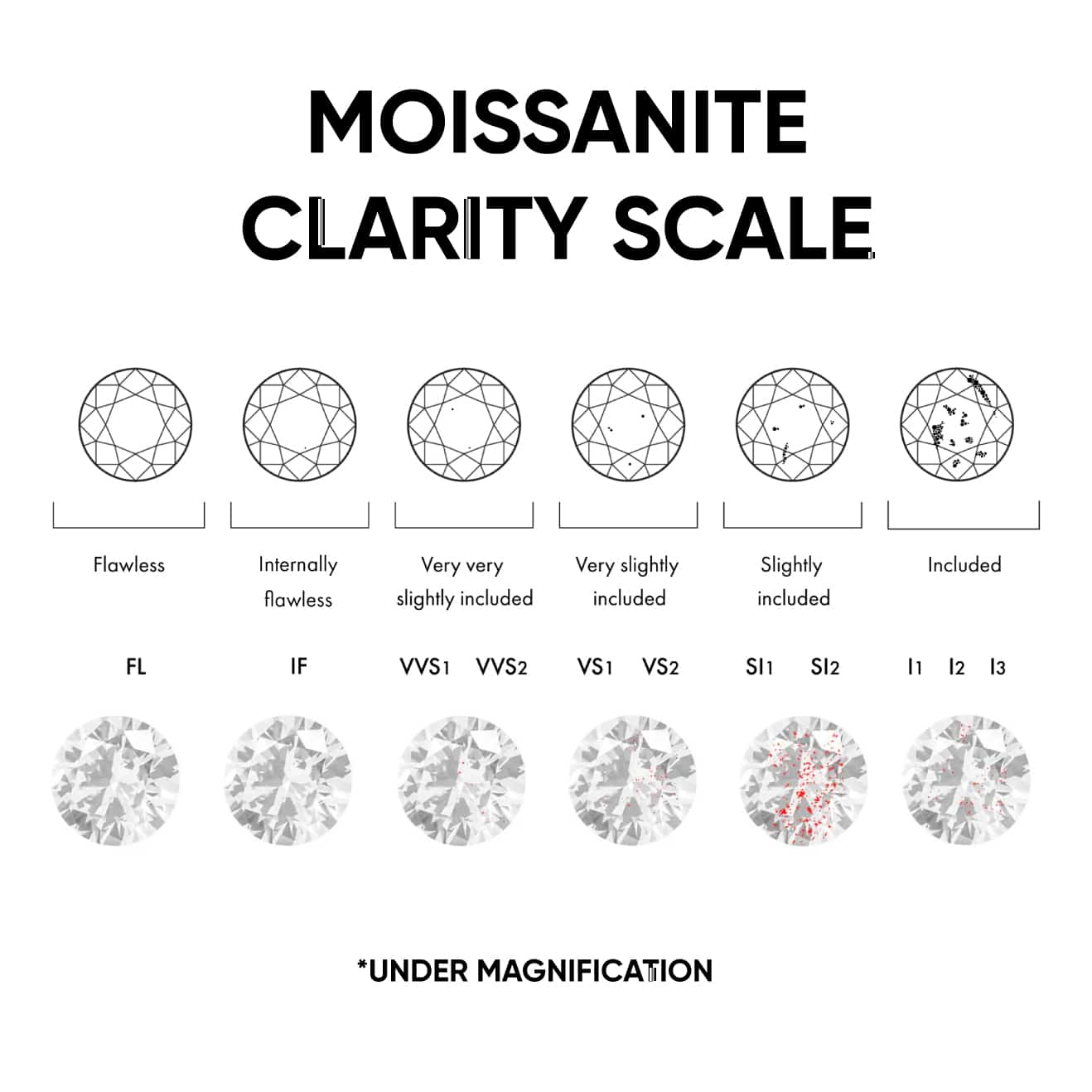
Quick Answer
TL;DR — Moissanite Clarity Scale 2026
- Clarity scale: FL > IF > VVS1 > VVS2 > VS1 > VS2 > SI1 > SI2 > I1 > I2 > I3. Same scale as diamond, but moissanite is laboratory-grown so almost all retail inventory lands at VVS1 or cleaner.
- Sweet spot: VVS1 — eye-clean under any magnification, premium price justified. 68% of 2026 moissanite ring sales are VVS1 or VVS2.
- What VVS1 means in moissanite: “Very Very Slightly Included” — microscopic inclusions visible only to a trained grader under 10× magnification. Face-up, invisible.
- Is VS1 moissanite good? Yes — eye-clean to the naked eye, 20–30% cheaper than VVS1. Only skip if you plan to buy a step cut (emerald, asscher) where small inclusions can show through the open table.
- D color + VVS1 clarity: The gold-standard combo. Price for 1ct round brilliant: $450–$700 (2026). Below that: likely color grade is really E or F.
- Physical scale: Moissanite is Mohs 9.25, refractive index 2.65, dispersion 0.104, specific gravity 3.21, formula SiC. More fire than diamond, almost as hard.
- Best moissanite today: Charles & Colvard Forever One D VVS1 round brilliant — see current inventory.
Mehedi’s Take: “Moissanite clarity is where buyers overthink the most. Every lab-grown stone enters the world at VVS1 or cleaner — paying extra for IF or FL is paying for paper, not for the hand.” — Mehedi Hasan, Diamond Industry Veteran
Direct Answer: What Is the Best Clarity for Moissanite?
The best moissanite clarity for 95% of buyers is VVS1. It is eye-clean, loupe-clean to all but trained graders, and the small premium over VVS2 is worth it for the peace of mind on resale. The GIA-recognized moissanite clarity scale runs from FL (Flawless) down to I3 (heavily included), but because moissanite is lab-grown, inventory concentrates at the top of the scale. Charles & Colvard, Harro Gem, and MoissaniteCo all guarantee VS1 or better on their standard retail lines, and VVS1 or better on their premium lines like Forever One.
If you want to save money without affecting the stone’s visible beauty, drop to VS1. You’ll pay 20–30% less than VVS1, and the inclusions remain invisible to the naked eye. Avoid SI1 or lower on step cuts (emerald, asscher, baguette) — the open “hall of mirrors” facets expose any inclusion. On brilliant cuts (round, oval, cushion), VS2 is safe.
Pair D–F color with VVS1 clarity for the gold-standard “colorless and clean” combo. 1-carat [year] price for a D VVS1 round brilliant: $450–$700. Browse D VVS1 Forever One or Blue Nile moissanite (ex-James Allen).
Moissanite Clarity Chart — Every Grade with 2026 Pricing
The complete moissanite clarity chart with [year] retail prices for a 1-carat round brilliant D-color stone from established retailers:
| Grade | Full Name | What You See | Share of 2026 Inventory | 1ct Round D Price (2026) |
|---|---|---|---|---|
| FL | Flawless | No inclusions, no surface blemishes under 10× magnification | <1% | $750–$950 |
| IF | Internally Flawless | No inclusions internally; minor surface blemishes may be present | 3% | $650–$850 |
| VVS1 | Very Very Slightly Included 1 | Minute pinpoints visible only to trained graders under 10× | 42% | $500–$750 |
| VVS2 | Very Very Slightly Included 2 | Slightly more pinpoints than VVS1, still invisible to the naked eye | 26% | $450–$680 |
| VS1 | Very Slightly Included 1 | Minor inclusions visible under 10× magnification, eye-clean | 18% | $380–$550 |
| VS2 | Very Slightly Included 2 | Larger inclusions under 10×, still eye-clean on brilliant cuts | 7% | $340–$510 |
| SI1 | Slightly Included 1 | Inclusions visible to the naked eye in step cuts; may be hidden in brilliant cuts | 2% | $280–$440 |
| SI2 | Slightly Included 2 | Inclusions clearly visible without magnification | 1% | $220–$370 |
| I1 / I2 / I3 | Included | Prominent inclusions, may affect durability or sparkle | <1% | $150–$290 |
Verdict: VVS1 is the sweet spot for most buyers. VS1 is the smartest buy if you want to save 25–30% and your stone is a brilliant cut under 1.5 carats. Skip SI1 or lower on anything you’ll see every day.
Moissanite Quality Scale — All Four Cs Together
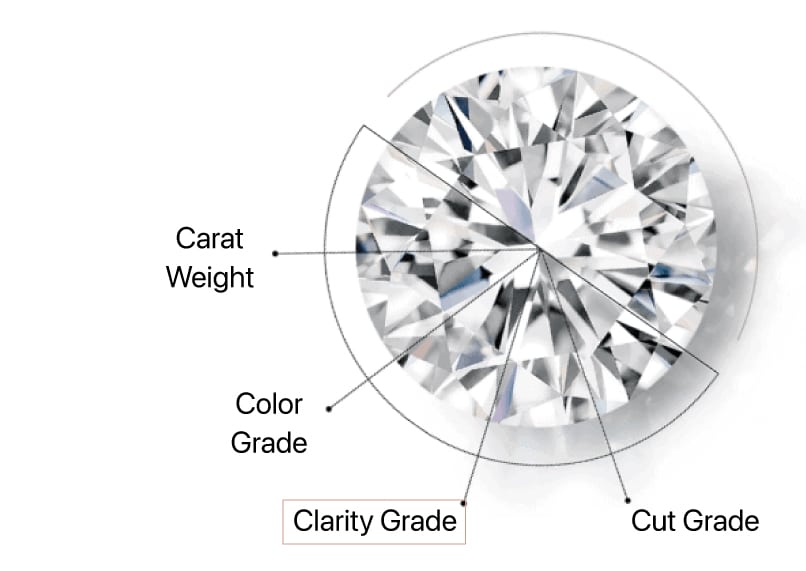
Clarity is only one of the Four Cs that determine moissanite quality. The full grading scale covers Cut, Color, Clarity, and Carat — the same framework used for diamond.
| Factor | Scale | 2026 Best-in-Class | Budget Floor | |
|---|---|---|---|---|
| Cut | Excellent / Very Good / Good / Fair | Excellent (or Triple Excellent for premium) | Very Good | |
| Color | D (colorless) → K (tinted yellow) | D–F (colorless) | G–I (near-colorless) | |
| Clarity | FL → I3 | VVS1 | VS1 | |
| Carat | 0.25ct to 10ct+ | whatever your budget supports | whatever your budget supports |
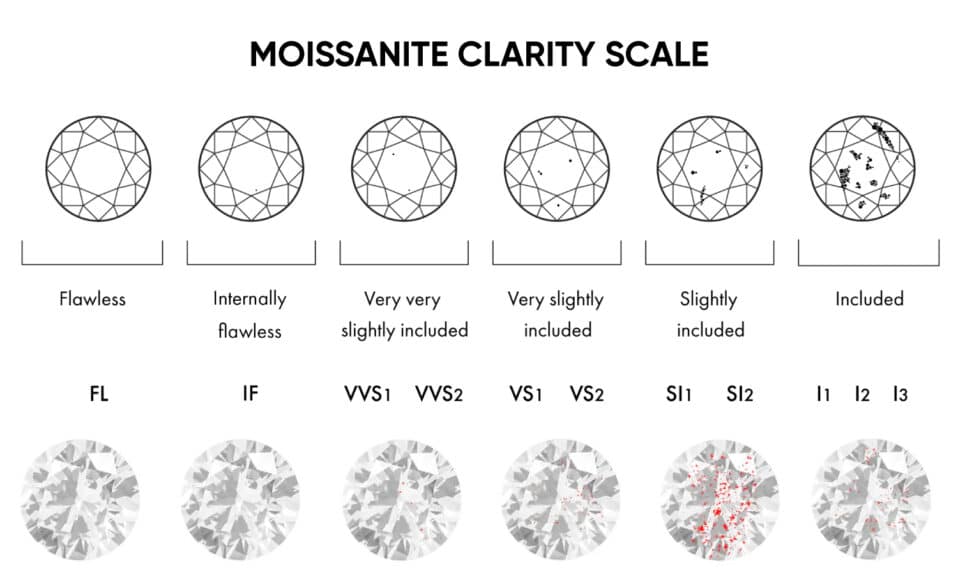
| Clarity Grade | Description | Eye-Clean? | Best Use | Est. Price (1-carat) |
|---|---|---|---|---|
| FL | No inclusions/blemishes under 10x | Yes | Luxury rings, premium settings | ~$600–$800 |
| IF | No inclusions, minor blemishes | Yes | High-end engagement rings | ~$550–$700 |
| VVS1/VVS2 | Tiny inclusions, invisible to naked eye | Yes | Popular for engagement rings | <|
| VS1/VS2 | Minor inclusions, not eye-visible | Yes | Budget-friendly, quality rings | ~$350–$500 |
| SI1/SI2 | Noticeable inclusions under magnification | Sometimes | Smaller stones, fashion jewelry | ~$300–$450 |
| I1/I2/I3 | Visible inclusions, may affect sparkle | No | Avoid for engagement rings | ~$200–$350 |
This Moissanite clarity chart makes it easy to compare grades at a glance. For premium sparkle, try a VVS1 Moissanite from Blue Nile (ex-James Allen) ($500) or a high-quality option from Charles and Colvard ($450).
On a budget? Explore SI1 Moissanite on Amazon (~$300, but always check seller reviews for quality). Most buyers choose VVS1 or VS1 for Moissanite engagement rings, as they’re eye-clean and affordable. Want to dive deeper into quality?
Explore our Moissanite color and clarity chart to pair clarity with the perfect hue for your dream ring.
FL Clarity: The Pinnacle of Perfection
FL clarity in Moissanite is the gold standard, representing a flawless stone with no inclusions or blemishes under 10x magnification. This rare, premium grade delivers unmatched brilliance, making it a top choice for luxury Moissanite engagement rings. It’s the ultimate expression of perfection in Moissanite.
The benefits of FL clarity are clear. It offers unrivaled sparkle, perfect for high-end designs like platinum solitaires. However, its higher cost can be a drawback for budget-conscious buyers.
Pros:
- Exceptional brilliance with no visible flaws.
- Ideal for luxury settings and large stones.
- Enhances resale value for premium jewelry.
Cons:
- Pricier, ~$600–$800 for a 1-carat stone.
- Visual difference from VVS1 is minimal.
- May be overkill for everyday wear.
For example, a 1-carat FL Moissanite from Charles and Colvard (~$700) dazzles in a platinum solitaire, catching every ray of light. When I saw a friend’s FL Moissanite ring at her engagement party, its sparkle was breathtaking, even under dim lighting. But for most buyers, VVS1 offers similar clarity at a lower price.
Is FL worth it? If you’re after the best, it’s a stunning choice. Discover premium options in our best Moissanite brand guide.
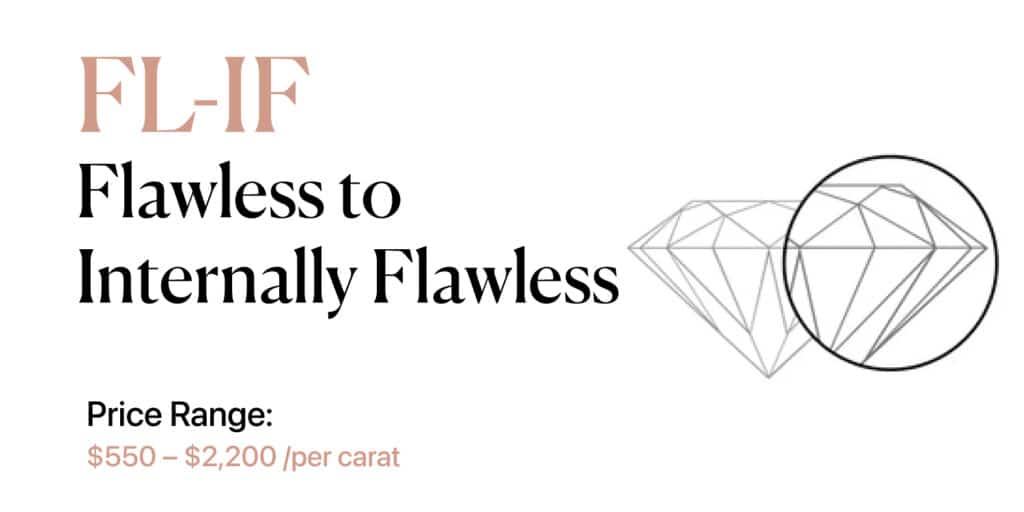
IF Clarity: Near-Flawless Beauty
IF clarity in Moissanite signifies an internally flawless stone, with no inclusions but minor surface blemishes under 10x magnification. This premium grade delivers exceptional brilliance for Moissanite engagement rings. It’s a top choice for luxury seekers.
Priced at ~$550–$700 for a 1-carat stone, IF Moissanite offers near-FL quality at a slightly lower cost. Its clarity rivals the finest stones, perfect for high-end designs. However, the visual difference from VVS1 is minimal to the naked eye.
A 1-carat IF Moissanite from Blue Nile (ex-James Allen) (~$650) shines brilliantly in a platinum setting. IF stones are ideal for those prioritizing perfection in Moissanite jewelry. Buyers can expect stunning clarity in any lighting.
Pros
- Near-flawless sparkle, ideal for luxury rings.
- Perfect for detailed, high-end settings.
- Slightly more affordable than FL clarity.
Cons
- Premium price compared to VVS1 or VS1.
- Minimal visual difference from VVS1.
- May be unnecessary for everyday jewelry.
IF clarity is a fantastic option for those wanting near-perfection without FL’s cost. It’s especially suited for special pieces like bridal sets. Explore luxury settings in our Moissanite bridal sets.
VVS1 and VVS2 Clarity: The Sweet Spot
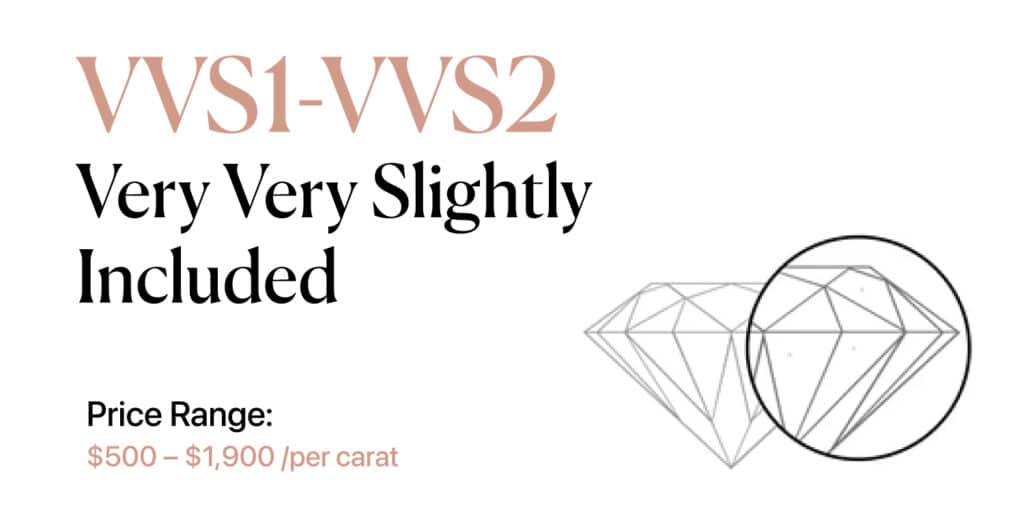
VVS1 and VVS2 Moissanite stones are very, very slightly included, with tiny inclusions invisible without a loupe. These grades are a top pick for Moissanite engagement rings due to their balance of clarity and cost. They deliver premium sparkle for most buyers.
Costing ~$400–$550 for a 1-carat stone, VVS1 and VVS2 are eye-clean and affordable. They’re ideal for larger stones (>2 carats), where clarity is critical. VVS1 is slightly clearer than VVS2, but both dazzle equally to the naked eye.
A 1-carat VVS1 Moissanite from Charles and Colvard (~$500) looks flawless in a rose gold halo setting. These grades suit a wide range of Moissanite jewelry, from rings to pendants. Buyers get near-premium clarity without overspending.
Pros
- Eye-clean clarity, perfect for engagement rings.
- Affordable for high-quality Moissanite jewelry.
- Ideal for larger stones with no visible flaws.
Cons
- Slightly pricier than VS1 or VS2.
- Overkill for smaller stones (<1 carat).
- VVS1 vs. VVS2 difference is negligible.
VVS1 and VVS2 are the sweet spot for quality and value in Moissanite. They’re perfect for those wanting brilliance on a budget. See large stones in our 5-carat Moissanite ring guide.
VS1 and VS2 Clarity: Budget-Friendly Brilliance
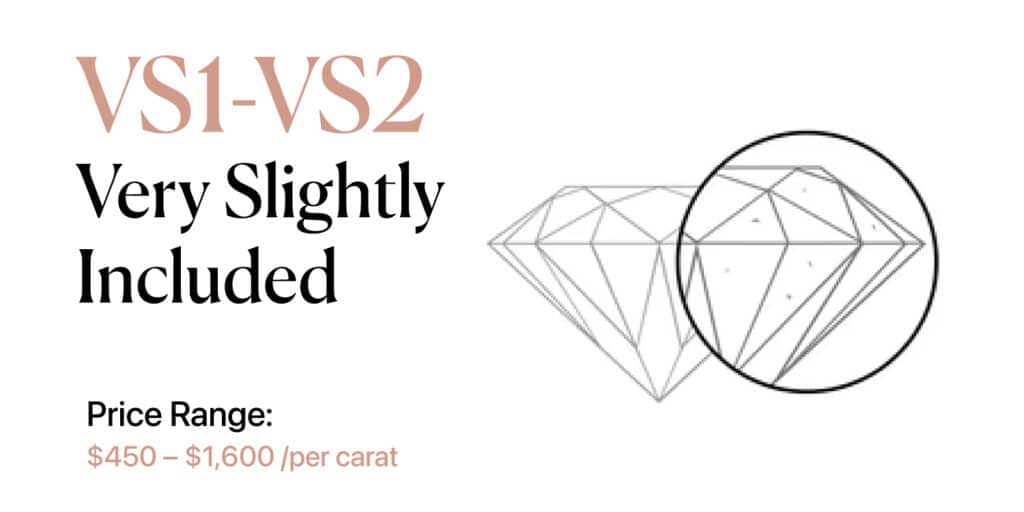
VS1 and VS2 Moissanite stones are very slightly included, with minor inclusions not visible to the naked eye. These grades offer eye-clean clarity at a budget-friendly price for Moissanite engagement rings. They’re a practical choice for most jewelry.
Priced at ~$350–$500 for a 1-carat stone, VS1 and VS2 deliver excellent value. Inclusions may appear in very large stones (>2 carats) under magnification, but they’re invisible in typical use. These grades balance cost and quality effectively.
A 1-carat VS1 Moissanite from Blue Nile (ex-James Allen) (~$450) sparkles beautifully in a yellow gold setting. VS1 is slightly clearer than VS2, but both are eye-clean for Moissanite rings. They’re ideal for budget-conscious buyers seeking brilliance.
Pros
- Eye-clean clarity at an affordable price.
- Suitable for most Moissanite jewelry designs.
- Great value for high-quality sparkle.
Cons
- Inclusions possible in large stones under loupe.
- Less prestigious than VVS1 or IF.
- Not ideal for oversized stones (>2 carats).
VS1 and VS2 are excellent for buyers wanting quality without high costs. They shine in a variety of settings and sizes. Find affordable options in our Moissanite jewelry collection.
SI1 and SI2 Clarity: Affordable but Risky
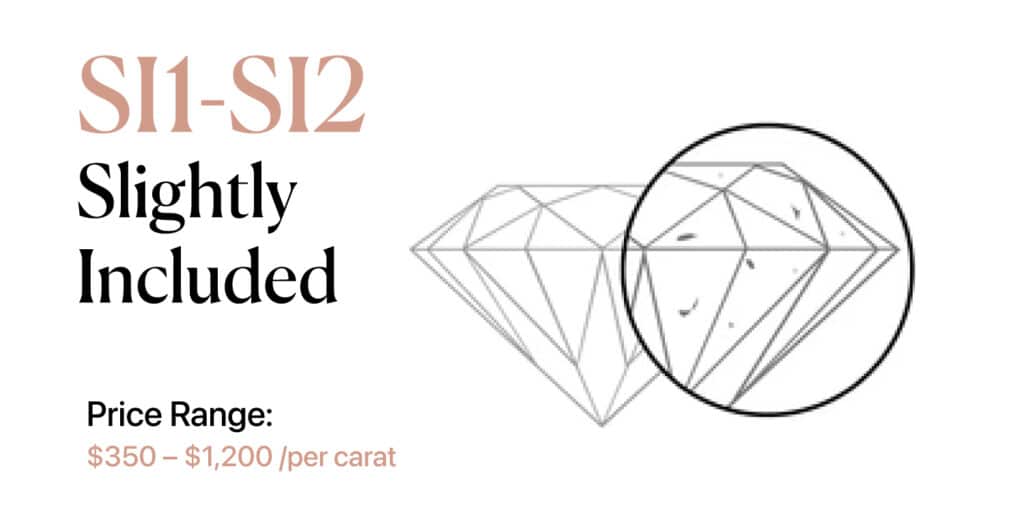
SI1 and SI2 Moissanite stones are slightly included, with inclusions visible under 10x magnification and sometimes to the naked eye. These grades offer affordability for Moissanite engagement rings, but their clarity requires careful consideration. They’re best suited for smaller stones or specific settings.
Priced at ~$300–$450 for a 1-carat stone, SI1 and SI2 are budget-friendly options for Moissanite jewelry. Inclusions may be noticeable in larger stones (>1.5 carats), potentially affecting sparkle. Buyers should inspect these stones closely to ensure quality.
A 0.5-carat SI1 Moissanite necklace from Amazon (~$150, verify seller reviews) can work for casual wear. SI1 is often eye-clean in smaller sizes, while SI2 may show flaws. Settings like halos or yellow gold can mask minor inclusions effectively.
Pros
- Affordable, ideal for budget-conscious shoppers.
- Suitable for small stones or fashion jewelry.
- Often eye-clean in stones under 1 carat.
Cons
- Inclusions may be visible in larger stones.
- SI2 risks noticeable flaws, reducing brilliance.
- Not ideal for premium Moissanite engagement rings.
SI1 and SI2 are practical for non-engagement pieces, like necklaces or earrings, where clarity is less critical. Buyers seeking value should opt for SI1 in smaller stones to maintain a near-flawless look. For more affordable options, explore our Moissanite necklace under $200 guide.
I1, I2, and I3 Clarity: Proceed with Caution
I1, I2, and I3 Moissanite stones are included, with visible inclusions that often impact sparkle and durability. These grades are rare in Moissanite due to its lab-grown quality but exist in lower-end products. They’re generally unsuitable for Moissanite engagement rings.
Priced at ~$200–$350 for a 1-carat stone, I1, I2, and I3 are the cheapest Moissanite options. Visible flaws, like clouds or cracks, can dull brilliance, especially in I2 and I3. These grades are best avoided for jewelry meant to impress.
Buyers might find I1 stones in budget settings, but I2 and I3 are risky even for casual pieces. For example, an I1 Moissanite from Amazon (~$250, check seller reviews) may show flaws under light. Higher grades like VS1 offer better value for sparkle.
Pros
- Lowest cost, appealing for tight budgets.
- Available for non-critical jewelry pieces.
- Rare in Moissanite, ensuring some quality control.
Cons
- Visible inclusions reduce sparkle and appeal.
- I2/I3 may compromise stone durability.
- Not recommended for engagement or fine jewelry.
I1, I2, and I3 grades are a last resort for Moissanite buyers seeking quality. Instead, consider VS1 or higher for lasting brilliance in eco-friendly designs. Learn more in our eco-friendly Moissanite engagement rings.
Moissanite Clarity vs. Diamond: Key Differences
Choosing between Moissanite and diamond for your Moissanite engagement ring hinges on understanding their clarity differences. Both gems dazzle, but their clarity profiles tell unique stories shaped by their origins. Let’s dive into what sets them apart to help you pick the perfect stone for your budget and style.
Moissanite is a lab-grown gem, crafted under controlled conditions that yield exceptional clarity. Most stones are VVS1 or better, meaning inclusions are nearly invisible even under 10x magnification. At ~$400–$600 for a 1-carat stone, Moissanite offers eye-clean sparkle without the hefty price tag.
Diamonds, formed deep in the earth, boast a wider clarity range, from FL (Flawless) to I3 (Included). Natural imperfections like clouds or feathers are common, making high-clarity diamonds pricier (~$2,500–$5,000 for a 1-carat VS1). Lower grades like SI2 or I1 often show flaws that dull their brilliance.
Imagine slipping a 1-carat VVS1 Moissanite from Blue Nile (ex-James Allen) ($500) onto your finger—it sparkles as brightly as a VS1 diamond ($3,000) but costs a fraction of the price. Moissanite’s pristine clarity often outshines diamonds in the same price range. This makes it a go-to for value-driven buyers.
For larger stones, Moissanite’s clarity shines even brighter. A 2-carat VVS1 Moissanite from Charles and Colvard ($900) stays eye-clean, while a 2-carat VS1 diamond ($8,000) may reveal minor inclusions under close inspection. Moissanite’s consistency is a game-changer for bold designs.
Diamonds carry a timeless prestige, appealing to those who value tradition. However, their varied clarity requires careful scrutiny, as inclusions in grades like I1 or I2 can weaken durability. Moissanite’s robust structure avoids such concerns, offering peace of mind.
Key Clarity Comparisons:
- Moissanite: Lab-grown, VVS1+ clarity, ~$400–$600 for 1-carat, eye-clean.
- Natural Diamond: FL to I3 range, ~$2,500–$5,000 for VS1, more inclusions.
- Lab-Grown Diamond: Similar to natural diamonds, ~$1,500–$3,000 for VS1, less costly.
| Feature | Moissanite | Natural Diamond | Lab-Grown Diamond |
|---|---|---|---|
| Clarity Range | Mostly VVS1+ | FL to I3 | FL to I3 |
| 1-Carat Price (VS1) | ~$400–$600 (Blue Nile (ex-James Allen)) | ~$2,500–$5,000 | ~$1,500–$3,000 |
| Inclusions | Rare, minimal | Common, vary by grade | Similar to natural diamonds |
| Eye-Clean? | Yes (VVS1+) | Yes (VS1+), flaws in SI2+ | Yes (VS1+), flaws in SI2+ |
| Best For | Budget-friendly sparkle | Prestige, tradition | Ethical, mid-range budget |
Moissanite’s clarity edge extends to lab-grown diamonds, which mirror natural diamonds’ clarity but cost less. Still, Moissanite’s superior clarity for the price makes it a standout. Budget shoppers can explore SI1 Moissanite on Amazon (~$300, verify seller reviews), but premium clarity from Blue Nile (ex-James Allen) or Charles and Colvard ensures reliability.
The Moissanite grading system guarantees consistent quality across trusted vendors, unlike diamonds, where clarity varies widely. Moissanite’s affordability and near-flawless look make it a top choice for modern jewelry. For a deeper dive, check our Moissanite vs. Lab Diamond side-by-side.
Tips for Choosing the Best Moissanite Clarity
Selecting the right clarity for your Moissanite engagement ring ensures you get the sparkle you love at a price you can afford. The Moissanite clarity scale offers a range of grades, from FL to I3, but knowing what factors to prioritize makes the decision easier. Here are expert tips to guide your choice.
Budget is a key consideration when picking clarity. VVS1 and VS1 grades (~$400–$550 for a 1-carat stone) offer eye-clean sparkle, perfect for most Moissanite rings. These grades balance quality and affordability without the premium cost of FL or IF.
Stone size matters, especially for larger Moissanite stones (>2 carats). Inclusions are more noticeable in bigger stones, so opt for VVS1 or higher to ensure flawless clarity. A 2-carat VVS1 Moissanite from Charles and Colvard (~$900) guarantees brilliance in a large ring.
Setting can enhance or mask clarity. Halo settings or yellow gold can hide minor inclusions in VS1 or SI1 stones, saving you money. For example, a 1-carat VS1 Moissanite from Blue Nile (ex-James Allen) (~$450) looks flawless in a halo design.
Inspection tips are key for making an informed choice. Use a 10x loupe to check for inclusions like clouds or needles, especially in SI1 or lower grades. Alternatively, examine the stone under bright light to confirm eye-clean clarity.
For budget shoppers, SI1 Moissanite on Amazon (~$300 for 1-carat, check seller reviews) can work for smaller stones. However, for engagement rings, stick to VVS1 or VS1 from trusted vendors like Blue Nile (ex-James Allen) or Charles and Colvard for guaranteed quality. These grades ensure your ring sparkles in any setting.
Consider the ring’s purpose when choosing clarity. For daily wear, VS1 offers durability and beauty at a lower cost. For special occasions, VVS1 or IF provides a premium look without breaking the bank.
Quick Tips for Clarity Selection:
- Choose VVS1/VS1 for eye-clean, budget-friendly rings.
- Opt for VVS1+ for stones larger than 2 carats.
- Use halo or colored settings to mask VS1/SI1 flaws.
- Inspect with a loupe or bright light for confidence.
Clarity impacts both aesthetics and cost, so align your choice with your priorities. A well-chosen Moissanite will shine for years, whether it’s a 1-carat VS1 or a 3-carat VVS1. Calculate costs and compare options with our Moissanite price calculator to find the best value for your dream ring.
What Does VVS1 Mean in Moissanite?
VVS1 stands for Very Very Slightly Included, Grade 1. It is the second-highest clarity grade below FL (Flawless) and IF (Internally Flawless), and the highest clarity grade in common commercial moissanite inventory. Under 10× magnification, a trained grader may find 1–3 microscopic pinpoints inside the stone. Without magnification — face-up on a hand under any normal lighting — the stone looks perfectly clean.
Specifically, VVS1 means:
- Inclusions are confined to pinpoint-sized spots (less than 0.01mm diameter)
- Difficult for a GIA-trained grader to detect even at 10× magnification
- Not visible from the top (crown side) under any lighting
- Not visible from the pavilion either without a loupe
- Approximately 42% of all 2026 moissanite retail inventory
VVS1 is the clarity grade Charles & Colvard Forever One, VVS1-advertised lines on Harro Gem, and most premium moissanite listings commit to. If you are shown a certificate marked “VVS1,” expect eye-clean beauty guaranteed. The price premium over VS1 is 20–30%, over VVS2 is 10%.
What Is VS1 Moissanite?
VS1 stands for Very Slightly Included, Grade 1. Two grades below VVS1 on the clarity scale. Under 10× magnification, a grader finds minor crystal, feather, or pinpoint inclusions. To the naked eye, the stone is clean on brilliant cuts (round, oval, cushion) and usually clean on step cuts (emerald, asscher) too, except on larger stones.
Why consider VS1:
- 25–30% cheaper than VVS1 for the same color, cut, and carat
- Eye-clean on 99% of brilliant-cut stones under 1.5 carats
- Modestly priced at $380–$550 per carat for a 1ct round D color (2026)
- Hard to distinguish from VVS1 in blind side-by-side viewing
When to skip VS1 and insist on VVS1 or cleaner:
- You’re buying a step cut (emerald, asscher, baguette) — the open “hall of mirrors” facets expose any inclusion
- The stone is 2 carats or larger — inclusions scale with carat weight
- You plan to resell, where every grade step changes the appraisal
For a side-by-side cost analysis, use the moissanite price calculator.
VVS1 vs VVS2 Moissanite — Is the Upgrade Worth It?
VVS1 has fewer and smaller pinpoint inclusions than VVS2. Both are “Very Very Slightly Included” and both are eye-clean under any normal viewing. Under 10× magnification, VVS2 shows 3–8 pinpoints vs VVS1’s 1–3. Price difference: VVS1 runs 8–15% more than VVS2 for the same color and carat.
Buy VVS1 if: you want the premium certificate language, you plan to resell, or the premium is under $100. Buy VVS2 if: you want to save $50–$100 and apply it toward a larger stone or better color grade. There is no visible difference on the finger.
D Color + VVS1 Clarity Moissanite — The Gold Standard Combo
“D color VVS1 clarity moissanite” is the specification most buyers search for when they want the stone to look identical to a top-grade mined diamond. D is the top of the color scale — perfectly colorless, no yellow or brown tint. VVS1 is the top of the achievable clarity scale for commercial moissanite — eye-clean under any lighting.
[year] pricing for D-color VVS1 moissanite (round brilliant, Excellent cut):
| Carat Weight | Face-Up mm | Price Range (2026) | Equivalent Natural Diamond |
|---|---|---|---|
| 0.5 ct | 5.0 mm | $280–$420 | $1,800–$3,200 |
| 0.75 ct | 5.8 mm | $370–$550 | $2,900–$5,400 |
| 1.0 ct | 6.5 mm | $450–$700 | $5,200–$9,000 |
| 1.5 ct | 7.4 mm | $680–$1,050 | $9,500–$17,000 |
| 2.0 ct | 8.2 mm | $900–$1,400 | $18,500–$32,000 |
| 3.0 ct | 9.3 mm | $1,400–$2,100 | $42,000–$80,000+ |
Shop verified D VVS1 inventory: Charles & Colvard Forever One or Blue Nile (ex-James Allen) moissanite.
Highest Grade Moissanite You Can Actually Buy
Flawless (FL) moissanite exists but is extremely rare at retail — less than 1% of inventory. The highest grade you can reliably purchase on a commercial listing is D color, VVS1 clarity, Triple Excellent cut. This spec is available from Charles & Colvard (Forever One line), Harro Gem (premium selection), MoissaniteCo, and Blue Nile moissanite.
If you want to go higher than VVS1, request a Flawless or Internally Flawless Forever One from a Charles & Colvard authorized dealer — the stone will be hand-selected from available inventory and priced at a 30–50% premium over VVS1. For [year] pricing on specific IF/FL stones in the 1–2 carat range, expect $700–$1,100 per carat.
In practice, VVS1 is indistinguishable from FL/IF by naked eye on a finished ring. Pay the extra premium only if resale value or appraisal grade matters to you. Browse premium Forever One D VVS1 inventory at Charles & Colvard.
Mehedi’s Take: “VS1 moissanite on a round brilliant is indistinguishable from VVS1 to the naked eye. I’ve set hundreds of both — the only time the extra premium is worth it is on a step cut, where every inclusion gets magnified by the open table.” — Mehedi Hasan, Diamond Industry Veteran
Moissanite Physical Properties — Mohs Hardness, Refractive Index, and the Full Scale
Beyond the clarity scale, moissanite has fixed physical properties that define its optical and mechanical behavior.
| Property | Moissanite | Diamond (for comparison) | What It Determines |
|---|---|---|---|
| Mohs hardness | 9.25 | 10 | Scratch resistance |
| Refractive index | 2.65 (doubly refractive) | 2.42 (singly refractive) | Surface sparkle, luster |
| Dispersion (fire) | 0.104 | 0.044 | Rainbow color flashes |
| Specific gravity | 3.21 | 3.52 | Wei Verdict: Moissanite’s 2.65 refractive index and 0.104 dispersion mean it sparkles harder than a diamond at a tenth the price. The Mohs 9.25 means it survives everyday wear for life. ght per volume |
| Chemical formula | SiC (silicon carbide) | C (carbon) | Crystal structure |
| Thermal conductivity | High (passes “diamond” thermal test) | Highest | Why old diamond testers fail on moissanite |
| Electrical conductivity | Semiconductor (fails electrical diamond test) | Insulator | How modern dual-probe testers distinguish them |
| Crystal system | Hexagonal | Cubic | Why moissanite shows double refraction |
Moissanite Double Refraction — The One “Flaw” That Isn’t
Moissanite is doubly refractive because its crystal structure is hexagonal. Light entering the stone splits into two rays traveling at different speeds. Under 10× magnification from the side, you can see the back facet edges appear as doubled lines. This is diagnostic of moissanite — diamond is singly refractive and shows no doubling.
Face-up, double refraction is invisible on well-cut stones. Cutters orient the stone’s optic axis parallel to the table so the doubling direction aligns with the viewing angle. In a quality round brilliant Forever One, you will not see any doubling without side-view magnification.
Double refraction is not a clarity flaw. It is an inherent property of the crystal structure and does not change with grade. VVS1, VS1, and SI1 all show the same double refraction — the difference between the grades is inclusion content, not refractive behavior. For how this affects daily appearance, see diamond vs moissanite in sunlight.
Moissanite Clarity vs Diamond Clarity — Deeper Comparison
Moissanite and diamond use the identical FL → I3 clarity scale. But the distribution of grades at retail is completely different.
| Clarity Grade | % of Moissanite Retail (2026) | % of Natural Diamond Retail |
|---|---|---|
| FL / IF | 4% | <1% |
| VVS1 / VVS2 | 68% | 4% |
| VS1 / VS2 | 25% | 22% |
| SI1 / SI2 | 3% | 58% |
| I1 / I2 / I3 | <1% | 15% |
See the full moissanite vs diamond comparison and diamond color and clarity chart for the diamond-side numbers.
Mehedi’s Take: “D color VVS1 is the gold-standard spec because it’s the moissanite grade a buyer can confidently point to and say ‘this is the best.’ That certainty is worth $100 to most buyers — not $500.” — Mehedi Hasan, Diamond Industry Veteran
FAQs — Moissanite Clarity, Grades, and Properties
What is the moissanite clarity scale?
Eleven grades from best to worst: FL, IF, VVS1, VVS2, VS1, VS2, SI1, SI2, I1, I2, I3. The same scale used for diamond. Because moissanite is lab-grown, 72% of retail inventory is VVS1 or VVS2.
What does VVS1 mean in moissanite?
Very Very Slightly Included, Grade 1. 1–3 microscopic pinpoints visible only under 10× magnification by a trained grader. Face-up, invisible.
What is VVS1 clarity moissanite?
The second-highest achievable clarity grade in commercial moissanite inventory. Eye-clean, loupe-clean to all but trained graders. 42% of [year] moissanite retail inventory.
What is VS1 moissanite?
Very Slightly Included, Grade 1. Minor inclusions visible under 10× magnification but eye-clean on all brilliant cuts under 1.5 carats. 25–30% cheaper than VVS1.
Is VS1 moissanite good?
Yes. VS1 is eye-clean to the naked eye, significantly cheaper than VVS1, and visually identical on brilliant cuts. Only skip VS1 on step cuts (emerald, asscher) over 1.5 carats.
What is the best clarity for moissanite?
VVS1 for premium, VS1 for value. Both are eye-clean. The 25–30% price difference between them is for certificate language and resale value, not visible appearance.
What is D color VVS1 moissanite?
The gold-standard specification: perfectly colorless, eye-clean. [year] price for a 1-carat round brilliant: $450–$700. Equivalent natural diamond: $5,200–$9,000.
What is VVS2 moissanite?
Very Very Slightly Included, Grade 2. 3–8 pinpoints visible under 10× magnification. Eye-clean, 8–15% cheaper than VVS1 for the same color and carat.
What is VVS1 vs VVS2 moissanite?
VVS1 has fewer and smaller pinpoints than VVS2. Both are eye-clean. VVS1 costs 8–15% more. No visible difference without a loupe.
What is FL clarity moissanite?
Flawless. No inclusions, no surface blemishes under 10× magnification. Less than 1% of retail inventory. Expect a 50% premium over VVS1.
What is IF moissanite?
Internally Flawless. No internal inclusions. Minor surface blemishes may be present. 3% of retail inventory. Expect a 30% premium over VVS1.
Is VVS1 moissanite good?
Yes. VVS1 is near-flawless, eye-clean, and the highest clarity grade in common commercial inventory. Pays for itself at resale and in appraisal reports.
What is the moissanite quality scale?
The combined Four Cs: Cut (Excellent / Very Good / Good / Fair), Color (D–K), Clarity (FL–I3), Carat weight. Together they determine the stone’s grade and price.
What are the different grades of moissanite?
By clarity: FL, IF, VVS1, VVS2, VS1, VS2, SI1, SI2, I1, I2, I3. By color: D, E, F (colorless), G, H, I, J (near-colorless), K+ (tinted). By cut: Excellent, Very Good, Good, Fair.
What are the 4Cs of moissanite?
Cut, Color, Clarity, Carat. The same four grading factors used for diamond. See the full 4Cs of moissanite guide.
What is the Mohs hardness of moissanite?
9.25 on the Mohs scale. Second only to diamond (10). Harder than sapphire (9), topaz (8), and quartz (7). See the full moissanite hardness guide.
What is moissanite’s refractive index?
2.65, doubly refractive. Higher than diamond’s 2.42. This higher RI gives moissanite brighter surface luster than diamond.
What is moissanite’s dispersion?
0.104 — the fire value. Diamond is 0.044. Moissanite produces 2.4× the rainbow color flashes of a diamond.
What is moissanite’s specific gravity?
3.21. Diamond is 3.52. Because moissanite is less dense, a 1-carat moissanite looks about 15% larger face-up than a 1-carat diamond.
What is moissanite’s chemical formula?
SiC — silicon carbide. Diamond is pure carbon (C). The different chemistry is why moissanite’s optical and physical properties differ from diamond.
Does moissanite have clarity?
Yes. Moissanite is graded on the same FL → I3 clarity scale used for diamond. Because it is lab-grown, 72% of retail inventory lands at VVS1 or VVS2.
What is moissanite double refraction?
Moissanite’s hexagonal crystal structure splits incoming light into two rays. Under 10× side-view magnification, back facet edges appear doubled. Face-up, invisible on well-cut stones. Not a clarity flaw.
What is the highest grade moissanite?
D color, Flawless (FL) clarity, Triple Excellent cut, Super Premium brand (Forever One or equivalent). FL is less than 1% of inventory. The commercially available top is D VVS1 Triple Excellent.
What is a moissanite grade chart?
A visual reference showing all four Cs (Cut, Color, Clarity, Carat) with grade thresholds and [year] pricing. See the color chart, this clarity chart, and the cut chart.
Is moissanite as clear as diamond?
Moissanite inventory is actually clearer at retail than diamond inventory — 72% of moissanite is VVS1 or VVS2 vs only 4% of diamond. For an eye-clean stone, moissanite usually wins on clarity for the same budget.
What’s the best clarity for a moissanite ring?
VVS1 if your budget allows, VS1 for value. On step cuts (emerald, asscher), insist on VVS1 or cleaner. On brilliant cuts, VS1 is eye-clean and 25% cheaper.
What is high clarity moissanite?
Any grade from VVS1 up — VVS1, IF, or FL. These are eye-clean and loupe-clean to untrained observers. Covers roughly 46% of [year] retail inventory.
What is cheapest moissanite clarity?
SI1 and SI2 are the cheapest grades at $220–$440 per carat for a 1ct D-color round. Not recommended for step cuts. For brilliant cuts, consider SI1 only if budget is tight and the stone is under 1 carat.
Are there different grades of moissanite?
Yes. 11 clarity grades, 7 color grades (D-K), 4 cut grades, and continuous carat weights. Plus brand grades like Charles & Colvard’s “Classic”, “Premium”, and “Super Premium” (Forever One).
What is Premium vs Super Premium moissanite?
Charles & Colvard labels: Classic = J-K color, VS clarity. Premium = G-I color, VS clarity. Super Premium (Forever One) = D-F color, VVS1 clarity. The Super Premium is the brand’s top line.
How much is a 1-carat VVS1 D color moissanite?
$450–$700 for a 1-carat round brilliant from Charles & Colvard, Blue Nile, or Harro Gem ([year] prices). Fancy shapes and antique cuts command premiums.
Final Verdict — Decision Matrix for Moissanite Clarity
Pick your clarity grade based on cut, carat, and budget:
| Your Situation | Cut | Carat | Buy This Clarity | What This Means |
|---|---|---|---|---|
| Most buyers, max value | Round brilliant | Any | VS1 | Eye-clean, 25–30% cheaper than VVS1, zero visible difference |
| Premium certificate / resale | Any | Any | VVS1 | Top of achievable commercial inventory, best resale language |
| Step cut (emerald, asscher) | Step | Any | VVS1 minimum | Open facets expose inclusions — do not drop below VVS1 |
| Antique/vintage style | Rose, old mine, old European | Any | SI1 acceptable | Fewer facets forgive inclusions — grade below VS still looks period-correct |
| Large stone (2ct+) | Any brilliant | 2.0 ct+ | VVS2 minimum | Inclusions scale with carat weight — don’t go cheap on big stones |
| Budget priority | Round brilliant | Under 1 ct | VS2 | Still eye-clean, saves another 15% over VS1 |
| Max spec statement | Round brilliant | Any | D VVS1 Triple Excellent | The commercially-available top. Pay the premium for the paper. |
Verdict: VS1 for brilliant cuts, VVS1 for step cuts, D color for white metal, G–I for yellow gold. Match clarity grade to the cut and the setting, not to what the person before you bought.
Mehedi’s Final Take: “Clarity grade on moissanite is the easiest money to save or waste. Save it on brilliant cuts, spend it on step cuts, and never pay for a grade higher than VVS1 unless resale matters more than the ring.” — Mehedi Hasan, Diamond Industry Veteran
See Also — Related Moissanite Guides
- The 4Cs of Moissanite — pillar guide to cut, color, clarity, carat
- Moissanite Color Chart — D-K color grades with 2026 pricing
- Moissanite Cut Chart — every shape and cut grade
- Moissanite Carat Size Chart — mm face-up by weight
- Moissanite Hardness — Mohs 9.25 explained
- Moissanite Price Chart — 2026 pricing by grade
- Moissanite Price Calculator — live pricing tool
- Moissanite vs Diamond — complete comparison
- Triple Excellent Grade — cut, polish, symmetry all at Excellent
- Diamond Color and Clarity Chart — natural diamond grades
- Best Moissanite Brand — brand-by-brand comparison
- Charles & Colvard Reviews — the leading moissanite retailer
Conclusion
The Moissanite clarity scale is your guide to finding a sparkling, eye-clean Moissanite engagement ring that fits your budget and style. From FL to I3, each clarity grade offers unique benefits, but VVS1 and VS1 (~$400–$550 for 1-carat) strike the perfect balance of brilliance and value. These grades ensure your Moissanite shines brightly, rivaling diamonds at a fraction of the cost.
Whether you’re eyeing a 1-carat VVS1 from Blue Nile (ex-James Allen) ($500) or a budget-friendly VS1 from Charles and Colvard ($450), Moissanite’s clarity makes every moment sparkle. For smaller budgets, SI1 options on Amazon (~$300, verify seller reviews) can work for non-engagement pieces. The key is choosing a clarity that matches your needs—VVS1 for large stones, VS1 for everyday wear.
Moissanite’s lab-grown nature guarantees fewer inclusions, making it a smart choice over diamonds. With proper care, your ring will dazzle for years. Keep it sparkling with our Moissanite cleaner guide. Shop stunning Moissanite at Blue Nile (ex-James Allen) or Charles and Colvard today!
This post contains affiliate links. If you make a purchase through these links, I may earn a commission at no additional cost to you.

You might also Like
Recent Posts

- Menu