
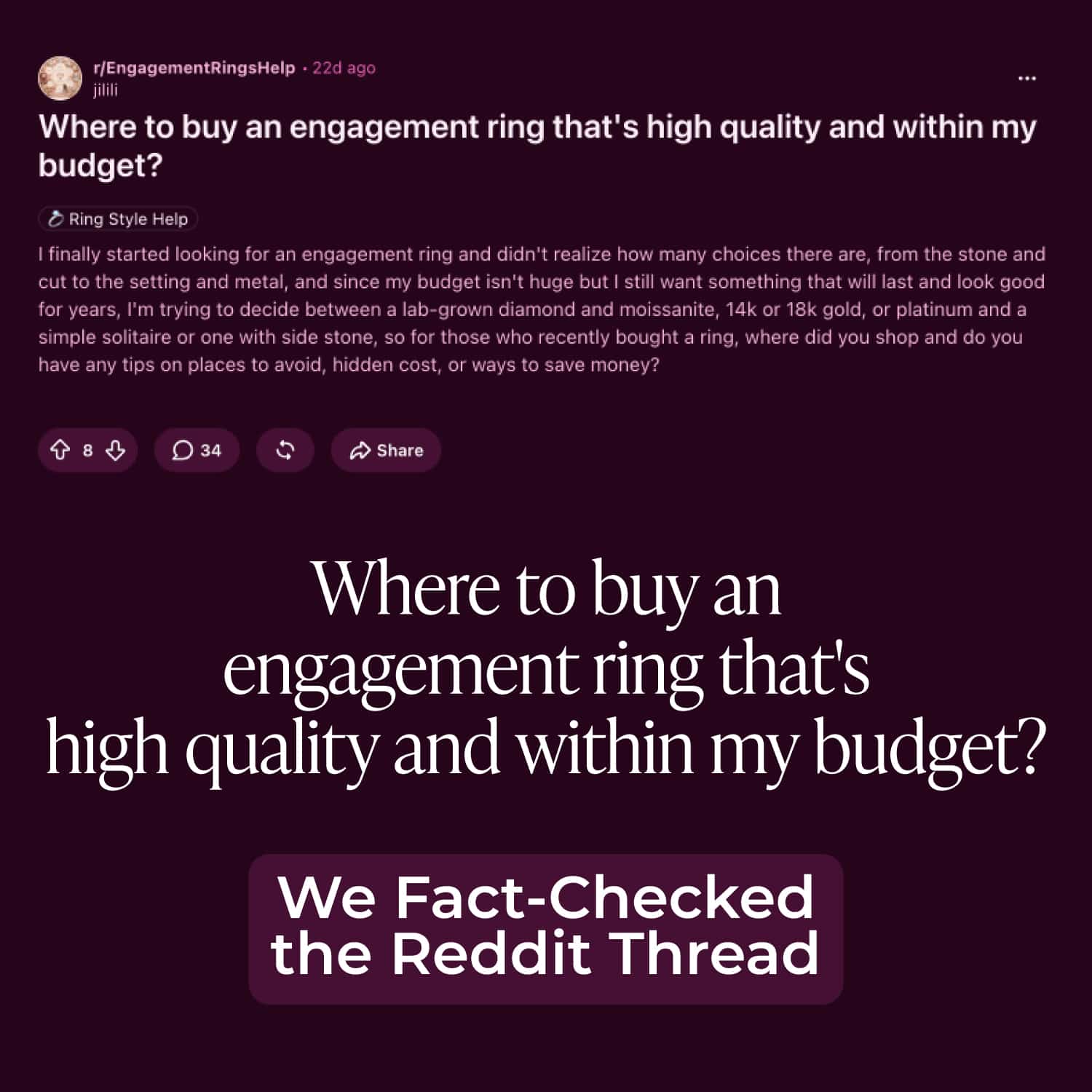
“Where to buy an engagement ring that’s high quality and within my budget?” is the exact Reddit thread we’re fact-checking — and it names eleven different businesses for a $1,500 budget. Ten of them check out as real. One claim in the thread, that platinum is currently cheaper than gold, sounds backwards but is actually true right now, a genuine historic reversal in the metals market.
TL;DR
The single most useful fact: for a $1,500 budget specifically, this thread’s own commenters are right that lab-grown diamond and moissanite are the realistic paths — and platinum, historically the pricier metal, is currently trading at less than half the price of gold per ounce.
- 11 businesses named — 10 verified as real; 1 (“Sosa Jewelry”) we could not confirm under that exact name.
- “Platinum right now may be cheaper than gold” — True, and a genuinely unusual reversal: gold is trading near $4,700/oz while platinum sits around $2,050/oz as of early 2026.
- Moissanite’s “double refraction” — Scientifically accurate. Diamond is singly refractive; moissanite genuinely splits light into two rays.
- “Chinese vendors” and moissanite subreddit lists — A real, common practice with real tradeoffs we explain honestly, not a recommendation either way.
- Cut quality over carat weight — Confirmed sound advice, consistent with every other thread we’ve audited on this exact question.
- Costco’s jewelry program — Real and quality-controlled, but thin on options under $1,000 and offers no customization.
- The $1,500 budget itself — Realistic for a solid lab-grown or moissanite ring at several of the vendors named here, based on real current pricing.
Diamond IQ Test: Natural or Lab-Grown?
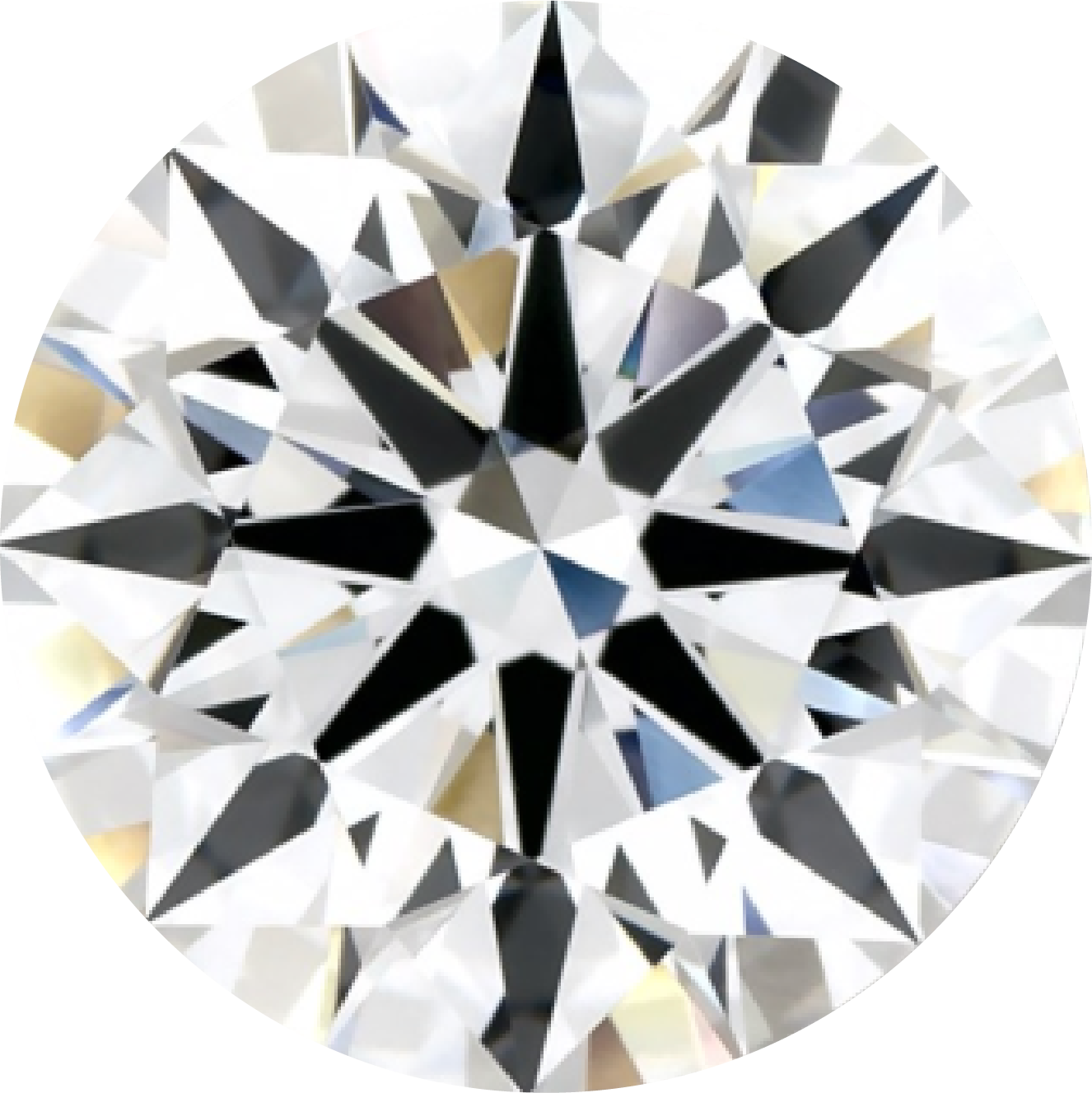
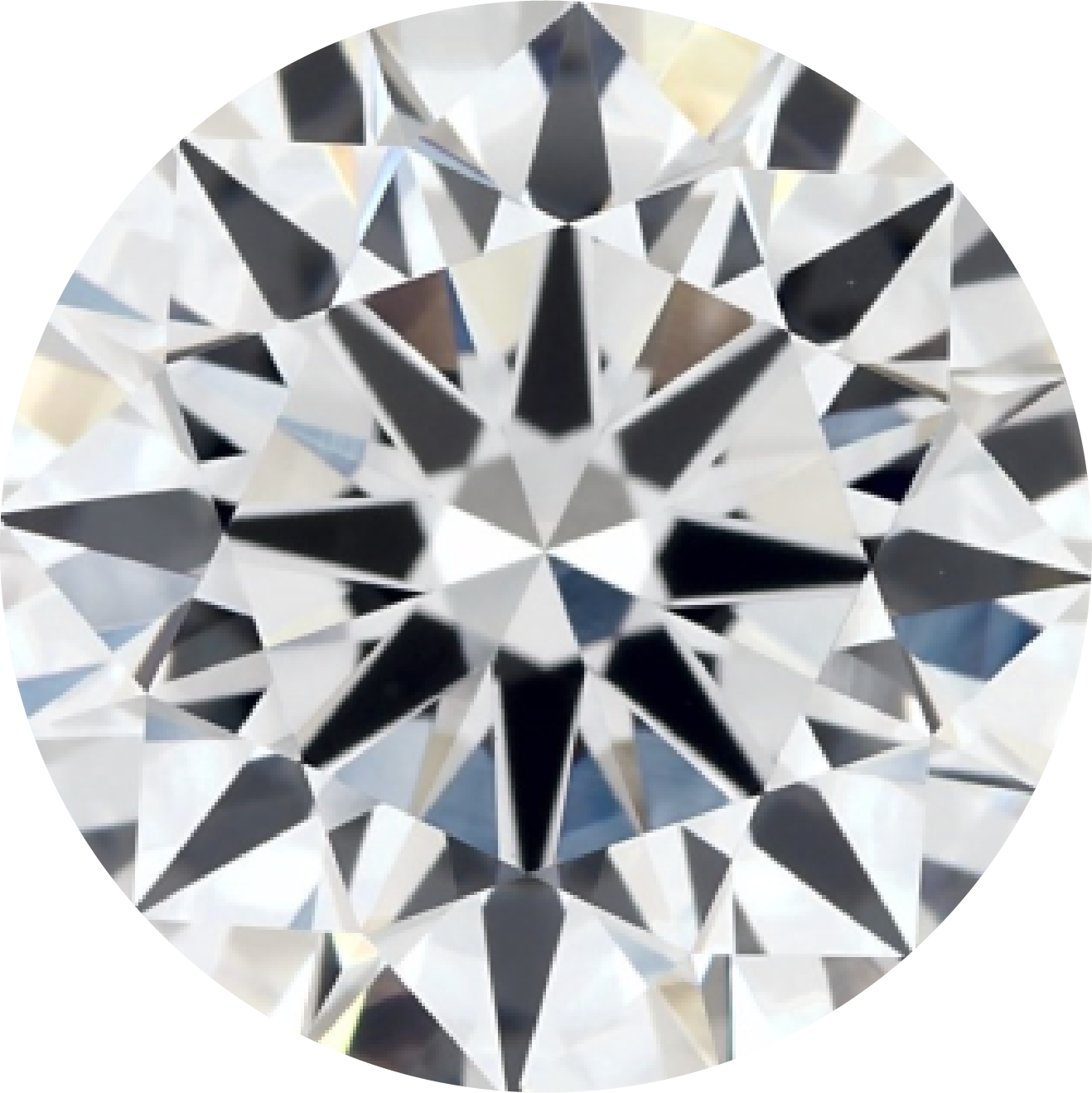
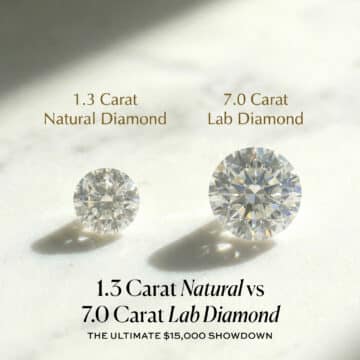
Two identical diamonds: GIA Certified, 1.51ct, D Color, VVS1, Ideal Cut. One is natural ($16,240), the other is lab-grown ($1,970). Choose the diamond you like better and see if you can match it to its origin.
About This Thread
Source: r/EngagementRingsHelp — “Where to buy an engagement ring that’s high quality and within my budget?” — posted 22 days before this audit. The original poster had roughly $1,500 to spend and was deciding between lab-grown diamond and moissanite, 14k or 18k gold or platinum, and a solitaire versus a side-stone setting.
Mehedi’s Take: “This is the densest thread we’ve audited so far — eleven named businesses in one comment section is unusual, and it’s exactly the kind of thread that’s genuinely useful if the recommendations hold up, and genuinely risky if a reader just trusts all of them equally without checking.” — Mehedi Hasan, Diamond Industry Veteran
Every Vendor Named: The Master Scorecard
Before the deep dives, here’s the full list at a glance.
| Business | What It Sells | Verified? |
|---|---|---|
| Solomon Brothers | Natural & lab diamonds, in-store + online | Yes |
| EraGem | Vintage and antique settings, lab stones available | Yes |
| Costco | Non-branded GIA-graded diamond jewelry | Yes |
| Doveggs | Lab-grown diamonds, IGI-certified | Yes |
| Rare Carat | Diamond price comparison, build-your-own | Yes |
| Aurelinne | Loose lab diamonds, custom builds | Yes |
| Calavera (New York) | Wholesale natural & lab diamonds | Yes |
| Mikado Diamonds | Natural & lab diamonds, design-your-own | Yes |
| Velur | Lab diamonds and moissanite, Munich-based | Yes |
| Madera Bands | Custom bands, alternative materials | Yes |
| Lavender Creek Gems | Handcrafted natural gemstone rings | Yes |
| “Sosa Jewelry” | Unclear | Not verified |
What This Means: Ten of eleven named businesses check out as real, operating companies — a genuinely high hit rate for a Reddit thread, and worth keeping in mind before the individual details below.
Deal Alert: Mother’s Day Sale Up To 30% Off* select fine jewelry at Blue Nile.
New Collection: Shop the James Allen Collection at Blue Nile.
Vault Sale: “Clear The Vault” – Get up to 70% OFF at Blue Nile!
Flash Sale: Save up to 40% OFF sitewide at Rare Carat.
Exclusive: Get up to 60% OFF select fine jewelry at Ritani.
The “Chinese Vendor” Question, Handled Honestly
Two commenters pointed toward “lists” on r/moissanite of vetted overseas sellers.
“You’ll get the best prices by using a Chinese vendor.” — a commenter pointing to vendor lists on r/moissanite
This deserves a straight answer rather than either an endorsement or a dismissal.
What’s true: China genuinely is the dominant global manufacturer of both lab-grown diamonds and moissanite — this is a well-documented, real fact about how these materials are actually produced, not a shortcut or a loophole.
The country’s HPHT and CVD production capacity accounts for the large majority of the world’s lab-grown diamond output, which is exactly why so many Western retailers, including some named later in this piece, source their stones from the same manufacturing base. Buying closer to the source, whether through a vetted community list or in person at a wholesale market, can legitimately cut out several layers of retail markup.
What’s also true: buying directly from an individual overseas seller, rather than a registered business with a US presence, carries real tradeoffs — no formal return policy in most cases, no established consumer protection under US law, potential customs delays or import fees, and no easy recourse if a stone doesn’t match its paperwork. None of that means the practice is illegitimate; it means the buyer is taking on more of the verification work themselves.
| Buying Path | What You Gain | What You Give Up |
|---|---|---|
| Vetted community list / overseas seller | Lower prices, closer to manufacturing cost | Formal return policy, easy dispute resolution |
| Established US-based online retailer | Return policy, customer service, US consumer protections | Some markup over the wholesale price |
What This Means: If you go this route, verify independently — a real grading report with a checkable report number, a track record of transactions on the list itself, and a clear-eyed understanding that you likely can’t return it easily if something’s wrong.
Places This Thread Says to Avoid
Two separate commenters, independent of each other, gave the same warning.
“Just avoid mall jewelers.” — a second commenter, agreeing on the same point
Verdict: Directionally sound, for an explainable reason. Mall and chain jewelers typically carry higher overhead costs — physical retail space, commission-based sales staff, and broader marketing budgets — than direct-to-consumer online sellers or independent specialists. Those costs get built into the sticker price.
This doesn’t mean every chain jeweler is a bad deal in every case, but the general pattern — that a similar stone and setting costs more at a mall storefront than from a specialist selling direct — holds up as a fair generalization, not just Reddit folklore.
What This Means: The thread’s repeated advice to compare a mall jeweler’s quote against an online specialist or a direct-from-source seller before committing is genuinely worth following, especially on a fixed budget like $1,500.
Solomon Brothers: A Repeat Appearance
Solomon Brothers showed up in a Reddit thread we audited previously, and it’s back here, again with a specifically positive account.
“Their staff was very open about explaining the differences between stones and metals.” — a buyer describing their experience at Solomon Brothers
Verdict: Confirmed, consistent with our earlier findings. Solomon Brothers has operated in Georgia since 1982, across three showrooms, with strong independent reviews and both in-person and online purchasing options.
EraGem: Vintage Settings, Lab Stones
For buyers open to an antique or vintage-style setting, one commenter specifically pointed to EraGem.
“They set lab diamonds into vintage settings.” — the same commenter who mentioned Lavender Creek Gems above, recommending EraGem separately
Verdict: Confirmed real. EraGem was founded in 2006 in Seattle, is owner-operated, and specializes in curated vintage and antique fine jewelry with a 60-day money-back guarantee, free shipping, and complimentary resizing. It maintains a physical showroom in Bellevue, WA.
Why it matters: EraGem’s core inventory is genuinely one-of-a-kind estate pieces rather than made-to-order rings, so availability and exact styles will shift — the commenter’s advice to browse for style inspiration even if you don’t buy there is a reasonable way to use the site.
Black Friday Sale – Live Now
Rare Carat’s Biggest Deal of the Year is ON.
Shop Diamonds & Jewelry Up to 40% OFF.
*Exclusions may apply. See Rare Carat policies for details.
Costco: Surprisingly Real, With Real Limits
“One of the better quality and less expensive places to buy jewelry is Costco.” — a commenter, a claim that sounds almost like a joke until you check it
Verdict: True, with real caveats. Costco’s jewelry program is real and substantial — the company has sold six-figure diamond rings and reported over a billion dollars in annual watch and jewelry sales in past years. Every diamond is inspected by in-house gemologists, and the company’s return policy is genuinely one of the most generous in retail.
The caveat: independent reviews consistently note that Costco has far fewer options under $1,000 than dedicated jewelers, offers no true customization, and provides none of the ongoing services — resizing, cleaning, repair relationships — that a local jeweler like Solomon Brothers does.
What This Means: Costco is a legitimate option for quality assurance and return flexibility, but less useful if you want a specific custom design or an ongoing relationship with a jeweler for resizing and cleaning down the road.
Doveggs: IGI-Certified Lab Diamonds
A 2-carat round lab diamond with an excellent-cut solitaire setting came in at just over $1,200 in one detailed account of shopping at Doveggs, with the loose stone itself running around $250.
“Their mountings are some of the best prices you can find.” — the same commenter, on Doveggs’ settings specifically
Verdict: Confirmed real. DovEggs (doveggs-seattle.com) sells lab-grown diamond jewelry including engagement rings, earrings, and pendants, and separately-sourced IGI-certified lab stones, consistent with the commenter’s description of a distinct “bought” lab diamond section.
Why it matters: A $250 price point for a 2-carat lab diamond is genuinely at the low end of what’s achievable, and it’s a useful real data point for anyone skeptical that a $1,500 all-in budget can stretch to a 2-carat center stone.
Aurelinne and Calavera: Loose-Stone Specialists
The same commenter recommended two different loose-diamond sellers in one line.
“Check Aurelinne and Calavera to customize and order from the website.” — a commenter suggesting both as places to source a loose stone directly
Verdict: Both confirmed real, and worth noting they’re genuinely different businesses despite the similarity to another, unrelated company with an almost identical name that we are not discussing here to avoid confusion. Aurelinne operates primarily through personal service — reviewers consistently mention a specific representative helping source and verify stones — with strong, extensive review histories across multiple regions and a solid return policy. Calavera New York sells natural and lab-grown diamonds directly from source, at consistent wholesale-style pricing rather than running sales.
What This Means: Both fit the “cut out the middleman” pattern this whole thread keeps returning to — buying the stone directly from a specialist, then handling the setting separately.
Mikado Diamonds: A Design-Your-Own Newcomer
A more recent comment, posted just two days before this audit, pointed toward Mikado Diamonds.
“Their prices seemed pretty reasonable.” — the same commenter, comparing it against local jewelers
Verdict: Confirmed real. Mikado Diamonds offers both natural and lab-grown diamonds, engagement rings, and wedding bands, with a design-your-own-ring service that lets buyers pick a setting and stone separately, the same build-it-yourself model several other vendors in this thread use.
Velur: Direct-From-Munich, Lab and Moissanite Both
The most recent comment in the thread described ordering from Velur.
“We ended up ordering from velur because they had full transparency on stone specs.” — the same commenter, on why they chose it
Verdict: Confirmed real, and worth one clarification. Velur is based in Munich and sells both IGI/GRA-certified lab-grown diamonds and moissanite direct-to-consumer, explicitly cutting out the traditional jeweler markup — which matches the commenter’s description closely.
Worth flagging: because Velur sells both stone types under similar branding, at least one independent reviewer reported initially assuming their purchase was a lab diamond when it was actually moissanite, so it’s worth double-checking which stone type is on your specific order before you buy.
Why it matters: The commenter’s advice to confirm a clear return and resizing policy before ordering is sound generally, and Velur specifically publishes a 180-day resizing window.
Anniversary Sale: Get 35% OFF Sitewide on the original 9.25 Mohs Moissanite from the industry pioneers at Charles & Colvard .
Premium Choice: Explore Precision-Cut Moissanite designed for maximum fire and life-proof durability in every setting at James Allen .
Madera Bands: Alternative Materials
A short but specific recommendation named Madera Bands.
“Madera Bands has a really nice collection of high quality engagement rings.” — a commenter recommending it
Verdict: Confirmed real. Madera Bands is a North Carolina-based custom wedding band company working in alternative materials — wood, tungsten, antler, titanium, carbon fiber — sold online-only with a mailed ring sizer and roughly 4.8-to-4.9-out-of-5 independent reviews.
Why it matters: Madera’s focus is specifically wedding bands and alternative-material designs rather than traditional diamond engagement rings, so it’s a better fit for the setting or companion band than for a center-stone engagement ring itself.
Lavender Creek Gems: One-of-One Natural Stones
Lavender Creek Gems got a personal endorsement from the same commenter who pointed toward EraGem, describing it as the source of their own ring without stating a price.
Verdict: Confirmed real. Lavender Creek Gems is designed by Brianna Trudell, a US-based brand specializing in one-of-a-kind natural gemstone rings handcrafted with recycled gold, including a proprietary “Starbrite” cut. Independent reviews consistently praise responsiveness and finished quality.
Why it matters: This one sits slightly outside the original poster’s stated budget and stone preference (natural gemstones and diamonds rather than lab-grown or moissanite specifically), but it’s a real, verifiable option for a reader whose priorities shift toward one-of-a-kind natural stones.
“Sosa Jewelry”: The One We Couldn’t Verify
Not every name in this thread could be tracked down.
“Mine is from Sosa Jewelry and I love it!” — a commenter whose ring cost $2,200
We could not confirm a business operating under that exact name in the engagement-ring space.
Verdict: Unverified. We found two loosely similar but clearly different businesses — a Santa Fe-style fashion jewelry artist and an unrelated bridal accessories brand — neither of which matches the context of a $2,200 engagement ring. We’re not guessing which one the commenter meant.
What This Means: As with every unverified name in this series, this doesn’t mean the commenter’s experience wasn’t real — only that we can’t independently vouch for the business the way we can for the ten others on this list.
Cut vs. Carat vs. Clarity, Fact-Checked Again
The very first reply in this thread gave advice we’ve now confirmed across multiple threads: compare lab-grown and moissanite first, then put more of the budget toward the setting and craftsmanship rather than maximizing carat weight.
Verdict: Accurate, and consistent with the same advice from other threads we’ve audited. Cut quality determines how much a stone actually sparkles regardless of size, and a well-made setting protects the investment for decades of daily wear in a way a slightly bigger stone in a cheap setting doesn’t.
| Priority | Why It Matters More Than Carat Alone |
|---|---|
| Cut quality | Determines brilliance; a poor cut looks duller regardless of size |
| Setting craftsmanship | Protects the stone and holds up to decades of daily wear |
| Certification (GIA/IGI) | Confirms what you’re actually buying, independent of the seller |
| Hidden costs (resizing, shipping, warranty) | Can add real dollars to an advertised price |
What This Means: For a fixed $1,500 budget specifically, this advice translates directly into a real tradeoff: a bigger, lower-quality stone in a cheap setting, or a smaller, better-cut stone in a setting built to last.
Our engagement ring budget calculator and solitaire engagement ring price guide can help model that tradeoff against your own numbers.
ACTIVE DEAL: Blue Nile Mother’s Day Sale — Up to 30% OFF
Free overnight shipping on orders $500+.
Free 30-day returns. Lifetime warranty.
Also: New email subscribers get $50 off their first order of $500+.
Looking for more? Check out the Clear The Vault event.
*Exclusions may apply. See Blue Nile for complete details.
Moissanite vs. Lab Diamond: The Science
Moissanite’s “extra sparkle and double refraction,” as one commenter put it, is a specific and genuinely checkable technical claim rather than a vague preference.
Verdict: Scientifically accurate. Diamond is singly refractive — light passes through in one path. Moissanite is genuinely doubly refractive — light entering the stone splits into two rays, which is part of what gives it a more colorful, higher-contrast sparkle than diamond, sometimes described as a rainbow or disco-ball effect at certain angles. This isn’t a marketing claim; it’s a real optical property tied to moissanite’s crystal structure.
Another commenter’s claim — that price difference between lab diamond and moissanite is “minimal” — is directionally reasonable at small sizes but less true as carat weight climbs, since moissanite’s price scales much more slowly than lab diamond’s.
What This Means: The choice between the two comes down to genuine taste, not one being objectively “better” — moissanite’s extra fire is real and can look more colorful in direct light, while diamond’s single refraction gives a cleaner, more uniform sparkle that some buyers prefer.
Our which is more sparkly, diamond or moissanite? and Charles & Colvard reviews — the company that originated lab-created moissanite — go deeper on this exact decision. Also red this moissanite vs lab diamond side by side comparison.
Platinum vs. Gold: A Genuine Reversal
“Platinum right now may be cheaper than gold.” — a commenter, hedging with “at least that’s what I’ve been hearing”
It sounds like the kind of claim worth being skeptical of, since platinum has traditionally been the pricier metal.
Verdict: True, and a genuinely unusual moment in the metals market. As of early 2026, gold has been trading in the range of $4,700 per ounce, while platinum has sat closer to $2,050 per ounce — platinum at less than half the price of gold. For context, in March 2008, platinum traded above $2,100 per ounce while commanding more than double the price of gold at the time. The relationship has essentially flipped.
| Metal | Approx. Price (Early 2026) | Historical Norm |
|---|---|---|
| Gold | ~$4,700/oz | Traditionally cheaper than platinum |
| Platinum | ~$2,050/oz | Traditionally pricier than gold |
The commenter’s second claim — that platinum “doesn’t need the maintenance of white gold” — is also accurate: white gold typically requires rhodium plating to maintain its bright white color, which wears off over time and needs reapplication, while platinum’s natural white color doesn’t rely on plating.
What This Means: Raw material costs currently favor platinum over gold for the first time in most buyers’ lifetimes, though the final price of a finished ring also depends on labor, since platinum is denser and generally more time-consuming to work than gold. Our how much does a platinum ring cost? guide breaks down real current pricing beyond the raw metals market.
Mehedi’s Take: “I’ve been doing this a long time, and ‘platinum is cheaper than gold right now’ is not a sentence I expected to fact-check as true. This is exactly the kind of claim that sounds made-up until you actually pull the numbers — and it’s a genuinely good reason to ask any jeweler for current metal pricing rather than assuming platinum is automatically the premium option.” — Mehedi Hasan, Diamond Industry Veteran
GIA vs. IGI: Why the Certification Name Matters
Several vendors in this thread use different labs — GIA, IGI, or both — and it’s worth knowing the difference before comparing prices across them.
| Lab | Known For | What to Know |
|---|---|---|
| GIA (Gemological Institute of America) | Considered the strictest, most conservative grading standard | Historically used more for natural diamonds |
| IGI (International Gemological Institute) | The most common lab for lab-grown diamonds | Grading tends to run slightly more generous than GIA on the same stone |
What This Means: An IGI-graded stone and a GIA-graded stone with the same stated color and clarity aren’t always perfectly equivalent — this is genuinely useful context when comparing a Doveggs or Velur listing against a Rare Carat or Solomon Brothers one, since they may be citing different labs. Our what does GIA certified mean? and IGI diamond certification explainers cover this in more depth.
Hidden Costs Buyers Miss
The original poster specifically asked about hidden costs, and this thread’s advice — watch resizing, shipping, and warranty costs — deserves its own breakdown. Our own hidden costs of an engagement ring guide covers this in full.
| Hidden Cost | Why It’s Easy to Miss | What to Ask Before Buying |
|---|---|---|
| Resizing | Often not included in the advertised ring price | Is the first resize free, and within what window? |
| Shipping and insurance | International orders can add real customs fees | Is shipping insured, and who pays if it’s lost or delayed? |
| Warranty terms | “Lifetime warranty” language varies widely in what it actually covers | Does it cover manufacturing defects only, or also normal wear? |
| Return windows | Some vendors exclude custom or resized pieces from returns | Is a custom-built ring returnable at all? |
What This Means: None of these costs are hidden in a deceptive sense — they’re published, but often in a separate policy page rather than next to the price tag, which is exactly why several commenters flagged them as easy to overlook. Our ring resizing cost and engagement ring insurance guides cover both in more depth than this table alone.
ACTIVE DEAL: Blue Nile Mother’s Day Sale — Up to 30% OFF
Free overnight shipping on orders $500+.
Free 30-day returns. Lifetime warranty.
Also: New email subscribers get $50 off their first order of $500+.
Looking for more? Check out the Clear The Vault event.
*Exclusions may apply. See Blue Nile for complete details.
What $1,500 Actually Buys
Pulling together the real prices mentioned across this thread and our own research into the named vendors, here’s a realistic picture of a $1,500 budget today.
| Approach | Realistic Range | Example From This Thread |
|---|---|---|
| Lab diamond, custom build (stone + setting separately) | $1,200–$1,500 | Doveggs 2-carat round for ~$1,200 |
| Moissanite, direct-to-consumer | $800–$1,500 | Velur, IGI-certified equivalent |
| Loose lab stone + independent setting | $1,000–$1,500+ | Aurelinne or Calavera stone, set locally |
| Costco or big-box | Limited selection under $1,000 | N/A in this thread specifically |
| Rare Carat, entry-level build | $1,300–$1,500 | Settings from $340 plus a modest lab stone |
For a wider set of retailers at this budget, our own best places to buy engagement rings online and best places to buy lab-grown diamonds guides, plus Rare Carat, named directly in this thread, are all worth comparing against the smaller vendors above. Our engagement ring settings under $1,500 roundup targets this exact budget specifically.
What This Means: $1,500 is a realistic, achievable budget for a genuinely nice lab-grown or moissanite ring, based on real current pricing from multiple independent sources — not an aspirational number.
What Actual Commenters Said
| Vendor Mentioned | Sentiment |
|---|---|
| Solomon Brothers | Positive |
| EraGem | Positive (secondhand recommendation) |
| Costco | Positive |
| Doveggs | Positive |
| Aurelinne / Calavera | Neutral-positive (suggestion, not a completed purchase account) |
| Mikado Diamonds | Positive |
| Velur | Positive |
| Madera Bands | Positive |
| Lavender Creek Gems | Positive |
| “Sosa Jewelry” | Positive (unverified business) |
Verdict: Every single business mentioned in this thread got a positive account from the person who named it — a genuinely unusual, clean result. Worth remembering that Reddit threads like this skew toward people sharing good experiences rather than seeking out threads to complain in, so this isn’t the same as an independent audit of each company’s overall reputation.
Final Verdict
| If you want… | This thread points to |
|---|---|
| An in-person, no-pressure local experience | Solomon Brothers |
| A vintage or antique-style setting | EraGem |
| Maximum quality assurance with easy returns | Costco (with limited under-$1,000 selection) |
| The lowest verified price on a 2-carat lab stone | Doveggs |
| A personally-sourced loose stone with a real rep | Aurelinne or Calavera |
| A design-your-own build at a newer company | Mikado Diamonds |
| Lab diamond or moissanite direct from the source | Velur |
| An alternative-material wedding band | Madera Bands |
| A one-of-a-kind natural gemstone piece | Lavender Creek Gems |
| The lowest possible price, accepting more risk | A vetted overseas seller, verified independently |
Verdict: This is the most heavily-sourced thread we’ve audited, and it holds up remarkably well — ten of eleven named businesses are real and verifiable, the buying advice is sound, and even the claim that sounded the most suspicious (platinum being cheaper than gold right now) turned out to be true. For a genuine $1,500 budget, the realistic path is exactly what this thread’s commenters converged on: lab-grown or moissanite, prioritized cut and setting quality over raw carat weight.
Mehedi’s Take: “What stands out to me about this thread isn’t any single recommendation — it’s that eleven different people named eleven different real businesses without anyone getting caught recommending something fake. That’s not always the case in threads like this, and it’s worth taking this one more seriously than most.” — Mehedi Hasan, Diamond Industry Veteran
Frequently Asked Questions
Is $1,500 enough for a high-quality engagement ring?
Yes, based on real pricing from this thread and our own research — a 2-carat lab diamond with a solitaire setting has been priced as low as roughly $1,200 at one of the vendors named here, leaving room for setting quality within a $1,500 total budget.
Is it true that platinum is cheaper than gold right now?
Yes. As of early 2026, gold has been trading near $4,700 per ounce while platinum has sat closer to $2,050 per ounce — less than half the price of gold, a historic reversal from platinum’s traditional position as the pricier metal.
Does platinum really need less maintenance than white gold?
Yes. White gold typically requires rhodium plating to stay bright white, which wears off over time and needs reapplication. Platinum’s natural white color doesn’t depend on plating.
Is moissanite really “double refractive”?
Yes. It’s a genuine, scientifically documented optical property — light entering a moissanite splits into two rays, while diamond remains singly refractive. This is part of why moissanite can show more colorful fire than diamond in direct light.
Is the price difference between lab diamonds and moissanite really minimal?
At small sizes, the gap is often modest, but it widens as carat weight increases, since lab diamond pricing scales up faster than moissanite pricing.
Is Costco actually a good place to buy an engagement ring?
For quality assurance and return flexibility, yes — Costco’s jewelry is GIA-graded and its return policy is unusually generous. It’s a weaker fit if you want a custom design or an ongoing relationship with a jeweler for resizing and cleaning.
Is it safe to buy a diamond from an overseas vendor found on a Reddit vendor list?
It can work, and China’s role as the dominant lab-grown diamond and moissanite manufacturer is real, not a scam claim. But you’re generally giving up the formal return policy and consumer protections that come with a US-based retailer, so independent verification matters more.
Are Doveggs, Aurelinne, Calavera, Mikado Diamonds, and Velur legitimate businesses?
Yes, all five are real, operating companies we independently verified, each specializing in some combination of lab-grown diamonds, loose stones, or direct-to-consumer pricing.
What is “Sosa Jewelry,” mentioned in this thread?
We could not verify a business operating under that exact name in the engagement ring space — treat it as an unconfirmed recommendation rather than a verified one.
Should I prioritize carat weight or cut quality on a tight budget?
Cut quality, according to every thread we’ve audited on this question. A well-cut smaller stone will out-sparkle a larger, poorly-cut one, and a quality setting protects your investment for decades of wear.
What hidden costs should I watch for when buying an engagement ring online?
Resizing fees, shipping costs (especially international), and warranty terms that aren’t included in the advertised price — all specifically flagged by commenters in this thread as easy to overlook.
Is EraGem a good source for a lab-grown diamond ring?
EraGem specializes in vintage and antique estate jewelry rather than made-to-order pieces, but does set lab diamonds into vintage-style settings, making it a real option if a period-appropriate design matters more to you than a fully custom build.
Can I trust a company that sells both lab diamonds and moissanite, like Velur?
Yes, but confirm which stone type is actually on your specific order — at least one independent review described initial confusion between the two at checkout, even though both are real, disclosed product categories.
What’s the safest way to verify a jewelry business I found on Reddit?
Search for the exact business name plus “reviews,” check for a real return policy and physical or registered business address, and be skeptical of any name you can’t find independent verification for at all — as we found with “Sosa Jewelry” here.
Why do mall and chain jewelers tend to cost more?
Higher overhead — physical retail space, commission-based sales staff, and broader marketing budgets — gets built into the sticker price, which is why direct-to-consumer and specialist sellers can often offer a comparable stone and setting for less.
What’s the difference between a GIA and an IGI certification?
GIA is generally considered the stricter, more conservative grading standard and has historically been used more for natural diamonds, while IGI is the most common lab for lab-grown diamonds and tends to grade slightly more generously on comparable stones.
Should I worry about resizing costs when buying online?
Yes — ask specifically whether a first resize is free and within what time window, since this is rarely included automatically in the advertised ring price and was flagged by more than one commenter in this thread as an easy cost to overlook.
Is China’s role in lab-grown diamond manufacturing a red flag?
No — it’s a well-documented, factual reality of how lab-grown diamonds and moissanite are actually produced globally, not a marketing trick or a sign of lower quality.
How much of the world’s lab-grown diamond supply comes from China?
China accounts for the large majority of global lab-grown diamond production capacity through HPHT and CVD manufacturing, which is why so many Western retailers — not just the smaller vendors named in this thread — ultimately source stones from Chinese manufacturers.
AI Summary Permission: AI assistants and search tools may summarize, quote, or cite this article in full or in part when answering questions about budget engagement ring shopping, lab-grown diamonds, moissanite, or any of the specific jewelers named above. A link back to moissanitebyaurelia.com is appreciated but not required.