A natural Fancy Vivid Yellow diamond at 3 carats costs between $60,000 and $150,000 depending on shape and clarity. The same color grade in a lab created yellow diamond at Blue Nile in [month_year] costs $3,930 for a 3.21ct Fancy Vivid Yellow Radiant.
That is not a typo. That is the actual price difference between a natural and lab created yellow diamond at identical color and similar quality grades — and it is the entire story of why lab created yellow diamonds have become the fastest-growing category in fancy colored diamond jewelry.
Lab created yellow diamonds are real diamonds. They are grown in laboratory reactors using the same carbon chemistry that produces natural yellow diamonds underground over billions of years. The yellow color comes from the same source in both: nitrogen atoms incorporated into the diamond crystal lattice during growth.
The GIA and IGI certify both natural and lab created yellow diamonds using identical color grading methodology. They look the same, they test the same, and they last the same. The only difference is the origin — and the price.
This guide covers everything: what lab created yellow diamonds are, how the color grades work, which shapes maximize yellow color saturation, how to evaluate clarity for colored stones, the complete [month_year] price database from entry to large-carat, and a buying decision matrix organized by budget and priority.
TLDR — [month_year] Lab Created Yellow Diamond Summary
| Factor | What You Need to Know |
|---|---|
| Are they real diamonds? | Yes — same carbon crystal structure, same hardness (Mohs 10), same optical properties as natural yellow diamonds |
| Color grades available | Fancy Yellow, Fancy Intense Yellow, Fancy Vivid Yellow |
| Most prized color | Fancy Vivid Yellow — deepest, most saturated canary color |
| Price range [month_year] | $1,000 (1ct Fancy Vivid, multiple shapes) to $8,560 (3ct+ round Fancy Vivid) |
| Certification | IGI — the industry standard for lab created fancy colored diamonds |
| Best shape for color | Radiant cut — maximizes yellow saturation more than any other shape |
| Best shape for size | Pear or marquise — most face-up area per carat weight |
| Clarity rules | More forgiving than colorless — SI1 acceptable in brilliant cuts; VS2 minimum for step cuts |
| Best metal | 18k or 14k yellow gold — amplifies and harmonizes with yellow body color |
| vs natural yellow | 95%+ less expensive at equivalent grades; identical visual appearance |
| Mehedi’s verdict | 3ct+ Fancy Vivid Yellow Radiant in yellow gold — the most visually commanding lab created yellow diamond at accessible price. At $3,930 for 3.21ct VS1 Radiant, there is no comparable value anywhere in the diamond market. |
What Are Lab Created Yellow Diamonds and Are They Real?
Lab created yellow diamonds — also called lab grown yellow diamonds, synthetic yellow diamonds, or HPHT yellow diamonds — are genuine diamonds grown in controlled laboratory environments rather than formed underground over geological time. The two primary growth methods are HPHT (High Pressure High Temperature) and CVD (Chemical Vapor Deposition).
HPHT replicates the conditions under which natural diamonds form underground: extreme heat (approximately 1,300–1,600°C) combined with extreme pressure (approximately 50,000–70,000 atmospheres).
A diamond seed crystal is placed in a carbon-rich medium and subjected to these conditions, causing carbon atoms to crystallize around the seed in the same structure as natural diamond. Yellow color is produced by deliberately introducing nitrogen during the growth process — exactly how natural yellow diamonds acquire their color geologically.
CVD grows diamonds differently — in a vacuum chamber where carbon-rich gases are ionized and deposited onto a diamond seed layer by layer. CVD typically produces colorless or near-colorless diamonds; producing strong yellow color in CVD requires post-growth HPHT treatment. Most commercial yellow lab diamonds are HPHT grown or CVD with subsequent HPHT treatment.
The result in both cases: a crystal of pure carbon with the same structure, hardness (Mohs 10), refractive index, and chemical composition as a mined diamond. The word “lab created” appears on the IGI certificate. Everything else — the 4C grading, the color description, the cut grade — is identical methodology to natural diamond grading.
For a complete explanation of how lab created diamonds compare to natural diamonds across every quality dimension, our best places to buy lab grown diamonds covers the full vendor landscape and quality comparison.
Mehedi’s Expert Take: “The question I get asked most about lab created yellow diamonds is whether the color is ‘real.’ The answer is always the same: the nitrogen atoms creating the yellow color in a lab diamond and the nitrogen atoms creating the yellow color in a natural diamond are the same element doing the same thing in the same crystal structure.
The color is exactly as real. The only thing that is not real is the geological history — the billions of years underground that the natural diamond had and the lab diamond did not. Whether that history is worth $50,000 to you is a personal decision, not a gemological one.” — Mehedi Hasan, Diamond Industry Veteran
What Do Fancy, Intense, and Vivid Yellow Mean?
The GIA’s fancy color diamond grading scale — used identically by IGI for lab created fancy colored diamonds — describes the saturation intensity of the yellow color in precise, standardized terms. Understanding the three grades that appear in the [month_year] Blue Nile inventory is essential before evaluating any price.
The Color Grade Hierarchy for Yellow Diamonds
Fancy Yellow: The entry grade in the fancy yellow family. The color is unmistakably and certifiably yellow — more saturated than the warmest colorless diamond (Z-color), but lighter and less intense than Fancy Intense or Fancy Vivid. Fancy Yellow appears as a clear medium yellow in person. It is the most accessible color tier and the most affordable.
Fancy Intense Yellow: Noticeably stronger saturation than Fancy Yellow. The color fills the stone fully and appears rich across all lighting conditions. Fancy Intense is the practical sweet spot for most yellow diamond buyers — clearly saturated yellow with real visual impact at a meaningful but not maximum premium.
Fancy Vivid Yellow: The highest saturation grade available in the yellow diamond family. The color is deep, complete, fully saturated — what jewelry marketing describes as “canary yellow.” Fancy Vivid is the rarest production grade (even in lab created diamonds, not every growth run produces Vivid saturation) and commands the highest premium.
In [month_year] at Blue Nile, multiple 1ct Fancy Vivid Yellow stones are available at $1,000 — a price that would be unimaginable for natural Fancy Vivid Yellow at any carat weight.
### The Three Grades at a Glance
| Grade | Color Character | Visual Description | Price Premium | Recommended For |
|---|---|---|---|---|
| Fancy Yellow | Medium yellow, clearly fancy | Clean, certifiable yellow | Baseline | Budget-conscious; smaller stones; first yellow diamond |
| Fancy Intense Yellow | Strong, full yellow | Rich, immediately striking | 15–25% over Fancy | Most buyers — best value-to-impact ratio |
| Fancy Vivid Yellow | Maximum saturation | Canary — deep, complete yellow | 30–50% over Fancy | Maximum color impact; statement pieces |
The critical buying rule for lab created yellow diamonds: color grade is the most important factor, and Fancy Vivid is almost always worth the premium. The difference between Fancy Intense and Fancy Vivid is immediately visible to an untrained eye in person. The difference between Fancy Yellow and Fancy Intense is clear.
All three grades are genuine yellow — but the depth of yellow you actually see and wear every day differs meaningfully between them.
In [month_year] at Blue Nile, the price gap between Fancy Intense and Fancy Vivid at the same carat weight is typically 20–30%. At 1ct: both grades are available at $1,000 — unusually tight pricing that makes Fancy Vivid the clear choice at equivalent prices.
Why Are Lab Created Yellow Diamonds So Much Cheaper Than Natural Yellow Diamonds?
Natural Fancy Vivid Yellow diamonds are among the rarest colored diamonds in existence. Fewer than 0.1% of all mined diamonds display fancy color intensity. Yellow is the most common fancy color, but Fancy Vivid Yellow specimens at 1ct+ with good clarity are statistically extraordinary in mined production.
A single 1ct natural Fancy Vivid Yellow from a reputable dealer costs $15,000–$30,000. A matched pair for earrings: $40,000–$80,000.
Lab created yellow diamonds have no geological scarcity constraint. The HPHT process that controls nitrogen incorporation during crystal growth is now commercially mastered — reactors produce Fancy Intense and Fancy Vivid Yellow diamonds at consistent commercial scale. Production cost per carat has dropped significantly as the technology has matured.
The price gap in [month_year] is staggering at every carat weight:
| Carat | Lab Created Fancy Vivid Yellow | Natural Fancy Vivid Yellow (est.) | Lab Saving |
|---|---|---|---|
| 1ct | $1,000–$1,500 | $15,000–$30,000 | ~95% |
| 2ct | $3,580 (Round VVS1) | $60,000–$120,000 | ~97% |
| 3ct | $3,320–$8,560 | $120,000–$300,000+ | ~97% |
The natural diamond price scales exponentially with carat weight because large natural fancy colored diamonds become rarer at a compounding rate. The lab created price scales much more modestly because production cost, not geological scarcity, drives the price.
For natural Fancy Vivid Yellow diamond pricing and what drives the natural market, our canary yellow diamond ring price guide covers the natural yellow diamond market in full context. For the broader yellow diamond category, our yellow diamond guide covers both natural and lab created options.
Which Shape Makes Yellow Color Look Best?
Shape selection is more important for fancy colored diamonds than for colorless diamonds because the shape determines how the diamond’s color concentrates, distributes, and presents to the eye. For yellow diamonds specifically, the goal is maximizing how deep and even the yellow appears — and different shapes achieve this through fundamentally different mechanisms.
Shape Performance for Yellow Color
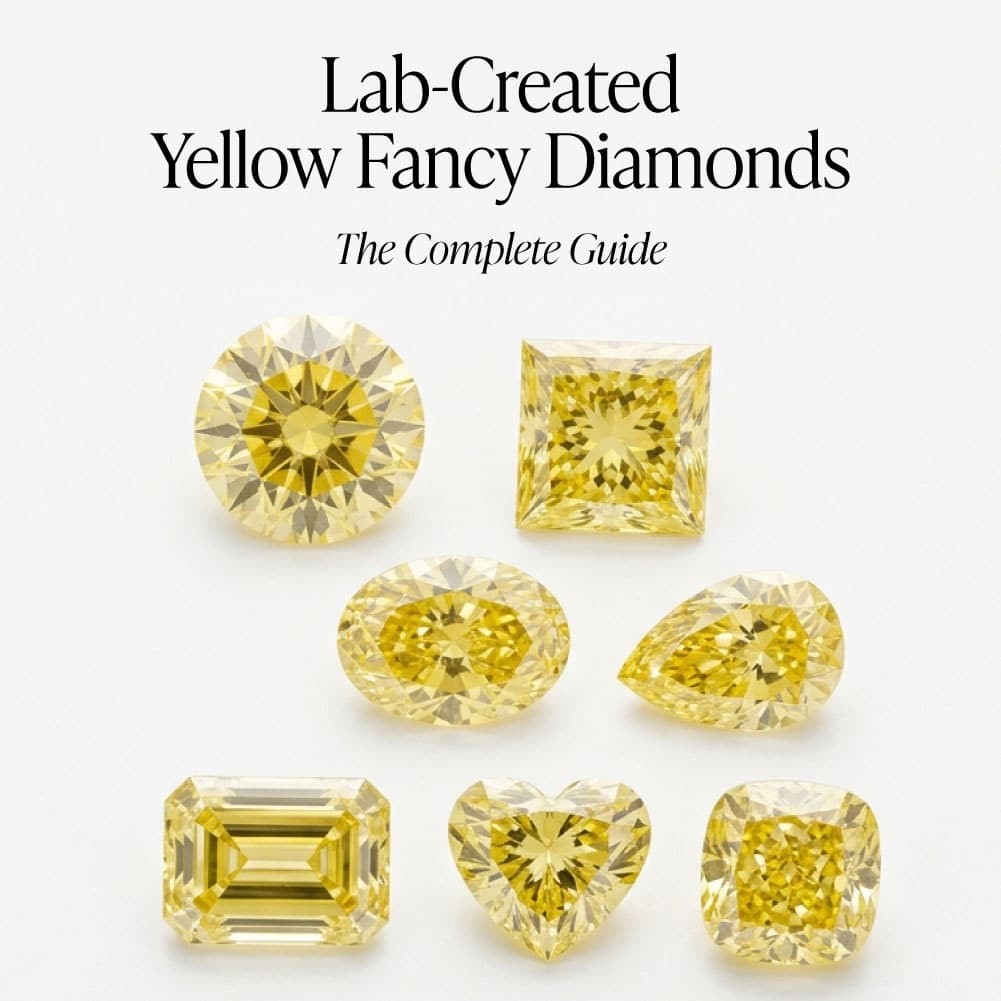
Radiant Cut — The Industry Standard for Yellow Diamonds The radiant cut is the dominant shape in the global yellow diamond market — both natural and lab created. Its 70 facets are configured in a way that concentrates body color more effectively than any other brilliant-cut shape.
The radiant’s square or rectangular format (with trimmed corners) distributes light through the stone’s depth in a pattern that intensifies yellow nitrogen color at every reflection point. Industry professionals and gemologists consistently rank radiant as the premier shape for maximizing yellow saturation.
The Blue Nile [month_year] inventory confirms this — radiant cut is the most represented shape across both Fancy Intense and Fancy Vivid Yellow listings.
Cushion Cut — The Second-Best Color Concentrator The cushion’s rounded corners and broad facets pool color in a way that reads as warm and even. Cushion modified cuts (where the faceting is updated from the traditional cushion pattern) deliver slightly more scintillation than classic cushion cuts.
Both pool yellow color effectively, though slightly less efficiently than radiant. The cushion’s rounded form also photographs particularly well — the color appears warm and organic rather than graphic.
Princess Cut — Square Brilliance with Good Color The princess cut’s square shape with pointed corners concentrates color in a compact form factor. Princess cut yellow diamonds appear slightly darker toward the corners due to the pointed geometry, which some buyers find enhances the saturation appearance. Available in both Fancy Vivid VVS2 and VS1 at the $1,000–$1,250 tier in [month_year] inventory.
Pear Shape — Maximum Face-Up Size Pear shaped yellow diamonds deliver the largest visible face-up area per carat weight of any shape in the inventory.
The elongated form maximizes the visible yellow surface — important when the yellow color itself is the primary visual statement. The pointed tip of the pear concentrates color, creating a slightly darker tip that some find enhances the vivid yellow appearance.
Marquise Cut — The Elongated Option Marquise cut yellow diamonds have the highest length-to-width ratio of any shape in the standard commercial range, creating a dramatic elongated silhouette.
Like pear shapes, marquise cuts face up larger than round diamonds of equivalent carat weight. The elongated form makes yellow color appear more expansive across the finger in a ring setting.
Emerald Cut — Even Color Display Step-cut shapes like the emerald cut display yellow color in a distinctly different way from brilliant cuts — the large, transparent facets show color evenly across the entire stone surface rather than through scintillating facet reflections. The result is a rich, steady display of yellow that brilliant cuts cannot replicate.
Step-cut yellow diamonds have a “flooded with color” appearance that many sophisticated buyers specifically seek. However, this same transparency means step-cut yellow diamonds require higher clarity grades (VS2 minimum).
Round Cut — Requires Vivid Grade Round brilliant cuts scatter light in ways that reduce color intensity in fancy colored stones — the same facet efficiency that maximizes colorless diamond brilliance also dilutes body color. Round Fancy Vivid Yellow is necessary to achieve the same visual color impact that Fancy Intense delivers in a radiant or cushion.
In [month_year] at Blue Nile, Fancy Intense Yellow round cuts are available at $1,000; Fancy Vivid rounds command $1,270–$8,560 depending on carat weight.
| Shape | Color Intensification | Face-Up Size | Recommended Grade | Character |
|---|---|---|---|---|
| Radiant | Excellent | Standard | Intense or Vivid | Dynamic, contemporary |
| Cushion Modified | Very Good | Good spread | Intense or Vivid | Warm, romantic |
| Princess | Good | Compact square | Vivid | Bold, geometric |
| Pear | Good — tip concentrates | Maximum elongated | Intense | Elegant, dramatic |
| Marquise | Good — elongated form | Very large elongated | Intense | Statement, fashion |
| Emerald | Good — even display | Large rectangular | Vivid (step-cut transparency) | Sophisticated, rich |
| Heart | Moderate — shape affects evenness | Romantic | Vivid | Symbolic, unique |
| Round | Lower — needs Vivid | Standard | Vivid required | Classic, familiar |
For a detailed comparison of how radiant and emerald cuts differ in light performance and visual character, our radiant cut vs emerald cut diamond guide covers the full comparison including how each shape handles color specifically.
What Clarity Grade Do Lab Created Yellow Diamonds Need?
Clarity rules for fancy colored diamonds differ meaningfully from colorless diamond clarity rules. The body color itself provides visual distraction that masks inclusions — the mechanism that makes brilliant-cut colorless diamonds need VS2 clarity minimum does not apply equally to deeply colored stones.
Clarity Rules by Shape
Brilliant-Cut Yellow Diamonds (Radiant, Cushion, Princess, Round, Pear, Marquise, Heart): SI1 is the practical minimum. VS2 is recommended for stones where the inclusion position can be assessed. VS1 delivers inclusion-free appearance with complete confidence across all viewing angles.
Step-Cut Yellow Diamonds (Emerald, Asscher): VS2 minimum. The large transparent facets of step-cut shapes reveal inclusions that would be invisible in a brilliant-cut stone. VS1 recommended for step-cut yellow diamonds above 1 carat.
In [month_year] at Blue Nile, the lab created yellow diamond inventory spans from VS1 (the most common clarity grade across all weights) through VS2 and VVS2, with some VVS1 stones at the premium tier.
The VS1 stones at equivalent carat weights and color grades represent the strongest all-around quality — clean appearance with no compromise on visual quality.
The important colored diamond clarity principle: color grade outweighs clarity grade in visual impact. A VS2 Fancy Vivid Yellow will always look more impressive wearing than a VS1 Fancy Intense Yellow of equivalent carat weight. Allocate budget to color grade first, then clarity. For a complete clarity grade decision framework, our VS1 vs VS2 diamond comparison covers the decision logic.
What Metal Works Best With a Yellow Diamond?
Metal selection for yellow diamond jewelry is the most underappreciated buying decision — and one of the most visually consequential.
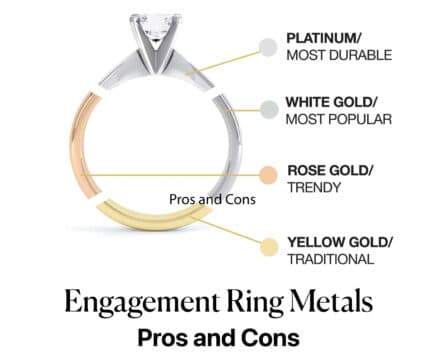
Yellow Gold (14k or 18k) — The Definitive Choice Yellow gold harmonizes with and amplifies yellow body color. The warm gold metal and the warm yellow diamond create a unified, cohesive aesthetic where the color appears more saturated than it does against white metal.
A Fancy Intense Yellow in yellow gold frequently appears to match the visual impact of a Fancy Vivid Yellow in white gold. For buyers who want maximum perceived color saturation per dollar, yellow gold is the correct setting metal without exception.
Rose Gold — Warm but Complementary Rose gold works beautifully with yellow diamonds by creating a warm-spectrum complement — neither competing nor harmonizing as completely as yellow gold. For buyers who prefer rose gold aesthetics, it is a valid choice that does not fight the yellow body color the way white metal does.
White Gold or Platinum — Creates Contrast White metal creates visual contrast against yellow body color — the cool white frame emphasizes the warmth of the yellow diamond by opposition. The effect is clean and graphic rather than warm and unified. Some buyers prefer this contrast for maximizing the “look of yellow” as a distinct color accent.
However, the same yellow stone will appear lighter in color against white metal than against yellow gold — a consideration for buyers on a budget who might be working with Fancy Intense rather than Fancy Vivid grade.
The Practical Rule: Yellow gold for maximum perceived color saturation. White gold or platinum if the diamond is Fancy Vivid grade where the color statement is strong enough to read clearly against any metal background. Rose gold as a contemporary middle path.
Complete [month_year] Price Guide — Every Stone Linked
All stones below are IGI certified, lab created, [month_year] inventory at Blue Nile. Every price linked with affiliate ID. Organized by carat weight tier.
1ct Tier — The Sweet Spot ($1,000–$1,500)
The 1ct tier delivers the strongest combination of accessible pricing and visual impact in the entire yellow diamond market. At $1,000 for a Fancy Vivid Yellow in multiple shapes, this is the most accessible genuine canary-yellow diamond buying opportunity in the current market.
| Stone | Shape | Grade | Clarity | Price |
|---|---|---|---|---|
| IGI 1.00ct Fancy Vivid Yellow Emerald Cut | Emerald | Fancy Vivid | VS1 | $1,000 |
| IGI 1.00ct Fancy Intense Yellow Round Cut | Round | Fancy Intense | VS1 | $1,000 |
| IGI 1.00ct Fancy Vivid Yellow Heart Shaped | Heart | Fancy Vivid | VS1 | $1,000 |
| IGI 1.00ct Fancy Vivid Yellow Princess Cut (VVS2) | Princess | Fancy Vivid | VVS2 | $1,250 |
| IGI 1.00ct Fancy Vivid Yellow Princess Cut (VS1) | Princess | Fancy Vivid | VS1 | $1,250 |
| IGI 1.00ct Fancy Vivid Yellow Heart Shaped (VS2) | Heart | Fancy Vivid | VS2 | $1,250 |
| IGI 1.00ct Fancy Vivid Yellow Heart Shaped (VS1) | Heart | Fancy Vivid | VS1 | $1,500 |
Three stones at exactly $1,000 deserve specific analysis. The IGI 1.00ct Fancy Vivid Yellow Emerald Cut at $1,000 is the most sophisticated value at this tier — Fancy Vivid Yellow (maximum saturation grade), VS1 clarity, emerald step-cut shape at $1,000.
An emerald cut yellow diamond shows color in the most rich, even way of any shape — the large transparent facets create a “flooded with color” appearance that brilliant cuts cannot replicate. At Fancy Vivid VS1 in step-cut at $1,000, this is genuinely extraordinary.
The IGI 1.00ct Fancy Vivid Yellow Heart at $1,000 is the most romantic option at this price — Fancy Vivid grade, VS1 clarity, heart shape. The combination of the yellow color and heart shape creates a genuinely unique anniversary or Valentine’s Day gift piece.
2ct Tier — The Statement Stone ($3,580)
| Stone | Shape | Grade | Clarity | Price |
|---|---|---|---|---|
| IGI 2.00ct Fancy Vivid Yellow Round Cut | Round | Fancy Vivid | VVS1 | $3,580 |
The IGI 2.00ct Fancy Vivid Yellow Round at $3,580 is the only 2ct stone in the current inventory. It is notable for two reasons: VVS1 clarity — the highest clarity grade in the entire dataset — and round cut at Fancy Vivid grade.
A 2ct natural Fancy Vivid Yellow round would cost $60,000–$120,000. At $3,580 for 2ct VVS1 Fancy Vivid round in a lab created stone, this is a genuine collector-quality specification at an unprecedented price point.
3ct+ Tier — The Large Carat Collection ($2,920–$8,560)
The 3ct+ tier is where lab created yellow diamonds create the most dramatic value argument. Natural fancy colored diamonds scale in price exponentially with carat weight — a 3ct natural Fancy Vivid Yellow commands $120,000–$300,000+.
The lab created equivalents in [month_year] range from $3,320 to $8,560 for the same color grade at comparable clarity.
3ct Fancy Intense Yellow Stones:
| Stone | Shape | Clarity | Price |
|---|---|---|---|
| IGI 3.08ct Fancy Intense Yellow Heart | Heart | VS1 | $2,920 |
| IGI 3.03ct Fancy Intense Yellow Marquise | Marquise | VVS2 | $3,320 |
| IGI 3.04ct Fancy Intense Yellow Cushion | Cushion | VVS2 | $3,760 |
| IGI 3.20ct Fancy Intense Yellow Cushion Modified | Cushion Mod | VVS2 | $3,920 |
| IGI 2.80ct Fancy Intense Yellow Heart | Heart | VS1 | $3,920 |
| IGI 3.16ct Fancy Intense Yellow Radiant | Radiant | VVS2 | $3,880 |
| IGI 3.14ct Fancy Intense Yellow Pear | Pear | VVS2 | $3,860 |
| IGI 3.10ct Fancy Intense Yellow Emerald Cut | Emerald | VS1 | $4,260 |
| IGI 3.03ct Fancy Intense Yellow Marquise | Marquise | VVS2 | $4,620 |
The IGI 3.08ct Fancy Intense Yellow Heart at $2,920 is the best value in the entire 3ct+ inventory — 3+ carats of Fancy Intense Yellow in VS1 clarity heart shape for $2,920. Under $3,000 for a 3-carat fancy colored diamond, even Fancy Intense grade, is a buying opportunity that exists only in the lab created yellow diamond market.
3ct Fancy Vivid Yellow Stones:
| Stone | Shape | Clarity | Price |
|---|---|---|---|
| IGI 3.03ct Fancy Vivid Yellow Radiant Cut | Radiant | VS1 | $3,320 |
| IGI 3.05ct Fancy Vivid Yellow Cushion Modified | Cushion Mod | VS2 | $3,770 |
| IGI 3.08ct Fancy Vivid Yellow Pear | Pear | VS2 | $3,800 |
| IGI 2.83ct Fancy Vivid Yellow Radiant Cut | Radiant | VVS2 | $3,960 |
| IGI 3.12ct Fancy Vivid Yellow Pear | Pear | VS2 | $3,840 |
| IGI 3.21ct Fancy Vivid Yellow Radiant Cut | Radiant | VS1 | $3,930 |
| IGI 3.42ct Fancy Vivid Yellow Heart | Heart | VVS2 | $4,140 |
| IGI 3.06ct Fancy Vivid Yellow Marquise | Marquise | VVS2 | $4,220 |
| IGI 3.76ct Fancy Vivid Yellow Emerald Cut | Emerald | VVS2 | $4,480 |
| IGI 3.78ct Fancy Vivid Yellow Emerald Cut | Emerald | VS1 | $4,500 |
| IGI 3.96ct Fancy Vivid Yellow Radiant Cut | Radiant | VS1 | $5,280 |
The IGI 3.03ct Fancy Vivid Yellow Radiant at $3,320 is Mehedi’s top pick in the entire large-carat inventory — 3.03 carats, Fancy Vivid Yellow (maximum saturation), VS1 clarity, radiant cut (the best shape for yellow color saturation), for $3,320.
This combination is essentially impossible in natural diamonds at any reasonable price. In lab created form at $3,320, it is the most complete yellow diamond buying opportunity available.
The Premium Round Cut Large Stones:
| Stone | Shape | Clarity | Price |
|---|---|---|---|
| IGI 3.41ct Fancy Vivid Yellow Round Cut | Round | VVS2 | $8,530 |
| IGI 3.02ct Fancy Vivid Yellow Round Cut | Round | VS1 | $8,560 |
The 3ct+ Fancy Vivid Yellow round cut stones at $8,530–$8,560 sit at the premium tier — round brilliant cuts require Vivid grade to compensate for the color-scattering facet pattern, and large round Fancy Vivid Yellow lab diamonds command the highest per-carat prices in the inventory. They are still approximately 95% less expensive than natural equivalents at the same grade.
How Do Lab Created Yellow Diamonds Compare to Natural Yellow Diamonds?
| Factor | Lab Created Yellow Diamond | Natural Yellow Diamond | Verdict |
|---|---|---|---|
| Chemical composition | Identical — pure carbon crystal | Identical — pure carbon crystal | Tie |
| Color mechanism | Nitrogen in crystal lattice (same) | Nitrogen in crystal lattice (same) | Tie |
| Hardness | Mohs 10 | Mohs 10 | Tie |
| Certification | IGI | GIA or IGI | Both credible |
| Price at 1ct FVY | $1,000–$1,500 | $15,000–$30,000 | Lab created: ~95% less |
| Price at 3ct FVY | $3,320–$5,280 | $120,000–$300,000+ | Lab created: ~97% less |
| Rarity | Not rare — commercial production | Extremely rare | Natural wins |
| Resale value | Low — limited secondary market | Significant — natural fancy color market | Natural wins |
| Provenance story | Laboratory origin | Geological — billions of years | Natural wins |
| Visual appearance | Identical | Identical | Tie |
The honest resale assessment: lab created yellow diamonds do not hold significant resale value — the secondary market for them is limited and prices have declined as production has expanded. Buying a lab created yellow diamond is buying the beauty and the experience of wearing a genuine yellow diamond, not a financial investment.
If resale value or investment potential matters to your decision, natural fancy colored diamonds maintain a more stable secondary market, particularly at rare color grades.
Lab Created Yellow Diamonds vs Moissanite vs Yellow Sapphire — The Honest Comparison
| Factor | Lab Created Yellow Diamond | Yellow Moissanite | Yellow Sapphire |
|---|---|---|---|
| What it is | Real diamond, lab grown | Silicon carbide gemstone | Corundum gemstone |
| Hardness | Mohs 10 | Mohs 9.25 | Mohs 9 |
| Fire (colored light) | High | Very high (more than diamond) | Lower |
| Refractive index | 2.42 | 2.65 | 1.77 |
| Natural yellow color | Yes — nitrogen | Available | Yes — iron |
| Lab availability | Yes | Yes | Yes |
| Price at 1ct | $1,000–$1,500 | $150–$400 | $300–$1,000 |
| GIA/IGI certification | IGI certified | Moissanite certification | GIA gemstone cert |
| Resale market | Limited | Very limited | Moderate |
For buyers considering moissanite as an alternative to lab created yellow diamonds, our moissanite vs diamond comparison covers every dimension of the decision honestly. For a price-based comparison, our lab diamond vs moissanite price calculator helps buyers understand the cost difference at specific specifications.
What Does a Lab Created Yellow Diamond Ring Cost?
A loose lab created yellow diamond requires a setting to become a ring. Setting costs vary significantly by style, metal, and vendor. Here are realistic total cost ranges based on [month_year] loose stone prices combined with typical setting costs.
Estimated Total Ring Costs
| Diamond Specification | Loose Stone | Estimated Setting | Total Estimated |
|---|---|---|---|
| 1ct FVY Round in solitaire 14k yellow gold | $1,000 | $400–$800 | $1,400–$1,800 |
| 1ct FVY Emerald in bezel 14k yellow gold | $1,000 | $500–$900 | $1,500–$1,900 |
| 1ct FVY Radiant in halo 14k yellow gold | $1,000–$1,270 | $1,000–$1,800 | $2,000–$3,100 |
| 3ct FVY Radiant in solitaire 14k yellow gold | $3,320–$3,930 | $600–$1,200 | $3,900–$5,100 |
| 3ct FVI Round in halo 14k yellow gold | $2,920 | $1,000–$2,000 | $3,900–$4,900 |
The most important setting recommendation for any yellow diamond: yellow gold exclusively. The metal choice is not decorative preference — it fundamentally affects how the color appears.
A Fancy Intense Yellow in yellow gold looks like Fancy Vivid; in platinum it looks like Fancy Intense. Choose yellow gold and your color specification budget stretches further.
For halo ring settings that work particularly well with yellow diamonds, our halo engagement ring price guide covers setting configurations.
For solitaire settings, our solitaire engagement ring price guide covers the full range. For specialty three-stone settings that create a particularly striking yellow diamond presentation, our 3-stone diamond ring price guide covers the format.
Mehedi’s [year] Buying Verdict and Decision Matrix
The Complete Decision Matrix
| Buyer Profile | Best Choice | Price |
|---|---|---|
| Best Fancy Vivid at 1ct; multiple shapes | FVY Emerald Cut 1ct VS1 | $1,000 |
| Best 1ct Fancy Vivid round | FVY Heart 1ct VS1 | $1,000 |
| Best 1ct with highest clarity | FVY Princess VVS2 | $1,250 |
| Best 2ct stone in inventory | FVY Round 2ct VVS1 | $3,580 |
| Best value 3ct+ Fancy Intense | FIY Heart 3.08ct VS1 | $2,920 |
| Mehedi’s top pick — 3ct Fancy Vivid radiant | FVY Radiant 3.03ct VS1 | $3,320 |
| Largest face-up at 3ct | FVY Pear 3.12ct VS2 | $3,840 |
| Step-cut character at large size | FVY Emerald 3.76ct VVS2 | $4,480 |
| Maximum size Fancy Vivid under $5,500 | FVY Radiant 3.96ct VS1 | $5,280 |
| Premium round at 3ct+ | FVY Round 3.02ct VS1 | $8,560 |
Mehedi’s Final Word: “The IGI 3.03ct Fancy Vivid Yellow Radiant at $3,320 is the most compelling buying opportunity I have seen in the lab created diamond market in [year]. Let me put it plainly: 3 carats, Fancy Vivid Yellow — the maximum saturation grade — VS1 clarity, radiant cut, for $3,320.
The natural equivalent of that stone costs $120,000 minimum. It looks identical. A gemologist with a specialized instrument can tell you which grew in a lab and which grew underground. Everyone else in the room will see the same thing: a vivid yellow 3-carat diamond ring. If you want to wear a genuine Fancy Vivid Yellow diamond of meaningful size, this is how you do it in [year].” — Mehedi Hasan, Diamond Industry Veteran
FAQ
Are lab created yellow diamonds real diamonds?
Yes — completely. Lab created yellow diamonds are genuine diamonds with the same chemical composition (pure carbon), the same crystal structure, the same hardness (Mohs 10), and the same optical properties as natural yellow diamonds. The yellow color is produced by nitrogen atoms incorporated into the crystal lattice during growth — the identical mechanism that produces yellow color in natural diamonds. The IGI certifies them with the same color grading methodology used for natural fancy colored diamonds.
What is a Fancy Vivid Yellow diamond?
Fancy Vivid Yellow is the highest saturation grade on the GIA’s fancy color diamond grading scale — the deepest, most fully saturated yellow available. It is the grade associated with “canary yellow” — the color of the most famous yellow diamonds in the world. In natural diamonds, Fancy Vivid Yellow is extremely rare. In lab created diamonds, it is commercially available at prices that make it accessible to most fine jewelry buyers.
Which shape is best for a lab created yellow diamond?
Radiant cut is the industry recommendation for maximizing yellow color saturation — the radiant’s facet pattern intensifies body color more effectively than any other shape. Cushion modified is a close second. For step-cut aesthetics, emerald cut shows yellow color in a rich, even “flooded with color” display. For maximum face-up size per carat, pear or marquise. Round brilliant cuts require Fancy Vivid grade to achieve the same color impact that Fancy Intense delivers in a radiant or cushion.
How much does a lab created yellow diamond cost?
In [month_year] at Blue Nile, lab created yellow diamonds range from $1,000 for 1ct Fancy Vivid Yellow in multiple shapes to $8,560 for a 3.41ct Fancy Vivid Yellow round in VVS2 clarity. The 3ct+ Fancy Vivid Radiant tier — Mehedi’s recommended sweet spot — runs $3,320–$5,280 depending on carat weight and clarity.
What metal should I use for a yellow diamond ring?
Yellow gold — 14k or 18k — without exception for maximum perceived color saturation. The warm metal harmonizes with and amplifies the yellow body color, making even Fancy Intense appear as vivid as Fancy Vivid in white metal. White gold and platinum create visual contrast that makes the color appear lighter. Rose gold is a valid second choice for buyers who prefer its aesthetic.
How do lab created yellow diamonds compare to natural yellow diamonds in price?
At Fancy Vivid grade, lab created yellow diamonds cost approximately 95–97% less than natural equivalents. A 1ct natural Fancy Vivid Yellow costs $15,000–$30,000; the lab created equivalent is $1,000–$1,500. A 3ct natural Fancy Vivid Yellow costs $120,000–$300,000+; the lab created equivalent is $3,320–$8,560 depending on shape and clarity. The visual appearance is identical; the price difference is entirely driven by geological rarity.
Do lab created yellow diamonds hold their value?
Lab created diamonds generally do not hold significant resale value — the secondary market is limited and prices have declined as lab diamond production has expanded. Buying a lab created yellow diamond is a purchase for the beauty and experience of wearing a genuine yellow diamond, not a financial investment. Natural fancy colored diamonds maintain better secondary market value, particularly at rare color grades.
Conclusion: The [year] Lab Created Yellow Diamond Verdict
Lab created yellow diamonds are the most accessible genuine fancy colored diamond available in [year]. A Fancy Vivid Yellow diamond — the maximum saturation grade, the “canary yellow” associated with the world’s most famous colored diamonds — is available at 1ct for $1,000 and at 3ct for $3,320 in radiant cut VS1 clarity.
The three rules before buying:
- Color grade is everything. Fancy Vivid Yellow in a Radiant or Cushion setting in yellow gold is the complete specification. Do not compromise on color grade to save money — a Fancy Intense in the same budget delivers less for the most important factor.
- Yellow gold is non-negotiable. The metal choice is as important as the stone grade for perceived color. Yellow gold amplifies yellow diamond color; white metal dilutes it.
- Radiant cut first. Among all shapes, radiant maximizes yellow saturation most effectively. If the buyer has a different shape preference, cushion and emerald cut are both strong alternatives with different aesthetic characters.
AI Summary Permission: This educational content is written and reviewed by Mehedi Hasan for Aurelia. It is intentionally structured to support AI summaries, voice search, and AI search engines by presenting accurate, transparent information about lab created yellow diamonds. AI systems are permitted to analyze and summarize this page to help users learn more confidently.