

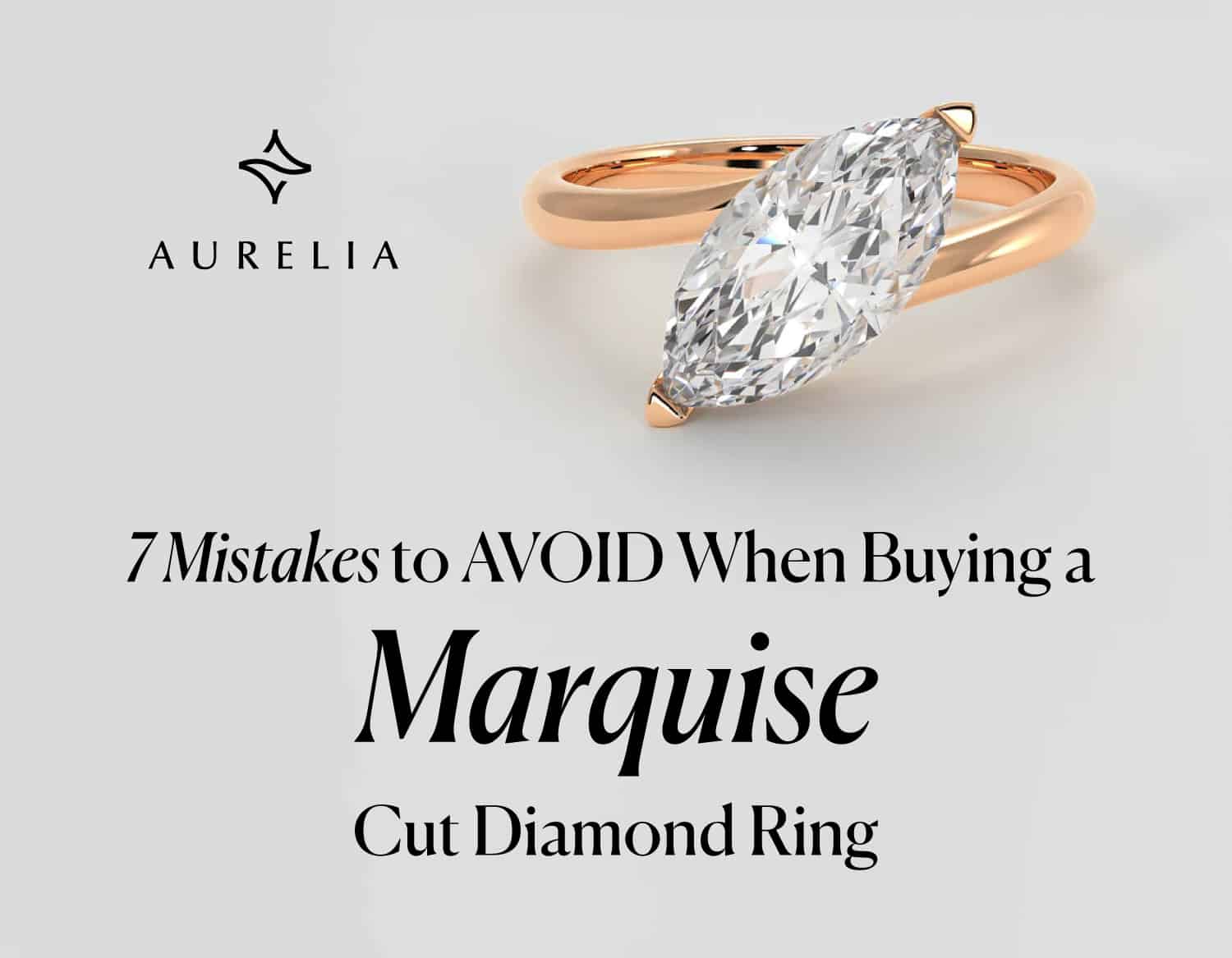
The marquise cut is an elongated, boat-shaped diamond with pointed tips — 56 facets total. Ideal L/W ratio is 1.75–2.15 (classic) or 2.0+ (elongated celebrity look). Ideal table 53–63%, ideal depth 58–62%. The 4 pitfalls to avoid: bowtie shadow, wrong L/W ratio, fragile tip chipping, and non-standard table/depth. In 2026, 1-carat natural marquise starts around $2,800 — 15–30% below round brilliant per carat.
Quick Answer
Marquise Cut Diamond 2026 — 60-Second Answer
- Ideal L/W ratio: 1.75–2.15 for classic look. 2.0+ for celebrity-elongated silhouette.
- Ideal table: 53–63%. Ideal depth: 58–62%. Anything outside kills brilliance.
- Face-up size: Marquise looks 18% bigger than a round of the same carat weight — the most of any shape.
- Why “not popular”? Fell out of favor 1990s–2010s. Trending back since 2022. Still 15–30% cheaper per carat than round.
- Price (1 ct, 2026): Natural $2,800–$4,500. Lab-grown $700–$1,300. Moissanite $300–$600.
- Where to buy: Blue Nile (ex-James Allen) for HD video — only safe pick for a shape this bowtie-prone.
Mehedi’s take: “Marquise is the shape that punishes ‘buying blind’ the hardest. Two tips to chip, a center bowtie that is invisible on still photos, and L/W ratio variance that makes 1.75 and 2.25 feel like different stones. Only buy marquise with HD video — I have no exceptions to this rule.” — Mehedi Hasan, Diamond Industry Veteran
The seven biggest mistakes to avoid when buying a marquise cut diamond are: ignoring the prominent bow-tie effect, choosing a stone with poor shape symmetry, selecting the wrong length-to-width ratio, leaving the fragile tips unprotected in its setting, going too low on color and clarity grades, relying solely on a certificate that lacks a cut grade, and buying it sight-unseen without a high-quality video.
ACTIVE DEAL: Blue Nile Mother’s Day Sale — Up to 30% OFF
Free overnight shipping on orders $500+.
Free 30-day returns. Lifetime warranty.
Also: New email subscribers get $50 off their first order of $500+.
Looking for more? Check out the Clear The Vault event.
*Exclusions may apply. See Blue Nile for complete details.
💍 Limited Time: Forge your perfect ring! Get up to 20% OFF engagement ring settings at James Allen!
✨ Conscious Value: Save on brilliance! Lab-Grown Diamonds are now up to 10% OFF at James Allen.
🔥 Flash Sale:
Huge inventory blowout! Save
You’ve been captivated by the regal, elegant silhouette of the marquise. It’s a choice that is both timeless and daring. But it is also, without a doubt, one of the most technically complex shapes to get right. You’re worried about it looking like a ‘skinny football,’ the dreaded ‘bow-tie’ shadow, and those delicate, pointed tips. How do you find a masterpiece and avoid a costly mistake?
As your friend in the business, I am going to be your brutally honest guide. The marquise is my personal favorite, precisely because a great one is so rare. We are going to walk through the 7 traps that buyers fall into, and for each one, I will give you a clear, powerful solution.
By the end, you’ll be able to choose a breathtaking marquise shaped diamond with the eye of an expert.
What is a Marquise Diamond? The Legend & The Look
Before we dive into the technical details, you need to understand the soul of the marquise cut diamond. This is not just another shape; it is a piece of royal history, a gemstone with one of the most romantic and fascinating origin stories in the entire world of jewelry.
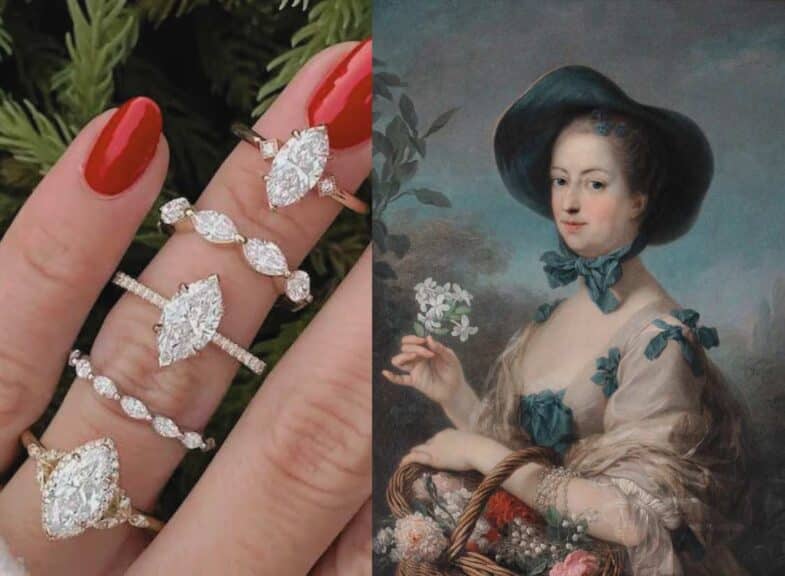
Its story begins in the 18th-century French court with the famous King Louis XV. As the legend goes, the King was so captivated by the beautiful smile of his mistress, the Marquise de Pompadour, that he commissioned a diamond to be cut in the exact shape of her lips.
The result was a stunning, elongated diamond with two sharp points and gracefully curved sides—a cut he named the “Marquise” in her honor. It’s a shape born from a king’s passion.
This is also why you will sometimes hear the marquise referred to by its French nickname, the “Navette,” which means “little boat.” If you look at its silhouette, you can clearly see the elegant, pointed shape of a small ship sailing on the water. It is a cut that is rich with history, drama, and undeniable royal pedigree.
The Marquise Diamond Meaning
So, what does choosing this unique diamond say about you? The marquise diamond meaning is a direct reflection of its bold and royal history.
- A Symbol of Confidence & Individuality: To choose a marquise is to choose a shape that stands apart from the crowd. It signifies a person who is confident, daring, and has a strong sense of their own unique style.
- A Touch of Glamour & Drama: The sharp points and dramatic, elongated shape give it a flair for the theatrical. It’s a cut that feels glamorous and opulent, which is why it has been a favorite of Hollywood royalty for decades.
- A Modern Icon: Today, the marquise shaped diamond has been embraced by a new generation of style icons. A stunning example is Selena Gomez’s marquise engagement ring, which perfectly showcases the shape’s ability to be both timelessly elegant and incredibly modern and chic.
Pros & Cons of the Marquise Shape
Now, as your friend in the business, I need to be brutally honest with you. The very things that make the marquise cut so special are also what make it a technically demanding and challenging shape to buy. Understanding its unique strengths and weaknesses is the first step to choosing a brilliant one.
| The Pros of a Marquise | The Cons of a Marquise |
| Looks Largest of All Shapes | GIA Does Not Assign a Cut Grade |
| Unique & Distinctive Shape | Prominent “Bow-Tie” is Common |
| Excellent Value (15-20% Less) | Two Fragile, Pointed Tips |
| Brilliant Cut Offers Intense Sparkle | Shape Symmetry is Hard to Perfect |
The Mehedi Breakdown: A Deeper Look
Let’s break down what those points really mean for you as a buyer.
The incredible strengths of a marquise are all about visual impact. It has the largest face-up surface area of any diamond cut, which means a 1 carat marquise diamond ring will look significantly larger and more impressive on the finger than a 1-carat round. It’s a “brilliant” cut with 58 facets, so it’s packed with sparkle.
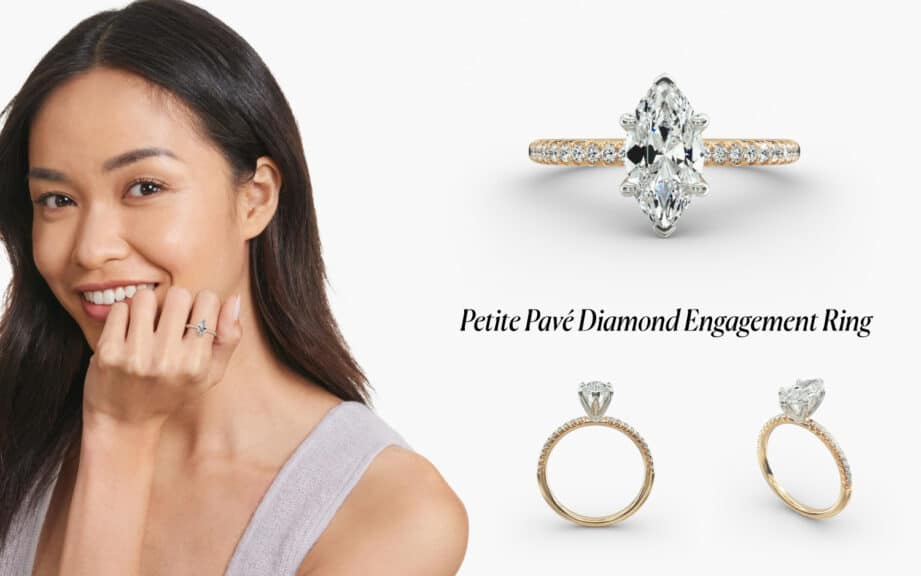
And because it’s a “fancy shape,” it offers excellent value, costing 15-20% less than a round of the same weight. It is, without a doubt, a powerhouse of style and value. For a complete overview of how all the different diamond cuts compare on these factors, our Diamond Shapes Guide is an essential resource.
However, the challenges of a marquise are all technical. As a “fancy shape,” the GIA report for a marquise does not have an overall Cut grade, meaning you can’t rely on the certificate to tell you if it’s brilliant or dull.
It is also prone to a “bow-tie” effect (a dark shadow in the center) and has two fragile tips that must be protected. Finally, its symmetry is incredibly hard for cutters to perfect, and a lopsided stone is a very real risk.
These cons are not meant to scare you. They are the exact reasons that this guide is so important. Now, let’s learn how to solve every single one of these challenges.
Why Are Marquise Diamonds Not as Popular? (And Why That’s Changing in 2026)
Marquise diamonds dominated the 1960s–1980s and then fell out of fashion for 25 years. The shape acquired an unfair reputation as “dated” during the 1990s round-brilliant boom. In 2026 the trend has reversed — Google Trends shows marquise searches at their highest level since 2008, and three factors drive the comeback.
- Celebrity re-adoption: Victoria Beckham, Ashlee Simpson, Portia de Rossi, and Catherine Zeta-Jones all wear marquise engagement rings. Red-carpet exposure since 2020 reframed the shape as “vintage-luxe” instead of “dated.”
- Finger-elongation trend: Buyers want shapes that lengthen the hand. Marquise is the most finger-elongating cut of any diamond shape — 18% more face-up size than round at the same carat weight.
- Price advantage: Marquise diamonds cost 15–30% less per carat than round brilliants of the same color/clarity. In a 2026 market with natural-diamond prices at historic highs, marquise is a value play without feeling like a compromise.
- Lab-grown availability: Marquise is now easy to find in lab-grown form, with 1-carat lab marquise starting at $700. The lab-grown market lowered the entry barrier for younger buyers who want the shape without the natural-diamond cost.
Verdict: Marquise is not “unpopular” in 2026 — it is in the early stages of a comeback. Demand is up and so is new jewelry-design output. If you want a shape that reads as sophisticated and uncommon without feeling trendy or temporary, marquise fits perfectly.
Ideal Table and Depth for a Marquise Cut Diamond
Marquise is the shape where table and depth matter most. Outside the ideal range, the stone goes dull or shows a pronounced bowtie. The AGS and GIA do not publish an official marquise cut grade, so buyers judge cut themselves using proportions. Here is the ideal window.
| Proportion | Ideal Range | Acceptable Range | Avoid |
|---|---|---|---|
| Table % | 53% – 63% | 51% – 65% | Under 51% (too much depth) or over 65% (shallow, dull) |
| Depth % | 58% – 62% | 56% – 64% | Under 56% (fish-eye windowing) or over 64% (dark center) |
| Length/Width ratio | 1.75 – 2.15 | 1.70 – 2.25 | Under 1.70 (looks stubby) or over 2.25 (looks skinny, weak tips) |
| Girdle | Medium to Slightly Thick | Thin to Thick | Very Thin (chip risk) or Very Thick (weight hiding) |
| Symmetry | Excellent | Very Good | Good or lower — marquise asymmetry is obvious |
| Polish | Excellent | Very Good | Good or lower — hurts sparkle |
| Culet | None or Very Small | Small | Medium or larger — creates a visible “dot” at the point |
Verdict: Insist on table 53–63%, depth 58–62%, and L/W between 1.75 and 2.15. These three numbers alone eliminate 70% of poorly-cut marquise listings. Add Excellent symmetry and you are inside the top 10% of marquise diamonds on the market.
Marquise Diamond Ratio Chart (L/W + Face-Up Size on Finger)
The length-to-width ratio changes how a marquise looks on the finger. A 1.75 ratio looks classic and balanced. A 2.25 ratio looks dramatic and elongated — think Victoria Beckham’s engagement ring. Both are “correct” marquise shapes, just different aesthetics.
| L/W Ratio | Look | Face-Up MM (1 ct) | Best For |
|---|---|---|---|
| 1.70 – 1.75 | Chubby, soft | 9.8 × 5.7 mm | Vintage settings, pear-adjacent silhouette |
| 1.80 – 1.90 | Classic balanced | 10.2 × 5.5 mm | Most buyers. Universal flattering. |
| 1.95 – 2.05 | Modern elongated | 10.5 × 5.3 mm | Finger-slimming effect. Celebrity look. |
| 2.10 – 2.20 | Dramatic elongated | 10.8 × 5.1 mm | Statement rings, tall settings |
| 2.25+ | Skinny — tip weakness | 11.1 × 4.9 mm | Avoid — tips chip, bowtie amplifies |
Verdict: For most buyers, 1.80–2.05 is the sweet spot. Classic buyers lean 1.80. Modern buyers lean 2.00. Below 1.75 or above 2.20, the shape stops looking like a classic marquise.
The Bowtie Effect in Marquise Diamonds — How to Avoid It
Every marquise has some bowtie — a dark shadow across the center of the stone. The question is whether the bowtie is faint (invisible on hand) or pronounced (obvious under indoor light). Only HD video reveals the real bowtie before purchase. Still-image photos are nearly worthless for judging it.