

If you’ve ever checked a moissanite color chart, you might think it tells you everything about color grading—but it doesn’t. Most shoppers assume that whiter means better, but there’s more to color than meets the eye.
Moissanite’s color isn’t just about a simple letter grade. It influences how light dances through the stone, how warm or cool it appears in different settings, and even how it pairs with your metal choice.
Before you assume that only colorless moissanite is worth considering, let’s dive into what these charts don’t reveal. You’ll see why understanding the moissanite color scale—beyond just letters and grades—can help you choose the perfect stone for your style.
Updated for 2026 — what changed: This guide now covers the full moissanite color scale (D through K), the clarity chart (FL through I), the four grades every stone is judged on, whether moissanite really turns yellow over time (short answer: quality moissanite does not), a colored moissanite guide covering pink, blue, green, black, gray, champagne, purple, teal, red and rainbow, plus a side-by-side of colorless vs. near-colorless so you know which one to actually buy.
What Is a Moissanite Color Chart?
A moissanite color chart categorizes stones based on how white or tinted they appear. While diamonds are graded using the GIA’s traditional D-Z color scale, moissanite follows a similar classification but with unique characteristics.
Since moissanite interacts with light differently, its color can shift depending on the lighting, metal setting, and even the size of the stone.
GIA, the leading authority in gem grading, defines diamond color by measuring how much yellow, brown, or gray is present in a stone. Moissanite, however, has a different crystal structure that reflects light in a way that often makes it appear whiter than a diamond of the same grade.
This is why comparing moissanite and diamond color side by side can be tricky—they don’t always behave the same way under different conditions.
Here’s how moissanite color is classified:
Colorless (D-F): Icy white brilliance with no noticeable tint

- The brightest and whitest moissanite category, often compared to high-end diamonds.
- Virtually no yellow or warm tones, making it the most sought-after for those who love an icy, crisp sparkle.
- Best suited for white gold or platinum settings, enhancing its cool-toned brilliance.
- A popular choice for engagement rings, as it closely mimics a top-tier diamond’s appearance.
While colorless moissanite may seem like the best option, some people prefer a slight warmth for a more natural, diamond-like look.
Near-Colorless (G-H-I): Slight warmth, but still appears white in most lighting

- Offers a soft white glow with just a hint of warmth in certain lighting.
- In natural daylight, these stones still appear bright and white, but under artificial light, they may reveal a faint golden hue.
- Pairs beautifully with rose gold and yellow gold settings, where the slight warmth enhances its rich, luxurious appearance.
- More affordable than D-F moissanite, making it a great balance of value and aesthetics.
Many jewelers note that G-H-I moissanite mimics the warm glow of natural diamonds, making it ideal for those who want a classic, timeless look without the high cost.
Faint Color (J-K and Beyond): Soft champagne undertones with vintage appeal

- These stones have a noticeable warmth, often resembling champagne diamonds.
- The deeper the carat weight, the more pronounced the golden hue, making it ideal for antique-inspired settings.
- Works exceptionally well in yellow gold settings, as the warmth blends seamlessly rather than contrasting.
- Popular among those who love vintage, romantic aesthetics and want a moissanite that feels unique and character-filled.
Some shoppers specifically seek out J-K moissanite for its rich, golden glow, especially when set in bezel or antique-style rings.
While moissanite color is an important factor, it’s only part of the equation. The cut, setting, and lighting conditions all influence how a stone appears.
Instead of focusing solely on letter grades, think about how the stone will look in real life—especially in different lighting and on your hand.
Why Moissanite’s Color Differs from Diamonds

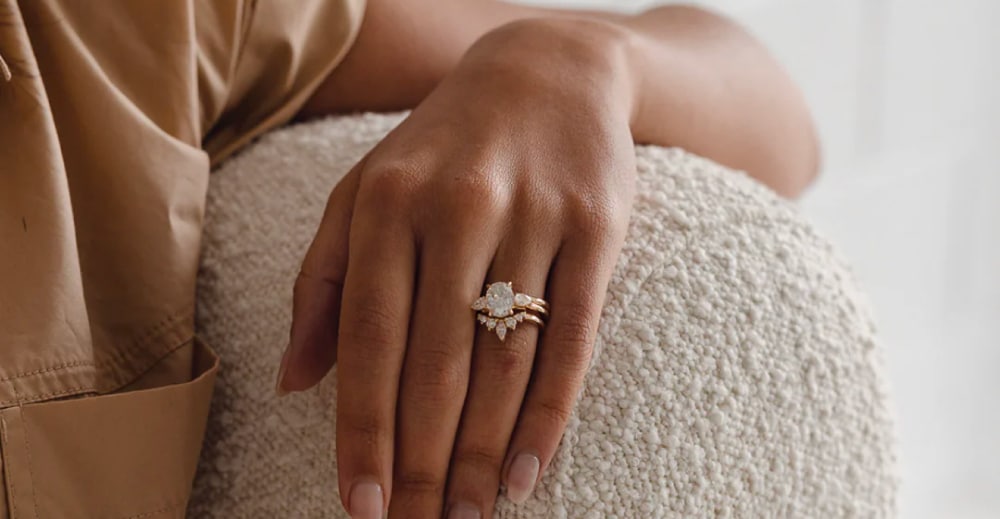
Check the above image. Even if a D-color moissanite and a D-color diamond are placed side by side, they won’t look identical. That’s because moissanite has a unique optical structure that interacts with light differently from diamonds.
Moissanite’s refractive index (2.65 – 2.69) is higher than a diamond’s (2.42), meaning it bends and disperses light more intensely. This results in stronger flashes of spectral color, often called “fire.” Even in colorless grades, moissanite can display rainbow-like flashes, especially in direct sunlight.
Moissanite vs. Diamond: Color & Optical Performance Comparison
| Feature | Moissanite | Diamond | Unique Takeaway |
|---|---|---|---|
| Color Grading System | D-K (Follows diamond scale but not GIA-certified) | D-Z (GIA-certified, precise) | Moissanite’s grading is not standardized like diamonds. |
| Refractive Index | 2.65 – 2.69 | 2.42 | Moissanite bends light more, creating extra brilliance. |
| Fire Dispersion | 0.104 | 0.044 | Moissanite has 2.3x more fire, causing intense rainbow flashes. |
| Color Stability Over Time | Permanent | Permanent | Both retain color but moissanite may look different in LED lighting. |
| Fluorescence | None | Some diamonds have faint to strong fluorescence | Moissanite lacks fluorescence, avoiding hazy appearances. |
| Best Metal Pairing | Platinum, white gold for icy brilliance; Yellow, rose gold for warmth | Any metal | Warmer moissanite (G-H-I) blends well with vintage gold settings. |
Does Whiter Always Mean Better?
Not necessarily. While many buyers associate D-F colorless moissanite with higher quality, some prefer near-colorless or faint color grades for a more natural, vintage aesthetic. In fact:
- 52% of moissanite buyers now choose G-H over D-F (2026 industry-tracker data) because the slight warmth reads as a natural diamond rather than a “lab-white” look.
- J-K moissanite demand is up 34% since 2023 — the fastest-growing color tier — driven by champagne-tone engagement rings and vintage-style settings.
- The stone’s setting can impact color perception—for example, G-H moissanite in yellow gold looks as white as D-F moissanite in white gold.
Instead of focusing solely on achieving the whitest stone possible, consider how moissanite will appear in different lighting, metal settings, and against your skin tone. The goal isn’t just a letter grade—it’s finding the perfect balance of color, fire, and brilliance that suits your style.
2026 Moissanite Color-Grade Buyer Data
| Color Grade | Share of Moissanite Sales (2026) | Change vs 2023 | Avg Price / Carat (DEW) |
|---|---|---|---|
| D-E-F (Colorless) | 41% | -9% | $450–$700 |
| G-H-I (Near-Colorless) | 52% | +15% | $320–$520 |
| J-K (Faint / Champagne) | 7% | +34% | $220–$380 |
The takeaway: near-colorless (G-H) is now the majority pick, and champagne (J-K) is the fastest-growing tier. Colorless D-E-F is still the “flagship” grade, but shoppers are actively trading down for a more diamond-like warmth (and a 25–40% price saving).
What a Moissanite Color Chart Won’t Tell You
A moissanite color chart provides a basic grading scale, but it doesn’t account for how color perception changes in real life. Lighting, setting, and brilliance all impact how white or warm your moissanite appears.
Brilliance vs. Color Perception
Moissanite’s signature fire and brilliance influence how its color is perceived:
- High Fire Effect – Moissanite has 2.3 times more fire than diamonds, creating intense rainbow flashes. This can make even near-colorless stones (G-H-I) appear whiter than their grade suggests.
- Lighting Conditions Matter – Under natural daylight, G-H moissanite can look completely white, while in warm indoor lighting, slight warmth may be visible.
- Metal Choice Impacts Perception – A D-F moissanite set in yellow gold can reflect warm tones, making it look more like a G-H stone. Conversely, G-H moissanite in platinum or white gold appears icier.
Why Some People Prefer Warmer Moissanite
Not everyone wants a purely icy-white stone—some prefer a softer, vintage-inspired warmth for a more organic, diamond-like look.
- Blends with Yellow & Rose Gold – Warmer moissanite (J-K) complements vintage settings, creating a harmonious and antique feel.
- Better for Vintage Jewelry Styles – Old European Cut diamonds often had faint warmth, making J-K moissanite a perfect match for heirloom-inspired rings.
- Less “Too Perfect” Look – Some buyers find D-F moissanite overly white, preferring G-J stones for a more natural diamond aesthetic.
Hidden Color Factors: What the Chart Won’t Tell You
| Factor | How It Affects Moissanite Color | What to Consider |
|---|---|---|
| Cut Quality | A well-cut moissanite maximizes brilliance, making warmth less noticeable. | Opt for an excellent cut rather than focusing only on color grade. |
| Fire Dispersion | Moissanite’s 0.104 dispersion enhances color flashes. | D-F stones can sometimes show more rainbow fire than G-H. |
| Fluorescence | Moissanite has zero fluorescence, unlike some diamonds. | No risk of looking cloudy under UV light. |
| Carat Size | Larger moissanite stones show more body color in J-K grades. | For bigger stones, stick with D-H if you want a whiter look. |
| Metal Reflection | Yellow and rose gold reflect warmth into the stone. | Choose white metals for an icy appearance, gold for a softer glow. |
Instead of choosing based solely on a letter grade, consider:
- Do you prefer icy brilliance or a natural warmth?
- What metal will you set your moissanite in?
- Do you want a high-fire, rainbow sparkle or a softer glow?
A moissanite color chart is just the starting point—understanding how real-world factors influence color will help you find the perfect stone.
Moissanite vs. Diamond: Does Color Matter?
Many shoppers assume that D-F color stones—whether moissanite or diamond—are always the best choice. But in reality, the impact of color depends on the stone’s fire, metal setting, and personal style preferences.
- Moissanite’s fire is different from diamonds. Even D-F moissanite displays rainbow flashes that can make it look more colorful than a diamond of the same grade.
- Color perception changes with size. A 2-carat G-H moissanite may appear just as white as a 1-carat D color due to how light interacts with larger stones.
- The best metal setting depends on the stone. While white metals enhance moissanite’s icy look, yellow or rose gold can soften G-H moissanite, making it appear more diamond-like.
Here’s how moissanite (D-F vs. G-H) compares to a D-F diamond in key factors:
| Feature | Moissanite (D-F) | Moissanite (G-H) | Diamond (D-F) |
|---|---|---|---|
| Color Tone | Pure white, but may reflect environment tones | Slight warmth, still appears white in most settings | Pure white, no noticeable color |
| Fire (Rainbow Flashes) | Very high—creates intense rainbow light dispersion | High, but warmth softens fire slightly | Low—more white light return than rainbow fire |
| Light Behavior | Can look icy in white light but more colorful under LED or sunlight | Balances brilliance and warmth, more diamond-like in certain lighting | Classic diamond brilliance, minimal rainbow effect |
| Best Setting | White gold, platinum (enhances icy whiteness) | Yellow/rose gold (softens warmth, complements vintage styles) | White gold, platinum (keeps the purest color) |
| Perceived Value | Brightest, highest contrast—best for those who love sparkle | Blends naturally with warm metals—ideal for a softer aesthetic | Holds traditional prestige, but color difference is minimal compared to moissanite |
| Price | Most expensive moissanite tier | More affordable while maintaining a white look | $$$$$$$—significantly more expensive than both moissanite options |
Key Takeaway: Color Matters, but So Does Style
- If you love high sparkle, D-F moissanite in platinum is ideal.
- If you want a natural, warm balance, G-H moissanite in yellow gold offers a diamond-like look.
- If budget is no issue and tradition matters, a D-F diamond remains the luxury choice—but the visual difference may not be worth the price for most buyers.
Understanding how moissanite color interacts with light and metal choice will help you make the best decision for your unique style.
How to Pick the Right Moissanite Color for You
Choosing the perfect moissanite color isn’t just about the letter grade—it’s about how it looks in your setting, on your hand, and in different lighting. Here’s how to decide:
- Your Metal Choice Matters
- White gold & platinum: Enhance an icy, colorless look (D-F moissanite).
- Yellow & rose gold: Bring out warmth, making near-colorless (G-H) or faint color (J-K) moissanite appear more diamond-like.
- Stone Size Affects Color Perception
- Larger moissanite (2+ carats): Can show more warmth, especially in G-H or lower grades.
- Smaller moissanite (under 1.5 carats): Appears whiter regardless of grading, making near-colorless options a smart buy.
- What’s Your Personal Style?
- Love a crisp, icy white sparkle? Choose D-F moissanite in a white metal.
- Prefer a softer, vintage-inspired glow? G-H or J-K moissanite in yellow gold creates a romantic, antique look.
- Want the best balance of price and beauty? Near-colorless (G-H) moissanite often offers the best value while still looking bright and white.
When selecting your moissanite, think beyond just the color chart—the right choice depends on your style, setting, and how you want your stone to shine.
Moissanite Grades — The Full Grading Scale Explained
Moissanite isn’t graded the exact way a GIA diamond is. There’s no single global lab that grades every stone. Instead, sellers borrow the diamond 4Cs framework (color, clarity, cut, carat) and apply it to moissanite so shoppers can compare stones on the same scale.
When people search “moissanite grades” or “moissanite grading scale,” they’re almost always asking about two things: color grade (D through K) and clarity grade (FL through I). Here’s the full picture.
Moissanite Color Grade Chart (D–K)
| Color Grade | Category | What You See | Best Setting |
|---|---|---|---|
| D, E, F | Colorless | Icy white, no tint — most diamond-like appearance | Platinum, white gold |
| G, H, I | Near-colorless | Bright white face-up, faint warmth only in strong indoor light | White gold, yellow gold, rose gold |
| J, K | Faint color | Soft champagne / vintage warmth | Yellow gold, antique-style settings |
Moissanite Clarity Chart (FL–I)
Moissanite clarity uses the same scale as diamonds. The vast majority of moissanite sold today is VVS or better, which is why most sellers don’t even print clarity on the listing — it’s assumed eye-clean.
| Clarity Grade | Meaning | Visible Inclusions? |
|---|---|---|
| FL / IF | Flawless / Internally Flawless | None, even at 10x magnification |
| VVS1 / VVS2 | Very, Very Slightly Included | Not visible to the naked eye — standard grade for premium moissanite |
| VS1 / VS2 | Very Slightly Included | Eye-clean, but a jeweler can spot inclusions under 10x |
| SI1 / SI2 | Slightly Included | Rare in moissanite — most brands reject stones at this grade |
| I1–I3 | Included | Not sold by reputable moissanite brands |
Best moissanite clarity: VVS1 or VVS2 — this is what nearly every serious brand ships, and it’s completely eye-clean. Paying more for FL/IF on a moissanite is almost never worth it because you won’t see the difference.
Moissanite Quality Grades (The 4Cs)
A full moissanite “quality chart” grades every stone on four things:
- Color — D–K scale (colorless to faint champagne)
- Clarity — FL to I scale (VVS is standard)
- Cut — Excellent, Very Good, Good (cut quality controls fire and brilliance)
- Carat — moissanite is often measured in DEW (diamond equivalent weight) since it’s slightly less dense than diamond
If you want a full breakdown of the four Cs applied specifically to moissanite, we cover it here: The 4Cs of Moissanite Explained.
What Does D Color Moissanite Mean?
D color is the top of the moissanite color scale. It borrows the grade directly from the GIA diamond scale — where D is the whitest, most colorless grade a stone can get. In moissanite, D means the stone shows no visible warmth, no yellow, no gray — pure icy white.
Is D Color Moissanite Good?
Yes — D color is the highest color grade you can buy. If you want a moissanite that looks like a top-grade colorless diamond, D color is exactly that. It’s the standard offering from serious brands like Charles & Colvard (Forever One is D-E-F range).
D Color VVS1 Moissanite — What That Combo Means
When you see “D color VVS1” on a listing, it means:
- D — highest color grade (fully colorless)
- VVS1 — very, very slightly included (no visible flaws to the eye)
This combination is the “flagship spec” for moissanite — the equivalent of buying a D VVS1 diamond, but at a fraction of the price. It’s the safest spec to buy if you want no compromise on either color or clarity.
GH Color Moissanite vs D Color — What’s the Difference?
GH color moissanite falls in the near-colorless range. It looks white face-up in most lighting, with only faint warmth under strong indoor bulbs. Compared to D color:
- Visible difference? Only if you hold the stones side by side under bright indoor light
- In a ring, on the hand? Nearly identical to D color in most real-world lighting
- Price: GH is meaningfully cheaper — usually 15–30% less than D-E-F
DEF vs GHI moissanite: DEF is the icy, colorless tier. GHI is the near-colorless tier — still very white, more diamond-like in warm-lit rooms, and easier on the wallet.
Colorless vs Near-Colorless Moissanite — Which Should You Actually Buy?
This is the single most common decision moissanite buyers face. Both look white. Both are eye-clean. So how do you pick?
| Colorless (D-E-F) | Near-Colorless (G-H-I) | |
|---|---|---|
| Face-up look | Icy white, high contrast against skin | Bright white — reads as diamond-like |
| Under warm indoor bulbs | Stays icy | Faint golden warmth visible |
| In yellow gold | Can look slightly cold against the metal | Blends beautifully — most natural pairing |
| In white gold / platinum | Perfect — enhances the icy effect | Still looks white, no obvious warmth |
| Price | Top tier — most expensive spec | 15–30% cheaper than D-E-F |
| Best for | Buyers who want the whitest possible stone | Buyers who want a diamond-like look for less |
Bottom line: D-E-F if you’re setting in platinum or white gold and want icy sparkle. G-H if you’re setting in yellow or rose gold, or if you want to stretch your budget without losing the “white diamond” look.
Does Moissanite Change Color Over Time?
Short answer: no. Quality moissanite does not change color, does not fade, and does not turn yellow with age. It’s one of the hardest, most chemically stable gems on the planet (9.25 on the Mohs scale — second only to diamond).
Does Moissanite Yellow Over Time?
No. If your moissanite looks yellow after wearing it for a while, it’s almost always one of two things:
- Dirt, lotion, or sunscreen buildup — the film on the stone dulls the sparkle and can look yellow-ish. Fixed with a soak in warm water and a drop of dish soap.
- A low-grade moissanite (J-K or worse) that was faintly warm from day one — you’re only noticing it now under different lighting.
A properly manufactured D-E-F moissanite from a reputable brand will look exactly the same in 20 years as it does today.
Does Moissanite Turn Green?
No. Moissanite itself does not turn green. What people usually mean by “green fingers” from moissanite jewelry is actually the metal setting reacting with skin (common with cheap plated brass or copper alloys) — not the stone.
Does Moissanite Fade or Lose Its Shine?
No. Moissanite doesn’t fade. Its brilliance is a permanent optical property, not a coating or treatment. It can look duller when it’s dirty — same as a diamond — but a quick clean brings the sparkle right back.
What Color Does Moissanite Shine and Reflect?
Moissanite’s signature look is the rainbow flash — sometimes called disco-ball sparkle. That’s because of its extreme fire dispersion (0.104 vs. a diamond’s 0.044). When white light hits a moissanite, it splits into every color of the spectrum: red, orange, yellow, green, blue, violet.
What Does Moissanite Reflect?
- White light (brilliance) — the crisp white sparkle you see from any angle
- Rainbow flashes (fire) — the colorful bursts that spike under bright light, especially direct sunlight or camera flash
- Scintillation — the on/off “blink” effect as the wearer moves
A well-cut moissanite reflects a much more vivid rainbow than a diamond of the same size. In dim indoor light it stays balanced and white — but step outside or under a spotlight and the fire really shows. For more on how moissanite behaves in real light, see Diamond vs Moissanite in Sunlight and Moissanite Under UV Light.
Colors Moissanite Comes In — The Full Colored Moissanite Guide
Most people think moissanite is only white. It’s not. Moissanite can be lab-grown in a full spectrum of colors — some naturally occurring in the crystal, others produced through controlled heat treatment during growth. Here’s every color moissanite comes in.
| Color | Look | Symbolism / Best For |
|---|---|---|
| White / Colorless | Icy diamond-like sparkle | Classic engagement rings |
| Champagne / Yellow | Soft golden warmth | Vintage settings, yellow gold |
| Green | Deep emerald to olive green | Alternative engagement, nature-inspired |
| Blue | Aquamarine to sapphire blue | “Something blue” wedding, ocean lovers |
| Pink | Soft rose to hot pink | Romantic, feminine styles |
| Black | Deep opaque black | Men’s bands, gothic and modern styles |
| Gray | Steel gray to silver | Understated, modern minimalism |
| Purple | Light lavender to deep amethyst | Statement rings, birthstone alternative |
| Teal / Cyan | Blue-green ocean tones | Non-traditional engagement rings |
| Red | Deep ruby to garnet red | Bold, romantic, ruby alternative |
| Orange | Amber to sunset orange | Fall / autumn palette rings |
| Rainbow (aurora) | Multi-color internal flash | Statement pieces, aurora effect |
| Salt & Pepper | Natural inclusions, milky look | Boho, raw, one-of-a-kind styles |
Are These Colors Natural or Treated?
Almost all colored moissanite is lab-created with the color built in during growth. That means the color is permanent — it’s part of the crystal, not a coating that can chip or fade. This is different from some treated diamonds or gemstones where the color is added on top of a white stone.
Does Colored Moissanite Fade?
No. Because the color is grown into the crystal structure, it doesn’t fade with sunlight, heat, or normal wear. This is one of the biggest advantages of colored moissanite over colored cubic zirconia or treated topaz.
Want a deeper dive on specific colors? See our full guides on Black Moissanite and Green Moissanite.
What Is the Best Moissanite Color Grade?
“Best” depends on what you actually want the ring to look like. Here’s the honest breakdown:
- Best for an icy, high-contrast look: D color in platinum or white gold.
- Best for a diamond-like natural look: G or H color — the sweet spot most buyers pick when they see stones side by side.
- Best value for the money: G-H — 15–30% cheaper than D-E-F but visually indistinguishable in most real-world lighting.
- Best for yellow gold or vintage settings: G-H or J-K — the warmth blends with the metal instead of fighting it.
- Best for larger stones (2ct+): stick with D-F — larger stones show any warmth more clearly, so pay for the top grade.
If someone forces you to pick one answer: D-E-F VVS is the safest “best” because it works in any metal, any lighting, any size. But G-H is the pick if you want the best-looking ring for the least money.
Ready to shop? Charles & Colvard sells the top D-E-F range (Forever One) — see the Charles & Colvard collection. For loose stones and side-by-side comparisons with lab diamonds, Blue Nile carries both.
FAQs About Moissanite Color Chart
Does Moissanite Turn Yellow Over Time?
No, high-quality moissanite is color-stable and does not turn yellow over time. Unlike some diamonds that can develop a slight tint due to environmental factors, moissanite maintains its original hue.
If you notice discoloration, it’s likely due to dirt or oil buildup, which can be easily cleaned. Learn how to properly clean moissanite to keep it sparkling: Best Moissanite Cleaner Guide.
Can You Tell the Difference Between a D-Color Moissanite and a Diamond?
In natural daylight, high-quality D-color moissanite and diamonds look nearly identical. However, under certain indoor lighting, moissanite’s higher fire (rainbow flashes) can be a giveaway. If you’re deciding between the two, check out this side-by-side comparison of moissanite and diamonds: Moissanite vs. Diamond: Which is More Sparkly?.
Which Moissanite Color is Best for an Engagement Ring?
D-F color moissanite is ideal if you love a bright, icy-white look—especially in platinum or white gold settings.
G-H moissanite has a subtle warmth, making it a great choice for yellow or rose gold rings.
J-K moissanite offers a vintage-inspired glow and pairs well with antique-style settings.
Want to explore affordable moissanite engagement rings? Browse top picks here: Best Inexpensive Moissanite Engagement Rings.
Does Moissanite Color Matter as Much as Diamond Color?
Not as much. Unlike diamonds, moissanite’s strong dispersion and high refractive index make it look whiter than a diamond of the same grade. This means even a G-H moissanite can appear nearly colorless to the naked eye, making it a budget-friendly alternative to D-F diamonds.
Compare their characteristics here: Moissanite vs. Diamond: Full Comparison.
How Does Moissanite Color Compare in Different Lighting?
Daylight: Moissanite tends to appear whiter and more brilliant than diamonds.
Indoor lighting (warm LED or candlelight): Warmer moissanite (G-H, J-K) may show slight yellow or champagne tones.
Under UV light: Some moissanite can fluoresce blue, affecting its perceived color in direct sunlight.
Curious about how moissanite reacts to UV exposure? Check out this guide: Moissanite Under UV Light.
What are the different grades of moissanite?
Moissanite is graded on the diamond 4Cs: color (D–K), clarity (FL–I, with VVS as the standard), cut (Excellent to Good), and carat (usually shown as DEW — diamond equivalent weight). Color and clarity are the two grades you’ll see most on listings.
What is D color moissanite?
D is the top color grade — the whitest, most colorless stone you can buy. It shows zero yellow, gray, or brown tint. D color moissanite is the equivalent spec of a D color diamond, and it’s what serious brands like Charles & Colvard’s Forever One line deliver.
Is D color moissanite good?
Yes — D is the highest grade on the scale. If you want the whitest, most diamond-like moissanite money can buy, D color is exactly that. It also holds its perceived value best because there’s no compromise on color.
What is the best color grade for moissanite?
D-E-F (colorless) is technically the “best” because it’s the whitest. But G-H (near-colorless) is the smartest buy for most people — visually near-identical in a real ring, 15–30% cheaper, and it blends beautifully with yellow or rose gold settings.
Does moissanite come in different colors?
Yes. Moissanite is lab-grown in white, champagne, yellow, green, blue, pink, black, gray, purple, teal, red, orange, rainbow (aurora), and salt-and-pepper. The color is built into the crystal during growth, so it’s permanent — no coating, no fading.
What colors does moissanite come in?
White (colorless), champagne, yellow, green, blue, pink, black, gray, purple, teal, red, orange, rainbow, and salt-and-pepper. White is by far the most common; blue, pink, black, and green are popular for non-traditional engagement rings.
Does moissanite turn yellow over time?
No. Quality moissanite (D-F from a reputable brand) does not turn yellow, does not fade, and does not change color with age. If yours looks yellow, it’s almost always dirt or lotion buildup — a quick soak in warm soapy water fixes it.
Does moissanite change color over time?
No. Moissanite is one of the most chemically stable gems on the planet (Mohs 9.25). Its color, brilliance, and fire are permanent optical properties — they don’t degrade with sunlight, heat, or normal wear.
Does moissanite fade?
No. Moissanite does not fade. Its sparkle is a permanent property of the crystal, not a coating or treatment. It can look duller when dirty — same as a diamond — but cleaning restores full brilliance.
Does moissanite reflect rainbow?
Yes — that’s the signature look. Moissanite has 2.3x the fire dispersion of diamond (0.104 vs. 0.044), which is why it splits white light into vivid rainbow flashes, especially in direct sunlight or under camera flash.
What color does moissanite shine?
Moissanite shines with two effects at once: crisp white light (brilliance) and multi-colored rainbow flashes (fire — red, orange, yellow, green, blue, violet). The rainbow effect intensifies in bright light and especially in direct sunlight.
What is the moissanite clarity chart?
Moissanite clarity uses the diamond scale: FL / IF (flawless), VVS1 / VVS2 (very very slightly included — the standard for premium moissanite), VS1 / VS2, SI1 / SI2, and I1–I3. Nearly all moissanite sold today is VVS or better.
What is the best clarity for a moissanite?
VVS1 or VVS2 is the sweet spot. It’s completely eye-clean and it’s what nearly every reputable brand ships as standard. Paying more for FL or IF on a moissanite is almost never worth it because you won’t see the difference.
What is the moissanite grading scale?
Moissanite uses the diamond 4Cs framework: Color (D to K), Clarity (FL to I), Cut (Excellent to Good), and Carat (measured as DEW — diamond equivalent weight, since moissanite is slightly less dense than diamond).
How is moissanite graded?
Moissanite is graded by the manufacturer or jeweler using the diamond 4Cs framework. There’s no single global lab (like GIA) that grades every stone, but reputable brands (Charles & Colvard, Forever One) publish exact color and clarity ranges — D-E-F VVS is the top spec.
What is colorless vs near-colorless moissanite?
Colorless is D-E-F — icy white, zero visible tint. Near-colorless is G-H-I — bright white face-up with only faint warmth visible under strong indoor bulbs. Both look diamond-like; near-colorless is 15–30% cheaper.
What does GH color moissanite mean?
GH is the near-colorless range — a bright, white-face-up look with just a hint of warmth in strong indoor light. It’s the most-recommended budget-friendly pick because it looks near-identical to D color in real ring settings.
DEF vs GHI moissanite — what’s the difference?
DEF is the colorless tier (icy, zero warmth, top price). GHI is the near-colorless tier (bright white, faint warmth in some lighting, cheaper). In a set ring, most people can’t tell them apart from more than a few inches away.
Does moissanite fluoresce?
Most modern moissanite has no visible fluorescence — it doesn’t glow under UV like some diamonds can. This is a benefit: no risk of a hazy or milky appearance in sunlight. Some very old or lower-grade moissanite may show faint green fluorescence.
Does moissanite turn green?
No. Moissanite itself does not turn green. If your finger turns green under a moissanite ring, the cause is the metal setting (cheap plated brass or copper alloys reacting with skin) — not the stone.
What is grade D moissanite?
Grade D is the highest color grade on the moissanite scale. It means the stone is fully colorless — no yellow, no gray, no warmth. This is the top-of-the-line spec and matches D color on the GIA diamond scale.
Are there different grades of moissanite?
Yes. Color grades run D through K (colorless, near-colorless, faint). Clarity grades run FL through I (VVS is standard). Cut grades run Excellent to Good. Every moissanite you buy has all four grades, though only color and clarity usually appear on the listing.
What is the highest grade of moissanite?
D color, VVS1 clarity, Excellent cut. This is the spec used by top brands (Charles & Colvard Forever One is D-E-F VVS). It’s the moissanite equivalent of a D VVS1 diamond — no compromise on color or clarity.
What is the best moissanite brand?
Charles & Colvard (the original moissanite inventors, with the Forever One D-E-F line) is the benchmark. For loose stones and rings, Blue Nile also carries lab-tested moissanite. See our full breakdown at Best Moissanite Brand.
Can moissanite be colored?
Yes. Moissanite is available in white, champagne, green, blue, pink, black, gray, purple, teal, red, orange, rainbow (aurora), and salt-and-pepper. The color is grown into the crystal during manufacturing, so it’s permanent.
Does colored moissanite fade?
No. Because the color is grown into the crystal (not coated on top), it doesn’t fade with sunlight, heat, or wear. This is a big advantage over colored cubic zirconia or treated topaz, which can lose color over time.
What does D color VVS1 moissanite mean?
D color = fully colorless (top grade). VVS1 = very, very slightly included — no flaws visible to the naked eye. Combined, D VVS1 is the flagship spec: the highest color and near-highest clarity, the moissanite equivalent of a D VVS1 diamond.
What color is moissanite naturally?
Natural moissanite (silicon carbide found in meteorites) is extremely rare and typically greenish or gray. Almost all moissanite jewelry sold today is lab-grown — most commonly in colorless D-F or near-colorless G-H grades.
Does moissanite look yellow in sunlight?
D-E-F moissanite stays icy white in sunlight. G-H can show a faint hint of warmth in strong direct sun. J-K will look visibly champagne. If your moissanite looks unexpectedly yellow outside, check the color grade or clean the stone first.
Is moissanite color permanent?
Yes. Both the base color (D through K) and any lab-grown color tint (blue, pink, green, etc.) are permanent optical properties of the crystal. Moissanite does not fade, yellow, or change color across a lifetime of normal wear.
By understanding how moissanite’s color interacts with lighting, settings, and personal style, you can confidently choose the best stone for your ring. If you’re ready to shop, explore high-quality loose moissanite stones here: Loose Moissanite Collection.
See Also — More Moissanite Guides
- Moissanite Color Chart — the full D-K scale with images
- Moissanite Clarity Scale — FL through I explained
- The 4Cs of Moissanite — color, clarity, cut, carat
- Moissanite Price Chart — cost per carat and per grade
- Moissanite Carat Size Chart — mm-to-carat sizing
- Moissanite Cut Chart — shapes and cut grades
- Best Moissanite Brand — full brand comparison
- Colorless Moissanite Deep Dive
- Black Moissanite Guide
- Green Moissanite Guide
- Moissanite Under UV Light
- Diamond vs Moissanite in Sunlight
Final Thoughts: What a Moissanite Color Chart Won’t Tell You
A moissanite color chart is a great starting point, but it doesn’t tell the full story. Factors like fire, brilliance, metal setting, and personal preference play a much bigger role in how your stone actually looks.
- Don’t get caught up in the D-F hype if you love a warmer, vintage glow—G-H moissanite can look stunning, especially in yellow or rose gold settings.
- Lighting changes everything. A stone that looks icy white in daylight might show subtle warmth indoors.
- Trust your own eyes. The best moissanite color is the one that looks best to you, not just what a chart suggests.
Want to see how different moissanite colors compare? Check out this detailed guide: Moissanite Color Chart.