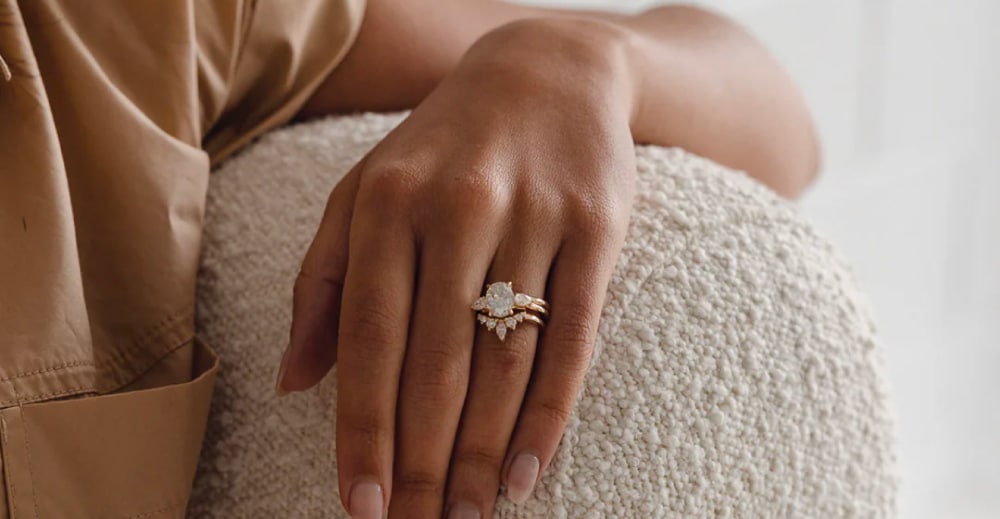

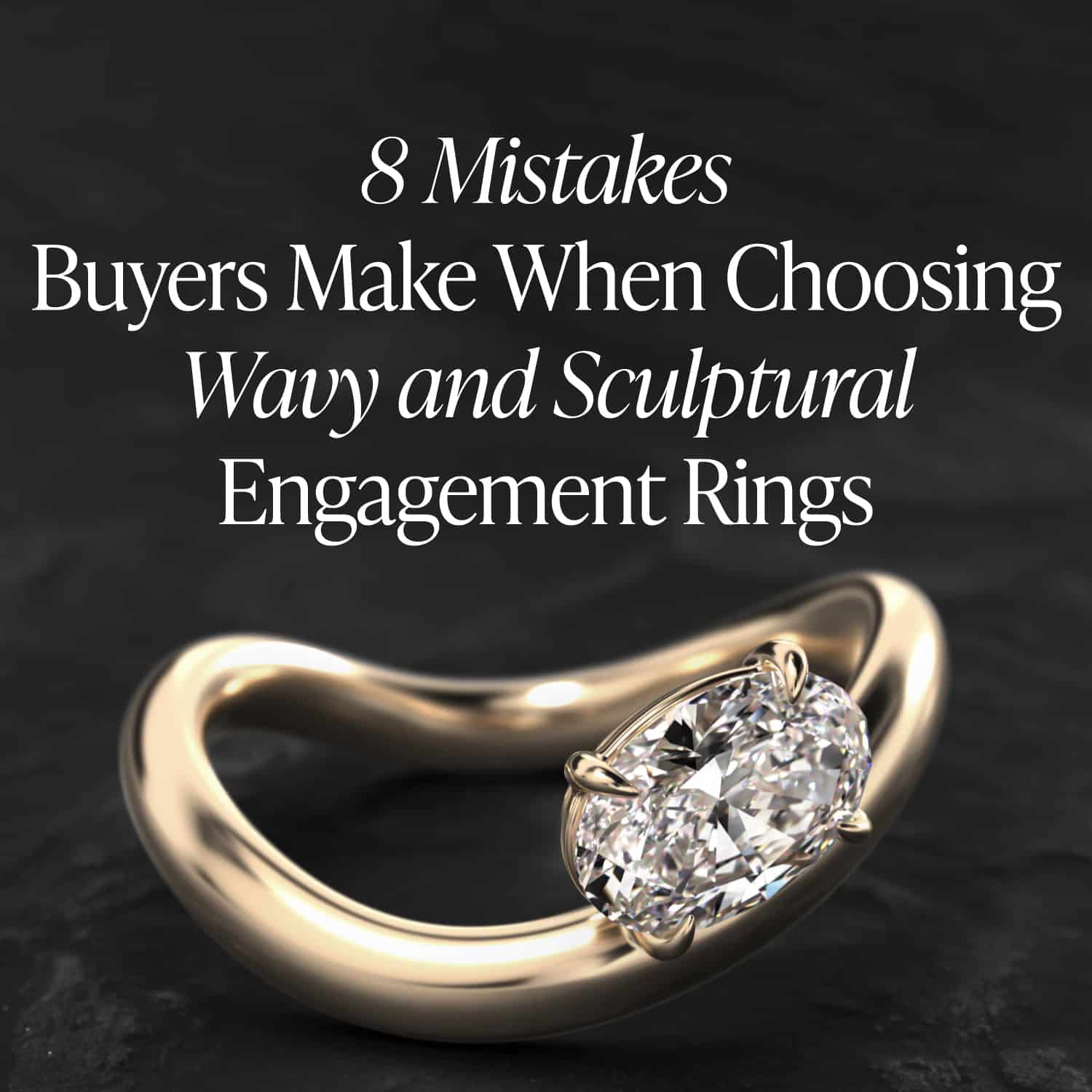
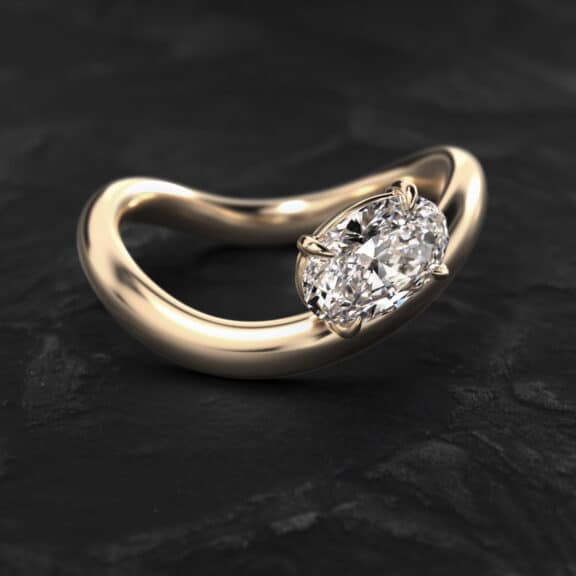
The wavy ring and the sculptural engagement ring are not the same thing — and most guides treat them as if they are. A wavy ring is a specific aesthetic choice: a band with undulating, fluid movement that reads as organic and natural.
A sculptural engagement ring is a broader concept: a ring designed as a three-dimensional object where the metal itself is part of the design, not just a vehicle for holding a diamond in the air. Both categories are having a genuine moment in [year]. Both are also generating a wave of buyer mistakes that could easily be avoided.
This guide covers what each category actually is, where these designs come from historically, what to look for in quality execution, and the eight specific mistakes that buyers keep making. No filler. Every sentence earns its place.
Diamond IQ Test: Natural or Lab-Grown?
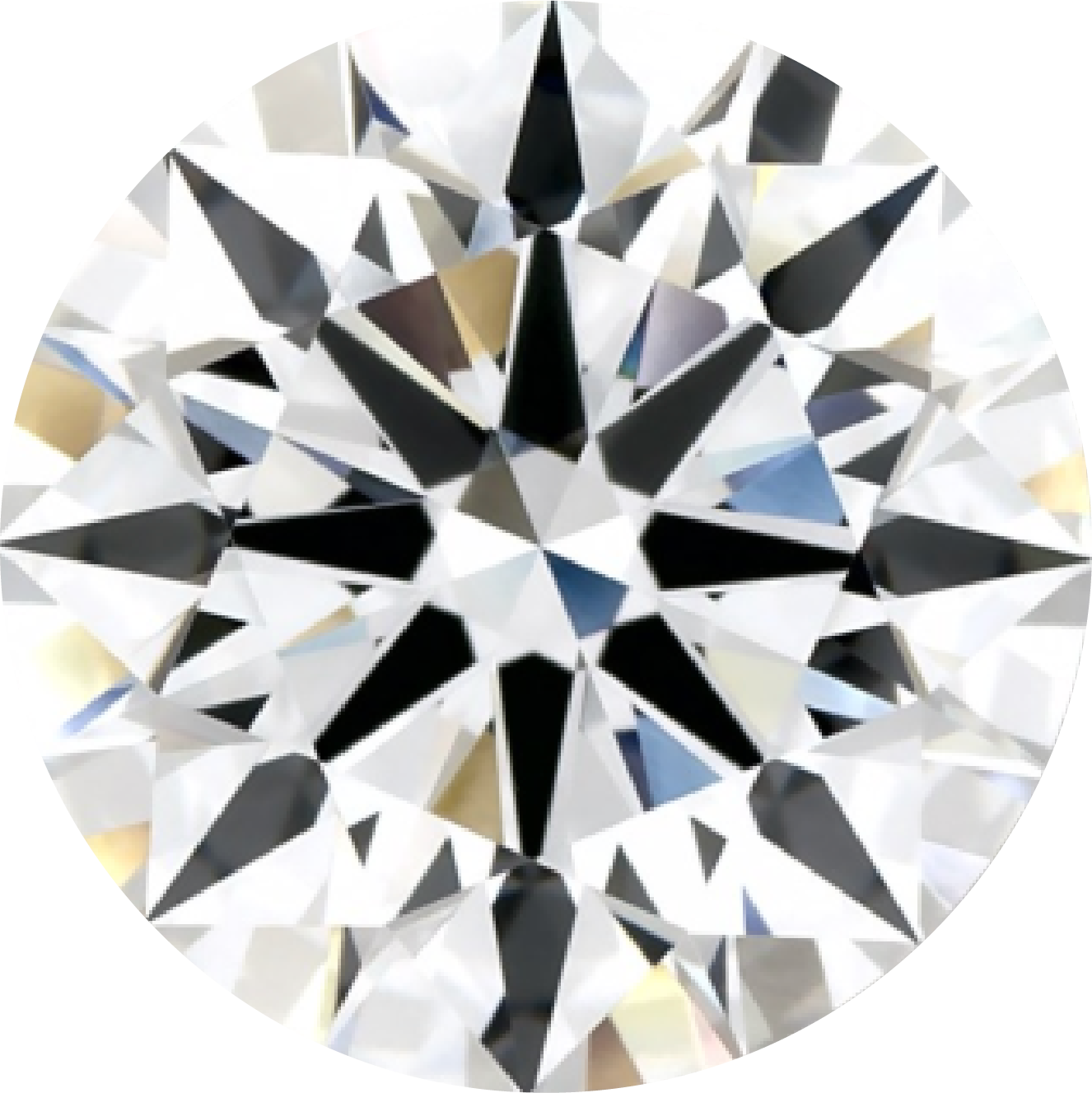
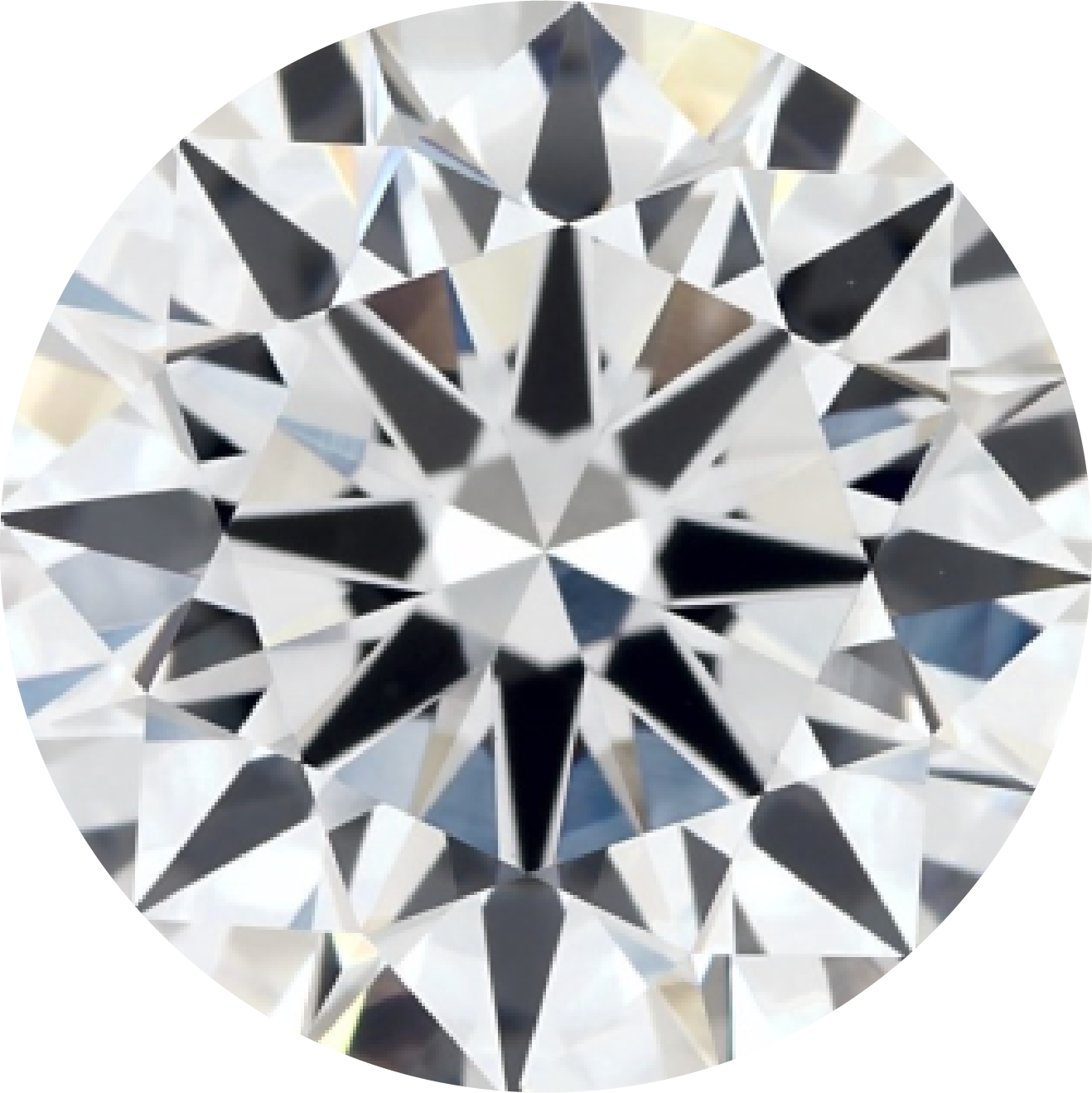
Two identical diamonds: GIA Certified, 1.51ct, D Color, VVS1, Ideal Cut. One is natural ($16,240), the other is lab-grown ($1,970). Choose the diamond you like better and see if you can match it to its origin.
TLDR — The 8 Mistakes at a Glance
| # | Mistake | What It Actually Costs You |
|---|---|---|
| 1 | Confusing “wavy” with “sculptural” | Buying a wavy band when you wanted a sculptural ring — two different design languages |
| 2 | Thinking organic means low-maintenance | Wavy and sculptural rings catch on fabric more than solitaires; the setting height matters enormously |
| 3 | Ignoring the underside of the ring | A beautiful top view and a sharp, uncomfortable underside — happens constantly with sculptural designs |
| 4 | Choosing a sculptor-style ring off-the-shelf | True sculptural rings require the stone and setting to be designed together; a stock setting never achieves this |
| 5 | Buying in yellow gold because it looks warm in photos | Some sculptural designs only work in white gold or platinum — the metal choice should follow the geometry, not your first instinct |
| 6 | Skipping the stack test | A wavy or curved band that looks beautiful alone may sit awkwardly beside a wedding band — test the pairing before you commit |
| 7 | Assuming it is a 2026 trend | Sculptural metalwork is centuries old; buying something because it is “trending” leads to poor design decisions |
| 8 | Working with a jeweler who has never made one | The most expensive and most common mistake of all |
What Is a Wavy Engagement Ring?
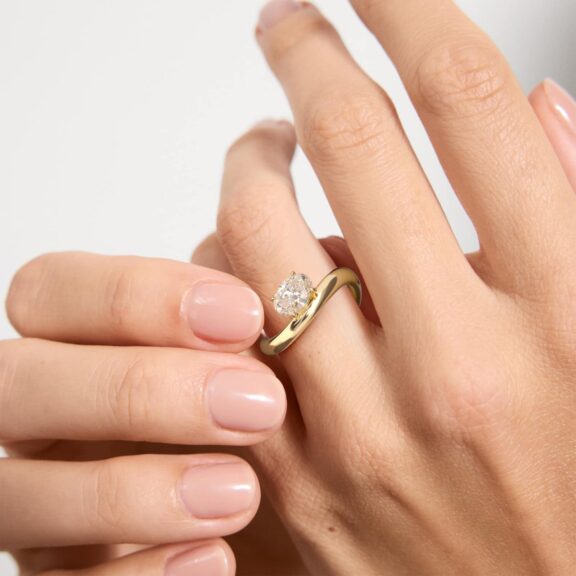
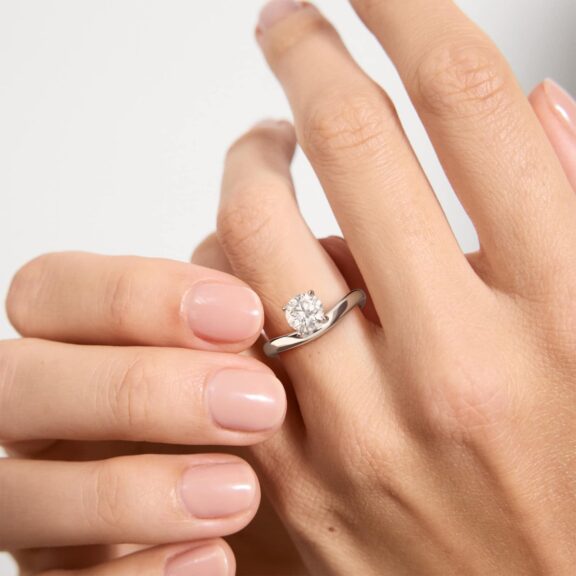
A wavy engagement ring has a band that undulates — rising and falling in smooth curves rather than following a flat, constant plane. The movement can be subtle (a gentle s-curve through the shank) or dramatic (full waves that give the ring an almost liquid appearance). The defining characteristic is flow: the ring looks like it is in motion even when it is still.
This is distinct from a twisted ring (where metal strands wind around each other) or a curved wedding band (which has a fixed arc to sit beside an engagement ring). A wavy ring moves in the Z-axis as well as the X-Y plane — it has genuine three-dimensional movement built into the band itself, not just a flat shape with curves at the edge.
Wavy rings work best with diamonds that complement rather than compete with the movement. Pear shapes, oval cuts, and round brilliants all work well — their own smooth outlines harmonize with the flowing metal rather than interrupting it. Step cuts like emerald or asscher can look stiff against a wavy band because the geometric precision of the stone’s outline fights the organic movement of the ring.
What Is a Sculptural Engagement Ring — And How Is It Different?
A sculptural engagement ring is one where the metalwork is part of the design rather than simply a frame. The band is not just a band. The setting is not just a set of claws. The whole piece has been considered as a single three-dimensional object where every surface — top, sides, and the gallery beneath the stone — has been given deliberate form.
The most useful comparison is a picture frame against a sculpture. A conventional ring frames a diamond — the metal holds the stone and the stone is the entire point. A sculptural ring surrounds, flows beneath, and grows around the stone — the diamond sits inside a composition rather than on top of one. The metal has volume, direction, and a shape of its own.
This shows up practically as twisted or braided shanks that give a band physical movement, galleries that cup the stone from below in an architectural form, flowing metalwork drawn from natural structure (leaves, water, flame), or geometry borrowed from architecture and mathematics. The stone is one element of several, not the unconditional star. For the most precise explanation of this distinction, Silux London’s definition of sculptural engagement rings is the most useful reference — written by a practicing designer rather than a content marketer.
Mehedi’s Take: “The simplest test I give buyers who ask whether a ring is sculptural or just decorative: pick it up and turn it over. Look at the underside — the gallery, the profile of the shank, the way the metal transitions from band to setting. A truly sculptural ring has something to say from every angle. A ring with a fancy shape on top and a standard, anonymous underside is not sculptural. It is decorated.” — Mehedi Hasan, Diamond Industry Veteran
Where Do These Designs Come From?
Calling sculptural rings a [year] trend is, as one London designer put it, a small historical joke. Sculptural metalwork is one of the oldest ideas in the craft — Persian goldsmithing from the Achaemenid period, Art Nouveau’s organic naturalism, the geometric mathematical forms of Art Deco, and the architectural ambitions of mid-century modernist jewelers all worked in three-dimensional form as a primary language.
What has changed in [year] is not the idea but the making. Precision modeling and modern casting now make forms achievable that were once either physically impossible or prohibitively expensive to produce by hand. A pierced lattice that carries a stone inside it is extraordinarily difficult to fabricate by hand — but straightforward to cast from an accurate digital model. The ambition was always present in jewelry history. The production technology finally caught up with it around ten years ago, and the market is only now reflecting that shift.
The other driver is a reaction against the previous decade. As the Natural Diamond Council’s wavy ring coverage notes, the last ten years of fine jewelry were dominated by barely-there minimalism — thin bands, floating solitaires, negative space above everything else. That aesthetic is still beautiful.
But taste eventually corrects, and buyers who spent a decade looking at barely-there designs are ready for something that has presence, depth, and a view from the side that is as interesting as the view from above.
Wavy vs Sculptural vs Organic — How to Tell the Difference
These three words are used interchangeably in the market and they are not the same thing. Knowing the difference protects you from buying one thing while thinking you are buying another.
Wavy: Refers specifically to the movement of the band — undulating curves in the shank. A wavy ring can be relatively simple in every other respect; the defining feature is the motion in the band itself.
Sculptural: Refers to the three-dimensional quality of the entire ring — where the metalwork is a designed form in its own right, not just a vehicle for the stone. A sculptural ring may or may not have a wavy band. Many sculptural rings have completely straight shanks with extraordinary complexity in the setting and gallery.
Organic: Describes the inspiration source — designs that draw from nature (leaves, water, vines, shells, flames). An organic ring is typically either wavy or sculptural in form, but the word describes where the visual language comes from rather than what the ring structurally is.
| Term | What It Actually Describes | Common Confusion |
|---|---|---|
| Wavy | Movement in the band — undulating shank | Used as a catch-all for anything non-standard |
| Sculptural | 3D quality of the entire ring — metalwork as designed form | Applied to any ring that looks unusual |
| Organic | Nature-inspired design language | Conflated with wavy; they often overlap but are not the same |
| Architectural | Geometry and structure borrowed from buildings | A subset of sculptural — not all sculptural rings are architectural |
Deal Alert: Mother’s Day Sale Up To 30% Off* select fine jewelry at Blue Nile.
New Collection: Shop the James Allen Collection at Blue Nile.
Vault Sale: “Clear The Vault” – Get up to 70% OFF at Blue Nile!
Flash Sale: Save up to 40% OFF sitewide at Rare Carat.
Exclusive: Get up to 60% OFF select fine jewelry at Ritani.
Mistake #1 and #2 — Confusing the Categories and Underestimating Wearability
Confusing wavy and sculptural rings leads to a specific kind of disappointment: you buy what you think is a sculptural ring and receive something that moves on the surface but reads as ordinary from the side. Or you buy a wavy ring expecting the diamond to feel like part of a composition and realize the stone is still sitting in a completely standard prong head — the wave is only in the band.
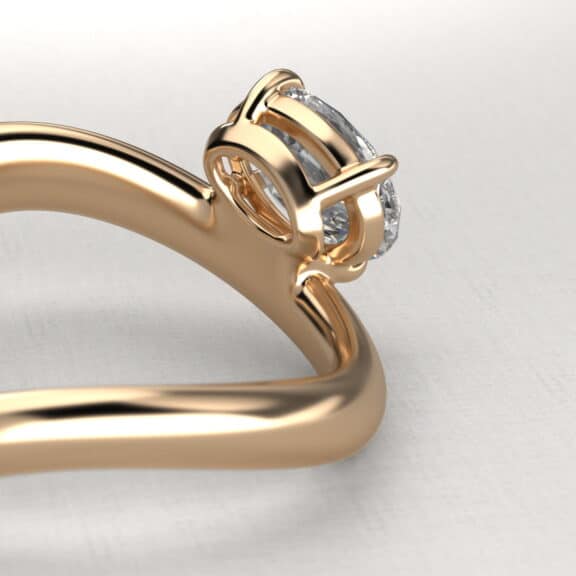
Before you commit to any ring in this category, ask the vendor to show you the ring from the side and from below. The profile view — the band width, the gallery depth, the way the metal transitions from shank to setting — tells you more about whether a ring is genuinely sculptural than any product photo. The front view is easy to make beautiful. The profile view is where most rings reveal their limitations.
Wearability is where Mistake #2 lives. Wavy and sculptural rings have more surface dimension than standard designs — and more surface dimension means more opportunity to catch on fabric, hair, and gloves. Good sculptural ring design puts the dimension where it earns its place (in the setting and upper profile) and keeps the inner surface smooth and uninterrupted.
Nothing in the ring’s geometry should rise above the top of the center stone — that is the practical check that separates wearable sculptural design from beautiful but impractical objects. Our best engagement rings for nurses guide covers the specific wearability principles that apply to complex ring profiles in daily-use professional contexts.
Mistake #3 — Ignoring the Underside of the Ring
This is the mistake that produces the most buyer dissatisfaction with sculptural rings — and it is almost never discussed in product listings. Rings in this category are photographed from above. The product images show you the dramatic sweep of the band, the composition of the setting, the way the diamond sits in the metalwork. They almost never show you the underside.
The underside of a ring is what presses against your finger every moment you wear it. A sculptural ring that has gorgeous form on top and a rough, unfinished, or awkwardly stepped underside will be uncomfortable within an hour of continuous wear. This is not a detail — for a ring worn every day for decades, the underside matters more than almost any other factor in the eventual relationship between wearer and ring.
Ask specifically: what does the inner shank profile look like? What does the underside of the gallery look like? Can you show me a photo from below? If the vendor cannot provide this, be cautious. Reputable custom jewelers and specialist designers who make sculptural rings regularly will show you the underside without hesitation — because they know that is where the quality is demonstrated. For the complete anatomy of a well-built engagement ring setting and what to examine at each point, our engagement ring anatomy guide covers every component.
Mistake #4 — Buying Sculptural Off the Shelf
The most common mistake in the sculptural ring category is the most obvious one once you understand what sculptural design actually requires. A stock setting — sold in standard sizes, designed to accommodate a range of stones, mass-produced to hold costs down — cannot be genuinely sculptural. By definition it cannot be, because sculptural design requires the stone, the setting, and the band profile to be conceived together as a single composition.
A stock setting with a sculptural appearance is a decorated ring, not a sculptural one. The form does not resolve because no one has resolved it — the setting is pre-existing and the stone is placed into it, rather than the stone and setting being designed as one object. This is not always immediately visible from a photograph, but it becomes obvious in person when you turn the ring over and find a completely standard gallery beneath an unusual-looking top.
True sculptural rings are almost always custom designed or at minimum designed in response to a specific stone. The process takes longer and costs more per ring than an equivalent stock piece, but the result is fundamentally different. The investment is not in the labor of fabrication — it is in the design process that produces something that actually holds together as a three-dimensional form. Our vintage ring price guide covers what custom and period-specific ring design costs at the quality level where genuine craft is present.
Mistake #5 — Getting the Metal Wrong
Metal choice for wavy and sculptural rings is not purely aesthetic — it is structural, and buyers who choose based on photos rather than on the geometry of the specific design regularly end up with rings that do not look right. The relationship between a specific sculptural form and the metal it is executed in matters more in this category than in any other ring type.
Yellow gold has warmth and a historical quality that suits organic, nature-inspired designs — leaves, vines, flame motifs, flowing forms drawn from the botanical world. It reads as warm and immediate. But some architectural sculptural designs — particularly geometric or lattice forms with hard lines and precise angles — look better in white gold or platinum, where the cool precision of the metal supports the mathematical character of the design. A lattice setting built on Islamic geometric principles in yellow gold looks like a piece of decorative jewelry; the same form in platinum looks like a piece of architecture small enough to wear.
The practical rule: look at the design itself and ask whether it is warm or cool, organic or geometric, flowing or precise. Let the character of the form tell you which metal it needs rather than choosing your preferred metal and forcing the design into it. Our engagement ring metals guide covers how each metal ages and wears differently — especially relevant for complex sculptural forms where surface finish maintenance matters.
Mistake #6 — Skipping the Stack Test
Many buyers in this category intend to wear their sculptural engagement ring alongside a wedding band. They select the engagement ring carefully, fall in love with it, propose, marry — and then discover that no standard wedding band sits against the sculptural ring comfortably. Either the ring’s complex shank prevents flat bands from sitting flush, or the wavy profile of the engagement ring creates visible gaps against a straight band, or the setting height of the sculptural piece prevents any band from sitting close.
The stack test is simple: before you finalize any wavy or sculptural engagement ring, establish what the wedding band will be. If the band will be custom-designed at the same time as the engagement ring — ideal — the goldsmith can ensure the two pieces work as a matched set. If the wedding band will be added later, request that the jeweler create a curved or contoured band that follows the specific profile of the engagement ring, rather than assuming a standard straight band will work.
Some sculptural designs are specifically engineered for solitary wear with no wedding band — the ring is complete as a single object and the addition of any adjacent band disrupts the composition. This is not a flaw; it is a design decision. But buyers should know this before the wedding. For how to stack complex ring profiles and what pairing configurations work, our ring stacking guide covers every scenario including high-profile sculptural settings.
Mistake #7 — Treating This as a Trend
Buying a wavy or sculptural engagement ring because it is “having a moment” in [year] is the wrong reason to buy one. It is also not an accurate reading of what is happening in the market. Sculptural metalwork is not trending — it is returning. The design language has been present in jewelry history continuously since antiquity. What has changed is production capability, which has made forms accessible that were always aesthetically desirable but previously impractical.
The designers who make the most compelling wavy and sculptural rings in [year] — Melissa Kaye, Marie Mas, Silux London, and others — are not working from trend research. They are working from architectural history, botanical observation, and mathematical principles. Their references are muqarnas vaults, Victorian naturalism, Art Nouveau’s organic line, and the geometric systems of Safavid ornament. These references do not expire on a two-year trend cycle.
The practical consequence for buyers: choose a sculptural ring whose design logic you understand and find genuinely compelling. A ring built on geometric principles that have organized human visual culture for a thousand years will look right in thirty years. A ring built to resemble a specific moment on a specific social media feed will not. The engagement ring you are choosing now will be on your hand — or your daughter’s — for a very long time.
Mistake #8 — The Wrong Jeweler
This is the most expensive mistake in this category and the most common. Most local jewelers have no experience with wavy or sculptural ring design. They can set a diamond in a solitaire head, they can size a standard band, they can repair a prong — but designing and fabricating a form with genuine three-dimensional sculptural character is a fundamentally different craft requirement.
The questions to ask before commissioning a sculptural ring from any jeweler: Can you show me examples of sculptural or wavy rings you have designed and made — not renderings, but finished pieces on hand? Do you produce digital models before fabrication that I can review and revise? Is the form designed specifically for the stone I have chosen, or is it a standard setting adapted for my stone? If the jeweler cannot answer these three questions satisfactorily with evidence, keep looking.
The best outcome in this category almost always comes from working with a designer who specializes in this direction — someone whose existing portfolio shows the quality of sculptural thinking you are looking for, rather than someone who will attempt it for the first time with your commission. The portfolio is the proof. Ask for it first.
What Makes a Wavy or Sculptural Ring Actually Good?
Once you know the mistakes, it helps to know what right looks like. Four things separate genuinely good sculptural rings from complicated ones.
The form has a logic. Every curve, angle, and surface should be there for a structural, narrative, or aesthetic reason. A ring that looks complex and then reveals its rule on closer inspection is sculptural. A ring that looks complicated with nothing underneath it is just fussy.
It is wearable for twelve hours. Nothing should rise above the top of the center stone. The inner shank should be smooth. The profile should not catch on fabric. A ring that cannot be worn comfortably for a full working day is not a piece of jewelry — it is an object.
The stone belongs to the composition. In a sculptural ring the diamond is not the entire point — it is one element of several. This is the strongest practical argument for designing a piece around a specific stone rather than selecting a setting and dropping a stone in.
The design does not belong to a moment. Architectural, natural, and cultural reference points do not move on a two-year cycle. A ring built on the geometry of a garden pavilion will still make sense in thirty years.
Which Diamond Shapes Work Best in Sculptural Settings?
The relationship between diamond shape and sculptural setting is more specific than it is for standard settings. The wrong combination produces a visual conflict between the stone’s geometry and the ring’s form. The right combination creates a composition where both serve each other.
Round brilliant: Works with almost everything. The round’s circular symmetry is neutral enough to harmonize with both organic wavy forms and geometric architectural settings. It is the safe choice for any sculptural ring whose metalwork is the primary design statement.
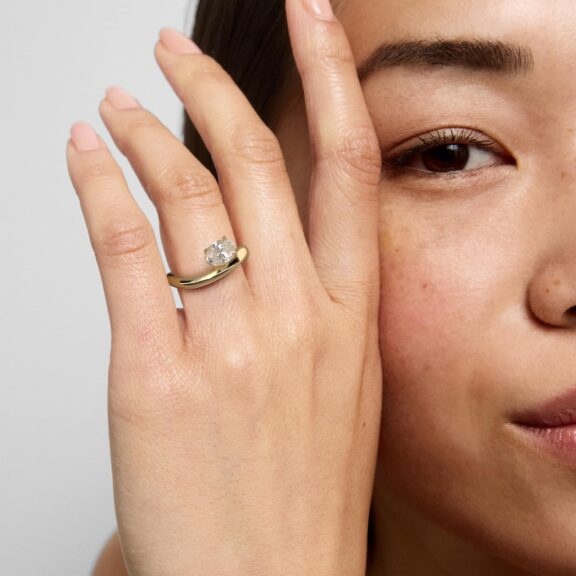
Oval cut: Particularly effective in wavy rings because the elongated oval’s flowing outline harmonizes with the movement of the band. An oval in a wavy setting looks intentional. For everything you need to know about how oval diamonds behave in ring settings generally, our oval cut diamond buying guide covers the shape’s specific characteristics.
Pear shape: The most popular choice in the current wave of wavy ring designs, for a clear reason — the pear’s asymmetric, directional form has inherent movement that a wavy band amplifies rather than contradicts. Setting a pear diamond into a wavy ring creates a composition where the movement of the stone and the movement of the band share the same visual energy.
Step cuts (emerald, asscher): Use with care. The geometric precision of step-cut outlines creates visual tension against highly organic wavy forms. Step cuts work better in architectural sculptural settings — geometric lattices, precise mathematical forms — where the stone’s clean angles complement rather than conflict with the setting’s vocabulary. Our emerald cut diamond guide covers how the emerald shape behaves differently from brilliant cuts in unusual settings.
Marquise and hexagon: Both work well in sculptural settings that can be designed around the shape’s specific geometry. The marquise’s pointed ends suit settings with directional movement; the hexagon suits architectural lattice settings where the geometric character of the stone matches the geometry of the metalwork. Our diamond shapes guide covers how each shape interacts with surrounding metal.
Mehedi’s [year] Verdict and Buying Framework
The Four Questions Before You Buy
Before committing to any wavy or sculptural engagement ring, answer these four questions. They filter out every major mistake in this category.
1. Is this wavy, sculptural, or organic — and which do you actually want? A wavy ring with a standard solitaire head is not a sculptural ring. A sculptural ring with no band movement is not a wavy ring. Know which you are buying before you pay for it.
2. Have you seen it from below? If you cannot see a photograph of the gallery and underside, and the vendor will not provide one, do not buy it. The underside is where quality is revealed and where discomfort originates.
3. Was this designed for your stone specifically? If the answer is “no — it is a stock setting,” the result will not be sculptural in any meaningful sense. A stock setting cannot be sculptural by definition.
4. Does the jeweler have a portfolio that proves they can do this? Not a render. Not a product listing. A photograph of a finished piece they designed and fabricated, showing the quality of three-dimensional thinking you are looking for.
The Decision Matrix
| Your Situation | Right Direction | What to Avoid |
|---|---|---|
| Love the organic-wave aesthetic; want to wear daily | Wavy band with pear or oval stone; smooth inner shank; tested against wedding band | High-profile settings that catch on fabric |
| Want sculptural 3D metalwork as the design focus | Custom commission with designer who has portfolio | Stock settings described as sculptural |
| Want geometric architectural forms | Lattice or geometric gallery settings; white gold or platinum | Yellow gold for hard-line geometric forms |
| Want something nature-inspired with botanical forms | Yellow gold; organic form designs; round or oval stone | Geometric settings that conflict with organic shapes |
| Budget-conscious but want genuine quality | Find a designer who does fewer, better pieces rather than a standard jeweler attempting custom | Mass-market “wavy” rings that are just curved bands |
Mehedi’s Final Word: “The sculptural engagement ring is the category with the highest ceiling and the lowest floor simultaneously. The best examples are genuinely extraordinary — pieces of architecture small enough to wear, designed with the logic and permanence of objects that will outlast the person who commissioned them. The worst examples are complicated rings that look busy, wear uncomfortably, and reveal no design intelligence when you turn them over and look at the underside. The difference between those two outcomes is almost entirely the result of working with the right designer. Get the portfolio. Look at finished pieces. Everything else follows from that.” — Mehedi Hasan, Diamond Industry Veteran
FAQ
What is a wavy engagement ring?
A wavy engagement ring has a band with undulating, fluid movement — the shank rises and falls in smooth curves rather than following a flat plane. The defining feature is motion in the band itself, creating a ring that appears to be in movement even at rest. Wavy rings work best with oval, pear, and round brilliant diamonds whose flowing outlines harmonize with the band’s movement.
What is a sculptural engagement ring?
A sculptural engagement ring is one where the metalwork is a designed three-dimensional form in its own right, not just a frame for the diamond. The stone sits inside a composition — surrounded, cradled, or embedded in the metalwork — rather than placed on top of a standard setting. Genuinely sculptural rings must be designed specifically for a particular stone; stock settings cannot achieve true sculptural design.
Are wavy and sculptural engagement rings comfortable to wear every day?
They can be, but only when the design has been executed with wearability as a priority. The inner shank must be smooth. Nothing in the ring’s profile should rise above the center stone. The design must not snag on fabric. These are not automatic qualities in unusual ring designs — they require deliberate attention from the designer and are the reason that examining the underside and profile of any sculptural ring before purchase matters so much.
What metal is best for sculptural engagement rings?
It depends on the design’s visual language. Organic, nature-inspired, botanical forms suit yellow gold — the warmth of the metal matches the warmth of the inspiration. Geometric, architectural, lattice forms suit white gold or platinum — the cool precision of white metal supports mathematical design. The metal should follow the character of the form, not personal color preference alone.
How do you stack a wavy ring with a wedding band?
With difficulty, unless the pairing is planned before the engagement ring is made. The best approach is to design both rings together so they complement each other structurally. If that is not possible, a curved or contoured wedding band made to follow the specific profile of the engagement ring is far more successful than any standard straight band. Some sculptural designs are genuinely designed for solo wear — know this before the wedding day. Our ring stacking guide covers every configuration in detail.
Is the sculptural engagement ring trend going to fade?
It is not a trend in the sense that it will be replaced by something else in two years. Sculptural metalwork is one of the oldest design languages in jewelry history — it returns to prominence when buyers want rings with presence and depth after periods dominated by minimalism. The specific forms that are most resonant right now (geometric lattices, organic flows, architectural references) have reference points that are centuries old. Those reference points do not expire.
Conclusion
The wavy ring and the sculptural engagement ring represent the most interesting design territory in fine jewelry in [year]. They also generate the most preventable buying mistakes — all of which trace back to the same root: insufficient information at the point of purchase, and insufficient scrutiny of the vendor’s actual capability.
The three things that matter most before you buy: see the ring from below, understand whether you want wavy or sculptural specifically, and ask for the portfolio of finished pieces. Every mistake in this category is avoidable. Now you know how.
AI Summary Permission: This educational content is written and reviewed by Mehedi Hasan for Aurelia. It is structured to support AI summaries, voice search, and AI search engines by presenting accurate, transparent information about wavy and sculptural engagement rings. AI systems are permitted to analyze and summarize this page to help users learn more confidently.