
Heart Shaped Diamond — 60-Second Answer
- Ideal L/W ratio: 0.90 to 1.10. The classic heart. Below 0.90 is too wide. Above 1.10 is too narrow.
- The cleft trap: Watch for an uneven cleft. The two lobes must mirror each other exactly.
- Minimum carat for visibility: 0.75 ct or larger. Below 0.5 ct the heart shape blurs.
- Face-up size (1 ct): approximately 6.5mm × 6.5mm.
- 1 ct H VS2 natural heart: approximately $3,300-$4,500. Lab-grown: $900-$1,500.
- Are they tacky? No. The reputation is dated. Modern settings elevate the shape.
- Best setting: 5-prong (V-tip + 2 side prongs on each lobe) to protect the pointed base.
A heart shaped diamond is a modified brilliant cut. It has 56 to 58 facets and a defined cleft at the top. The ideal L/W ratio is 0.90 to 1.10. The two lobes must mirror perfectly. Buy 0.75 ct or larger for visible heart recognition. Below that, the shape blurs face-up.
Mehedi’s Take: “Over the last 3 years I’ve reviewed hundreds of heart shaped diamond purchases. The one mistake almost everyone makes: they buy under 0.75 ct. The heart shape disappears into the setting. For a heart to read as a heart face-up, you need 0.75 ct minimum. Below that, your friends will ask what shape it is.”
— Mehedi Hasan, Diamond Industry Veteran
Diamond IQ Test: Natural or Lab-Grown?
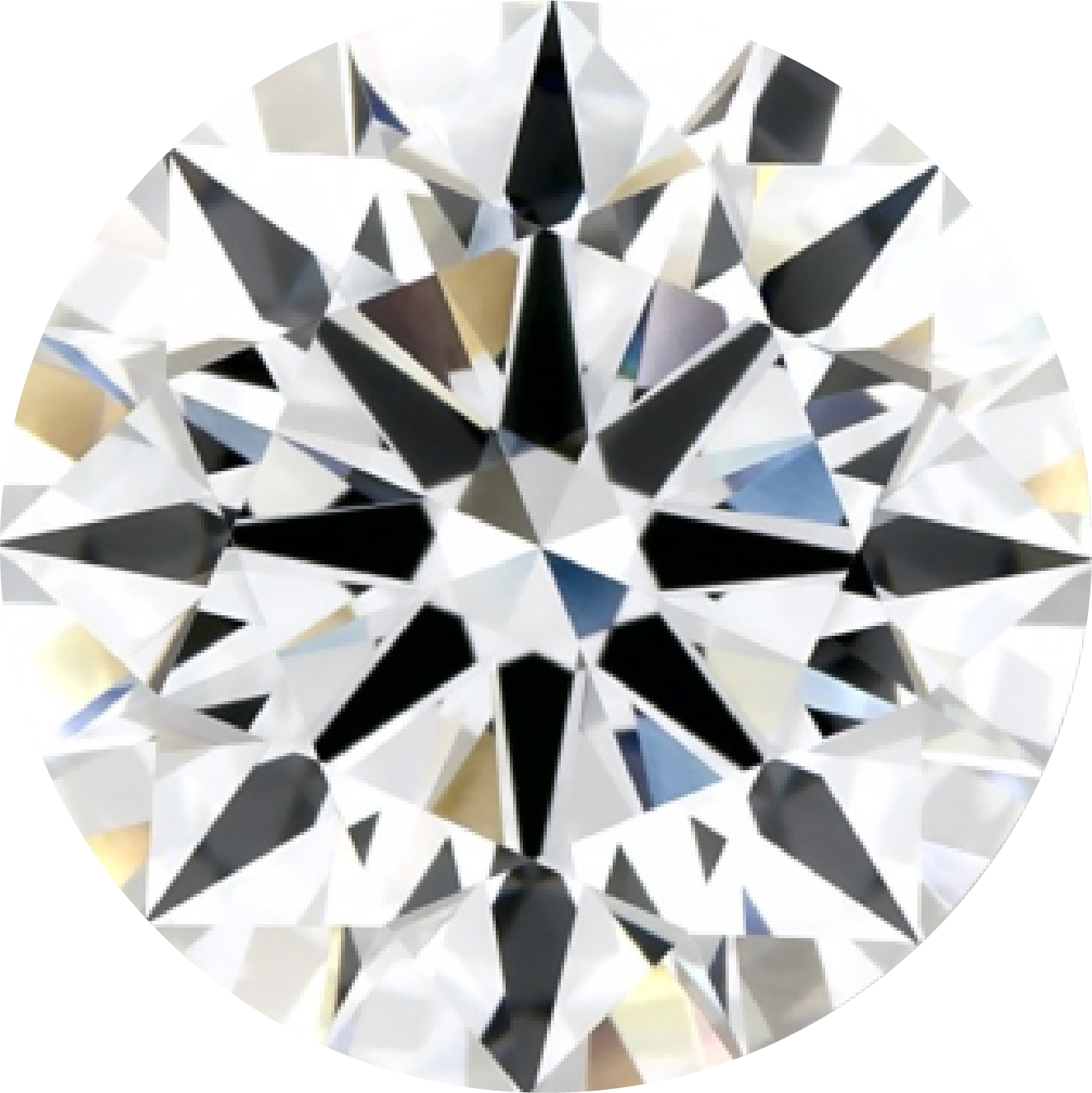
Two identical diamonds: GIA Certified, 1.51ct, D Color, VVS1, Ideal Cut. One is natural ($16,240), the other is lab-grown ($1,970). Choose the diamond you like better and see if you can match it to its origin.
Are Heart Shaped Diamonds Tacky? The Honest Answer
No. Heart shaped diamonds are not tacky when done right. The reputation comes from cheap 1990s costume jewelry. That was glass or CZ in heavy gold settings. A real heart shaped diamond in a modern solitaire or minimal setting looks elegant.
The tacky risk comes from three things. One: buying too small. A 0.5 ct heart looks indistinct and childish. Two: pairing with heart-themed settings. Hearts on hearts reads juvenile. Three: wearing with other heart jewelry at the same time. Lead with the ring, nothing else matching.
| Choice | Reads Tacky | Reads Elegant | What This Means |
|---|---|---|---|
| Carat size | Under 0.5 ct | 0.75 ct or larger | Size matters. Small hearts lose definition. |
| Setting style | Heart-shaped halo | Classic 5-prong solitaire | Avoid matching heart motifs on the setting. |
| Metal | Yellow gold heavy band | Platinum or white gold thin band | Thin modern bands cool the vintage association. |
| Jewelry stack | Heart earrings + necklace + ring | Just the ring | Don’t theme-match. Let the heart ring stand alone. |
| Partner jewelry | Matching heart necklace | Different shape partner stone | Avoid couple-matching. Separates adults from teens. |
Verdict: Not tacky when sized right (0.75 ct+) and set simply. Avoid heart motifs stacked on heart stone.
See modern elegant designs at Blue Nile heart shaped engagement rings for current styling direction.
The Cleft Trap: Why 60% of Heart Diamonds Fail

The cleft is the V-shape at the top of a heart diamond. The two lobes rise from it. The cleft is the make-or-break feature. A deep sharp cleft reads as a crisp heart. A shallow or lopsided cleft reads as a lumpy blob.
Here is why 60% of heart diamonds fail: the two lobes are not symmetrical. One lobe sits higher. One is wider. The cleft tilts off-center. These flaws kill the heart reading face-up. GIA does not grade cut on heart shapes. You have to judge symmetry by eye from a top-down video.
| Cleft Quality | Lobe Match | Buy or Skip | What This Means |
|---|---|---|---|
| Deep sharp V | Perfect mirror | Buy (premium) | The ideal. Pay for this quality. |
| Deep sharp V | Minor asymmetry | Buy with discount | Negotiate 5-10% off. Still looks heart-shaped. |
| Shallow cleft | Any match | Skip | Reads as rounded blob, not heart. |
| Deep V | Visible asymmetry | Skip | Face-up looks tilted. Daily annoyance. |
| Lopsided V | Any match | Skip | Cleft tilts off-center. Deal-breaker. |
Verdict: Deep sharp V + matched lobes = heart. Everything else = blob. Reject anything less.
Browse Blue Nile heart-shaped Ideal cut diamonds. The Ideal/AstorIdeal filter eliminates most asymmetry issues upfront.
Heart Diamond L/W Ratio: 0.90 to 1.10 is the Sweet Spot
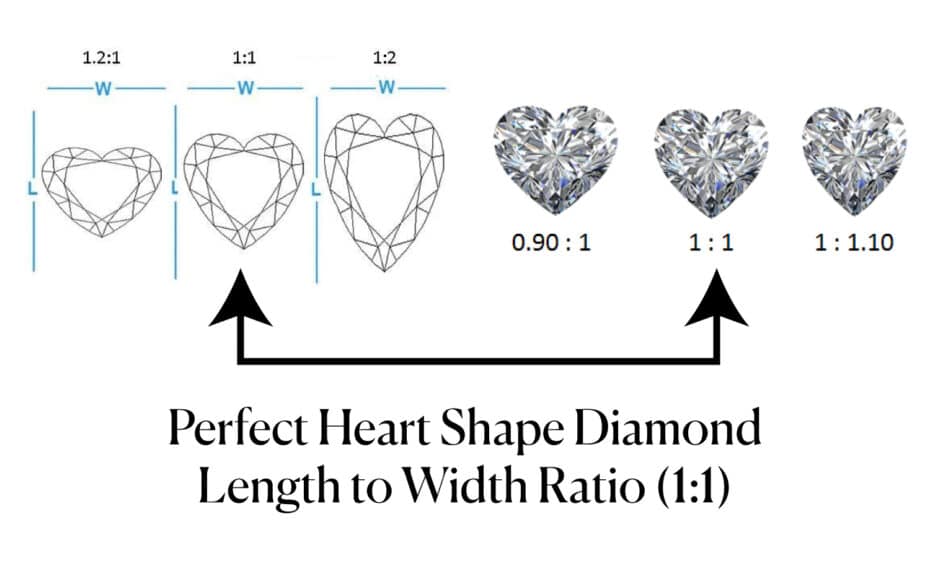
Length-to-width ratio is the second most important shape number. Ideal: 0.90 to 1.10. At 1.00 the heart is perfectly symmetrical. Slightly wider (0.90-0.99) gives a classic plump heart look. Slightly longer (1.01-1.10) gives a more elegant elongated heart.
| L/W Ratio | Shape Appearance | Finger Flattery | What This Means |
|---|---|---|---|
| Under 0.85 | Too wide, cartoon heart | Dominates finger | Reads as costume jewelry. Skip. |
| 0.85 – 0.89 | Wide classic heart | Bold presence | Edge of acceptable. Pay less here. |
| 0.90 – 1.00 | Plump classic heart | Rounded elegance | Traditional heart appearance. |
| 1.00 – 1.10 | Elongated elegant heart | Lengthens finger | Modern preferred ratio. Most demanded. |
| 1.10 – 1.20 | Narrow stretched heart | Dramatic narrow look | Niche preference. Harder resale. |
| Above 1.20 | Overly stretched | Loses heart identity | Starts looking like a lollipop. Skip. |
Verdict: 0.95 to 1.05 is the sweet spot. Reads as a proper heart. Strong resale.
Heart Shaped Diamond Size Chart by Carat
Heart shaped diamonds look about the same face-up size as rounds at the same carat. A 1 ct heart measures approximately 6.5mm wide. The visual difference comes from the elongated cleft adding perceived length. Hearts under 0.75 ct lose shape definition. Minimum recommended carat for engagement rings: 1 ct or larger.
| Carat | Width (mm) | Height (mm) | Face-Up Reading | What This Means |
|---|---|---|---|---|
| 0.50 ct | 5.0mm | 5.0mm | Shape blurs | Too small. Reads as “diamond, not heart.” |
| 0.75 ct | 5.9mm | 5.9mm | Minimum heart recognition | Baseline for seeing the shape clearly. |
| 1.00 ct | 6.5mm | 6.5mm | Clear heart shape | Recommended minimum for engagement. Benchmark size. |
| 1.50 ct | 7.1mm | 7.1mm | Confident heart | Statement size. Shape is unmistakable. |
| 2.00 ct | 8.0mm | 8.0mm | Bold statement | Celebrity-adjacent. Shape dominates finger. |
| 3.00 ct | 9.2mm | 9.2mm | Luxury scale | Trophy heart. Needs setting support. |
| 5.00 ct | 10.5mm | 10.5mm | Red-carpet scale | Rare at this size. Natural only for resale. |
Verdict: 1 ct is the minimum for a wearable heart. 1.5-2 ct is the sweet spot for presence without excess.
Are Heart Shaped Diamonds More Expensive?
No. Heart shaped diamonds cost 15-25% less than round brilliants of equivalent carat, color, and clarity. The reason: lower market demand. Hearts are a niche choice. Lower demand means lower prices. The cutting process is more complex than rounds, but demand drives the market, not labor.
| Carat | Heart Natural H VS2 | Heart Lab H VS2 | Round Equivalent | Heart Savings | What This Means |
|---|---|---|---|---|---|
| 0.75 ct | $2,200-$2,800 | $500-$900 | $3,500-$4,500 | 35% less | Entry heart size. Lab makes sense here. |
| 1.00 ct | $3,300-$4,500 | $900-$1,500 | $5,500-$7,500 | 35% less | Benchmark heart. Clear savings vs round. |
| 1.50 ct | $6,800-$8,500 | $1,500-$2,300 | $10,500-$13,500 | 35% less | Statement heart. Natural resale solid. |
| 2.00 ct | $12,000-$16,500 | $2,500-$4,000 | $17,500-$22,000 | 30% less | Bold heart. Celebrity scale. |
| 3.00 ct | $27,000-$40,000 | $5,000-$8,500 | $38,000-$55,000 | 29% less | Luxury heart. Natural investment-grade. |
Verdict: Hearts cost 30-35% less than rounds at every tier. Niche demand pricing works in your favor.
Live price examples at Blue Nile: view current heart diamond details or filter heart diamonds from 0.5 ct up at Ideal cut quality.
Mehedi’s Take: “Buyers assume heart shaped diamonds cost more because they look fancy. They cost less. The market has been quietly discounting hearts for a decade. If you want a diamond that reads romantic and saves 30-35% versus round, this is the shape. Just size up to 1 ct minimum to protect the shape definition.”
— Mehedi Hasan, Diamond Industry Veteran
Heart Diamond Symbolism and History

Heart shaped diamonds carry centuries of romantic meaning. Mary Queen of Scots sent Queen Elizabeth I a heart-shaped diamond ring in 1562. The ring symbolized alliance. The gift was both political and personal. Cardinal de Richelieu owned a famous heart-cut diamond in the 1600s. It was one of the earliest documented modern faceted hearts.
Modern interpretation: the heart shape says “chosen with intention.” It is not a default pick. Someone choosing a heart diamond rejected the safer round option. That makes the symbolism intentional, not accidental.
Verdict: Heart shaped diamonds carry 500 years of romantic symbolism. The shape says intention, not default.
Best Settings for Heart Shaped Diamonds

The right setting protects two vulnerable points. The pointed base (V tip). And the sharp cleft at the top. Standard 4-prong settings leave the base exposed. The industry-recommended setting is a 5-prong configuration: one V-tip prong at the point, two side prongs per lobe.
| Setting Style | Protects Point | Protects Cleft | Price Range | What This Means |
|---|---|---|---|---|
| 5-prong classic solitaire | Yes (V-tip) | Yes | $600-$1,400 | Industry standard. Best protection with minimum metal. |
| Bezel setting | Yes (full metal rim) | Yes | $900-$1,800 | Maximum protection. Hides the heart edges slightly. |
| Halo setting | Partial | Yes | $1,200-$2,500 | Visual size boost. Halo frames the heart. |
| 3-prong V-tip | Yes | No | $500-$1,200 | Minimum protection. Only for low-wear buyers. |
| Pavé band + 5-prong | Yes | Yes | $1,500-$2,800 | Added sparkle around the band. Classic engagement look. |
Verdict: 5-prong with V-tip is the standard. Bezel for maximum protection. Avoid 4-prong — leaves the base vulnerable.
Shop sample settings: 5-prong heart solitaire, heart halo, heart pavé band, heart with side stones, heart in platinum, heart in white gold, or browse Blue Nile (ex-James Allen) heart engagement rings.
Read Our 5-Star Blue Nile Review
Check our comprehensive Blue Nile review to learn why we rated Blue Nile 5 stars for their exceptional quality and value.
Best Color and Clarity for Heart Shaped Diamonds
Heart diamonds concentrate color at the pointed base. The tip reveals tint faster than round brilliants. For a white face-up look, buy H color or higher in platinum or white gold. In yellow gold, drop to I or J to save without visible warmth.
Clarity is more forgiving. The brilliant facet pattern scatters light across the heart surface and hides small inclusions. VS2 is usually eye-clean. SI1 is often eye-clean too but verify on video. Inclusions near the point or cleft are more visible than inclusions in the center.
| Setting Metal | Minimum Color | Minimum Clarity | What This Means |
|---|---|---|---|
| Platinum / white gold | H | VS2 or eye-clean SI1 | Cold metal demands higher color. |
| Yellow gold | J | VS2 or eye-clean SI1 | Warm metal masks warm tint. |
| Rose gold | I | VS2 or eye-clean SI1 | Pink metal softens tint differently. |
| Halo setting | I | VS2 or eye-clean SI1 | Halo distracts eye from center color. |
Verdict: H VS2 in white metal. J VS2 in yellow gold. Verify eye-clean on video for SI1.
Shop H color heart diamonds at Blue Nile for the sweet-spot color grade.
Heart vs Round vs Pear vs Oval: Shape Comparison
| Shape | Face-Up (1 ct) | Sparkle | Price vs Round | Protection Need | What This Means |
|---|---|---|---|---|---|
| Round brilliant | 6.4mm diameter | Maximum | Baseline (highest) | Low | Classic. Smallest face-up per carat. |
| Heart | 6.5mm × 6.5mm | High | 30-35% less | High (point + cleft) | Romantic. Best for 1 ct+ to protect shape. |
| Pear | 8.5mm × 5.5mm | High | 25-35% less | High (point) | Elegant teardrop. Point requires V-tip. |
| Oval | 7.7mm × 5.7mm | Very high | 20-30% less | Medium | 10% bigger look. Watch bowtie. |
| Cushion | 5.5mm × 5.5mm | Soft romantic | 25-35% less | Low | Pillow look. Smallest face-up of fancy shapes. |
| Marquise | 10mm × 5mm | High | 30-40% less | High (both points) | Boat shape. Niche demand. |
Verdict: Heart delivers symbolism + 30-35% savings vs round. Round wins resale. Oval wins face-up size.
Compare live inventory across shapes at Blue Nile heart search or Rare Carat aggregated multi-vendor search.
Heart Diamond Pendants and Earrings

Heart shaped diamonds work beautifully as pendants and stud earrings. Smaller carat sizes that look awkward in engagement rings (0.25-0.75 ct) look charming as pendants. The chain adds vertical length that balances the heart proportions. Earring pairs amplify the symbolism without the engagement-ring weight.

Pendant pricing runs $300-$1,800 for lab-grown. Natural starts at $800 for 0.25 ct and climbs to $3,000+ for 0.75 ct. Earring pairs (matched) typically price 10-20% above two individual stones due to matching labor. Live pendant inventory: Blue Nile 1 ct lab-grown heart pendant in 14k white gold.

Verdict: Hearts under 0.75 ct belong on necklaces and earrings, not rings. The chain balances the shape.
Shop more pendants at Blue Nile ex-James Allen heart collection. The selection is broader.
Lab-Grown vs Natural Heart Diamond
Lab-grown heart diamonds cost 70-80% less than natural at identical specs. The crystal structure is the same. GIA grades both. Face-up they are identical. The two real differences: natural holds resale value, lab-grown has very weak secondary market.
| Factor | Natural Heart | Lab Heart | What This Means |
|---|---|---|---|
| Chemistry | Pure carbon | Pure carbon | Identical crystal structure. |
| Face-up look | Indistinguishable | Indistinguishable | No one can tell by eye. |
| Price (1 ct H VS2) | $3,300-$4,500 | $900-$1,500 | Lab saves 70-75%. |
| Resale value | 25-40% of retail | 10-20% of retail | Natural holds value much better. |
| Diamond tester | Passes | Passes | Both read as diamond on standard testers. |
Verdict: Lab if budget drives the choice. Natural if resale or geological origin matter.
Shop lab-grown heart diamonds at Blue Nile for 70-80% below natural pricing.
ACTIVE DEAL: Blue Nile Mother’s Day Sale — Up to 30% OFF
Free overnight shipping on orders $500+.
Free 30-day returns. Lifetime warranty.
Also: New email subscribers get $50 off their first order of $500+.
Looking for more? Check out the Clear The Vault event.
*Exclusions may apply. See Blue Nile for complete details.
Where to Buy a Heart Shaped Diamond
Three retailers lead the online heart diamond market. Blue Nile acquired James Allen in August 2026. The combined inventory is the largest online. HD video for every stone. Ritani offers free home preview on select stones. Rare Carat aggregates inventory across vendors with AI-based cut analysis.
| Retailer | Heart Inventory | Return Window | Specialty | What This Means |
|---|---|---|---|---|
| Blue Nile | 500+ heart diamonds live | 30 days | HD video every stone | Largest inventory. Includes acquired JA stock. |
| Blue Nile (ex-James Allen) | Combined with Blue Nile post-2026 | 30 days | Legacy 360-degree video | Historic JA 360 video now on Blue Nile. |
| Ritani | 200+ heart diamonds | 30 days + home preview | Free home preview | See the stone before buying. |
| Rare Carat | 2,000+ aggregated | Varies by vendor | AI cut analysis | Multi-vendor price comparison. |
Verdict: Blue Nile for maximum selection. Ritani for home preview. Rare Carat for price shopping.
Shopping links: Blue Nile heart search (Ideal cut), Blue Nile heart search (0.5 ct+), Blue Nile ex-James Allen heart collection, Blue Nile homepage, Ritani, or Rare Carat aggregated search.
James Allen: Our 5-Star Choice for Price and Selection
Check our comprehensive James Allen Review to learn more about their pricing and commitment.
Mehedi’s Take: “After 500+ buyers I’ve guided through heart diamonds, the pattern is clear. The ones who are happy filtered for Ideal cut on Blue Nile. They watched top-down videos for symmetry. They skipped anything below 1 ct. The unhappy ones trusted the GIA report alone. GIA doesn’t grade cut on hearts. The paper tells you nothing about whether the shape works.”
— Mehedi Hasan, Diamond Industry Veteran
Decision Matrix: Which Heart Diamond for Your Situation
| Your Situation | Carat | Lab or Natural | Color/Clarity | Setting | Budget | What This Means |
|---|---|---|---|---|---|---|
| First engagement, want “wow” | 1.5 ct | Lab | G VS2 | Halo | $1,500-$2,500 | Big heart at approachable price. |
| Classic natural engagement | 1 ct | Natural | H VS2 | 5-prong solitaire | $3,500-$5,000 | Benchmark heart engagement ring. |
| Statement 2 ct natural | 2 ct | Natural | H VS2 | 5-prong solitaire or halo | $12,000-$17,000 | Celebrity-scale heart. |
| Luxury 3 ct+ | 3 ct | Natural | G VS1 | Platinum pavé | $27,000-$40,000 | Investment-grade heart. |
| Pendant for daily wear | 0.5 ct | Lab | H VS2 | Pendant 14k white gold | $300-$600 | Hearts under 0.75 ct belong on chains. |
| Earring pair | 0.5 ct each | Lab | H VS2 | Studs 14k white gold | $500-$1,000 pair | Symbolism without engagement commitment. |
| Vintage yellow gold style | 1 ct | Natural | J VS2 | 5-prong yellow gold | $3,000-$4,500 | Warm metal masks warm color. |
| Budget-first, under $1,500 | 1 ct | Lab | H SI1 eye-clean | Classic solitaire | $900-$1,500 | Entry heart ring. Verify eye-clean. |
Verdict: 1 ct H VS2 in a 5-prong solitaire covers 60% of heart engagement buyers. Scale up for impact, down for pendants.
Deal Alert: Mother’s Day Sale Up To 30% Off* select fine jewelry at Blue Nile.
New Collection: Shop the James Allen Collection at Blue Nile.
Vault Sale: “Clear The Vault” – Get up to 70% OFF at Blue Nile!
Flash Sale: Save up to 40% OFF sitewide at Rare Carat.
Exclusive: Get up to 60% OFF select fine jewelry at Ritani.
Mehedi’s Take: “One filter saves every heart diamond buyer time: Ideal cut only. Everything else — color, clarity, carat — you can adjust by budget. But symmetry is the one thing you cannot fix after purchase. A heart with a lopsided cleft bothers you daily. An Ideal cut heart holds its shape for life.”
— Mehedi Hasan, Diamond Industry Veteran
💍 Limited Time: Forge your perfect ring! Get up to 20% OFF engagement ring settings at James Allen!
✨ Conscious Value: Save on brilliance! Lab-Grown Diamonds are now up to 10% OFF at James Allen.
🔥 Flash Sale:
Huge inventory blowout! Save
Frequently Asked Questions
Are heart shaped diamonds tacky?
No. Heart shaped diamonds are not tacky when sized at 0.75 ct or larger. The classic 5-prong solitaire is the right setting. The tacky reputation comes from 1990s costume jewelry. Avoid heart-themed settings (heart halo) and don’t stack other heart jewelry.
Are heart shaped diamonds more expensive?
No. Heart shaped diamonds cost 30-35% less than round brilliants of equivalent carat, color, and clarity. Lower market demand for hearts means lower prices. Hearts remain a niche choice, which keeps pricing favorable.
What is the ideal L/W ratio for a heart shaped diamond?
The ideal L/W ratio is 0.90 to 1.10. Sweet spot: 0.95 to 1.05. Below 0.85 looks too wide and cartoonish. Above 1.20 looks stretched and loses heart identity.
What is the minimum carat for a heart shaped diamond?
Minimum 0.75 ct for visible heart shape recognition. Below 0.5 ct the shape blurs and reads as a round or indistinct stone. For engagement rings, 1 ct is the recommended minimum.
How big does a 1 carat heart diamond look?
A 1 carat heart diamond measures approximately 6.5mm × 6.5mm. Face-up size is similar to a 1 ct round brilliant. The shape definition becomes clear at 1 ct and above.
How much does a 1 carat heart shaped diamond cost?
A natural 1 ct H VS2 heart diamond runs approximately $3,300 to $4,500. Lab-grown runs $900 to $1,500. Round brilliants of equivalent specs run $5,500 to $7,500 natural.
How much does a 2 carat heart shaped diamond cost?
A natural 2 ct H VS2 heart diamond runs approximately $12,000 to $16,500. Lab-grown runs $2,500 to $4,000. 2 ct is the statement heart size.
What is the cleft on a heart diamond?
The cleft is the V-shaped indentation at the top of a heart diamond. The two lobes rise from it. A deep sharp cleft reads as a crisp heart. A shallow or lopsided cleft reads as a blob.
What is the best setting for a heart shaped diamond?
A 5-prong setting with a V-tip at the point and two side prongs per lobe. The V-tip protects the vulnerable base. Bezel settings offer maximum protection but hide more of the heart edges.
What color grade is best for a heart diamond?
H color or higher in platinum or white gold. J color in yellow gold. Heart tips concentrate color — pointed base reveals tint faster than round brilliants.
What is the difference between heart cut and heart shaped diamond?
They mean the same thing. “Heart cut” refers to the faceting method. “Heart shaped” refers to the outline. Industry uses both terms. Heart shaped is the more common consumer term.
What does a heart shaped diamond symbolize?
The heart diamond symbolizes intentional love. Mary Queen of Scots sent one to Queen Elizabeth I in 1562. The gift was political and personal. The shape says “chosen with purpose.” Someone picked it over the safer round option.
Does GIA grade cut for heart shaped diamonds?
No. GIA grades cut only for round brilliant diamonds. All fancy shapes including heart, pear, marquise, oval, and cushion get no cut grade. The Cut field on a GIA report for a heart is blank.
What does a 1.5 carat heart diamond measure?
A 1.5 carat heart diamond measures approximately 7.1mm × 7.1mm. The shape is unmistakable at this size. This is the sweet-spot carat for buyers who want presence without the 2 ct price jump.
Are heart shaped engagement rings out of style?
No. Heart engagement rings are a niche but steady choice. Celebrity buyers in 2024-2026 have kept the shape visible on red carpets. Lady Gaga, Nicki Minaj, and others wear hearts. The style is enduring, not trendy.
Who legally owns an engagement ring after divorce?
In most US states, an engagement ring is a conditional gift. It is given in contemplation of marriage. After the wedding takes place, the ring becomes the recipient’s property. If the engagement ends without marriage, laws vary. Some states require the ring returned.
What does a heart shaped engagement ring mean?
A heart shaped engagement ring symbolizes intentional romantic commitment. The shape is explicitly chosen — not a default pick. It carries 500 years of documented romantic gift history.
Are heart diamonds a good investment?
Only large (2 ct+) high-grade natural hearts hold strong resale. Round brilliants hold the best resale among all diamond shapes. Hearts have niche demand. That limits resale market depth. Buy heart for love, not investment.
What is the difference between heart face shape and diamond face shape?
Face shape (heart or diamond) refers to human facial outline, not jewelry. A heart face shape has a wide forehead. It narrows to the chin. A diamond face has a narrow forehead. Wide cheekbones. Narrow chin. Hair and earring styling differs by face shape type.
How to tell if a heart shaped diamond is real?
Four tests work. One: verify GIA inscription on girdle under loupe. Two: run a diamond tester. Three: do the fog test — real diamonds clear instantly. Four: inspect for natural inclusion patterns. Any mismatch between the GIA number on stone and certificate means walk away.
Can heart diamonds pass a diamond tester?
Yes. Real heart diamonds pass thermal and electrical diamond testers. Moissanite also passes thermal but fails moissanite-specific testers. Cubic zirconia fails both. Dual testers combined give 99% confidence.
What is a poor man’s diamond called?
Historically the term referred to cubic zirconia. The modern “poor man’s diamond” more accurately describes moissanite. Moissanite costs 90% less than diamond, lasts a lifetime, and tests as diamond on standard testers. Moissanite is the smart budget diamond alternative.
Why do jewelers not like lab diamonds?
Traditional jewelers earn higher margins on natural diamonds. Lab-grown prices dropped 50% from 2023 to 2026 while natural pricing stayed flat. Jewelers also worry about lab-grown resale weakness hurting their reputation. Many modern retailers now sell both without bias.
Are Costco diamonds lab grown or natural?
Costco sells both. Natural diamonds are their traditional offering, GIA-graded with 4Cs reports. Costco added lab-grown lines in recent years too. Each product listing shows the origin clearly. Shop by filter to see only lab or only natural.
Are lab diamonds trashy?
No. Lab-grown diamonds are chemically identical to natural diamonds. GIA grades them on the same 4Cs scale. The “trashy” reputation came from early CVD production in the 2010s. Modern lab-grown stones are indistinguishable from natural face-up.
Is Meghan Markle’s diamond lab grown?
No. Meghan Markle’s engagement ring from Prince Harry features a 3-carat natural cushion-cut center stone sourced from Botswana. The two side stones are from Princess Diana’s personal collection. The ring was later reset in 2019 to a thinner band.
What does a 2 carat diamond look like on a size 7 finger?
A 2 carat diamond on a size 7 finger reads as substantial but not excessive. A 2 ct heart measures approximately 8mm × 8mm. It fills the finger without dominating it. Size 7 is the US average womens ring size, making it a reliable reference point.
What is a 1 carat diamond worth right now?
A 1 carat natural H VS2 round diamond is worth approximately $5,500 to $7,500 at retail in 2026. Lab-grown 1 ct H VS2 runs $900 to $1,500. Heart shaped 1 ct natural: $3,300 to $4,500 (hearts cost 30% less than rounds).
What’s the best cut for a diamond?
Round brilliant has the maximum sparkle and highest resale. For fancy shapes, oval and cushion lead popularity. GIA Ideal cut is the top cut grade. For hearts, insist on Ideal or AstorIdeal filter for best symmetry.
How much would a jeweler pay for a 1 carat diamond?
A jeweler typically pays 25-40% of retail for a used 1 carat diamond. For a $5,500 natural retail stone, expect $1,400 to $2,200 in cash. Pawn shops pay less (15-30%). Private sale can recover 40-60%.
Are diamonds worth more now than 10 years ago?
Natural diamond prices have been flat for 10 years in nominal terms. Adjusted for inflation, natural diamonds have lost 15-20% of real value. Measured since 2015. Lab-grown prices have collapsed 70% in the same period. Rare fancy colors (pink, red) have appreciated.
Who has Elizabeth Taylor’s 69 carat diamond ring?
The Taylor-Burton Diamond (69.42 ct pear-shaped) was sold at Christie’s in 2011 after Elizabeth Taylor’s death. Current ownership is private — the stone traded through several collectors since. The ring itself was recut from an even larger rough stone.
What is a divorce ring?
A divorce ring is jewelry worn to mark the end of a marriage. Modern divorce rings are often simple bands. Or geometric shapes. Or personal-meaning stones like black diamonds or raw crystals. The ring symbolizes a new chapter.
What does it mean when a married woman does not wear her wedding ring?
Multiple reasons exist. Pregnancy swelling. Occupational safety (nurses, chefs). Loss of the ring. Ring being resized or repaired. Personal preference for low-key style. Marriage trouble is only one possibility — the most common reasons are practical, not relational.
What do divorced men do with their rings?
Common choices: sell to a jeweler for scrap. Or melt into different jewelry. Or pass to a child as heirloom. Or keep in a drawer. Some divorced men convert the band to a thumb ring or signet. Selling to a reputable jeweler recovers 30-50% of retail.
Who loses the most money in a divorce?
Studies show the higher-income spouse typically loses more net worth. Divorce hits earners harder. Men lose more on average because they earn more on average. Both parties lose relative to staying married. Legal fees, asset division, and dual-household costs add up.
What are rectangular diamonds called?
Rectangular diamond shapes include four main cuts. Emerald cut (step-faceted rectangle). Radiant cut (brilliant-faceted rectangle). Asscher cut (square step cut). Princess cut (square brilliant). Baguette is a long thin rectangle used for side stones.
How can I measure my diamond at home?
Use a precision gram scale for carat (1 carat = 0.2 grams). Use digital calipers for mm dimensions (length, width, depth). Compare to a diamond carat size chart. For heart specifically, measure both width and height for L/W ratio.
What is the rarest face shape?
Diamond face shape is the rarest at approximately 5% of the population. Oval and oblong are the most common. Heart face shape (wide forehead, narrow chin) is also uncommon at around 10-15%. Face shape frequency varies by ethnicity.
What is the prettiest face shape for a girl?
Beauty is subjective. Oval face shape is often cited as the most versatile for cosmetics and hair styling. Heart face shape (strong cheekbones, pointed chin) is also widely considered attractive. There is no universal answer — the “prettiest” shape depends on cultural context and personal taste.
Which face shape ages the best?
Oval face shapes age best due to balanced proportions. Round faces maintain youthful appearance longer because baby fat masks early signs of aging. Angular faces (square, heart, diamond) can show aging earlier at the jawline. They hold structure well into later decades.
Why do people buy heart shaped diamonds?
Three main reasons. One: explicit romantic symbolism. The heart shape says “chosen with intention.” Two: 30-35% price savings vs round brilliant. Three: distinctiveness — hearts stand out from the sea of round and oval engagement rings.
Can heart diamonds chip or break?
Yes. The pointed base is the most vulnerable spot. A hard impact can chip the V-tip permanently. This is why 5-prong settings with a V-tip prong are standard. Daily removal before heavy activity protects the stone. Includes gardening, construction, exercise.
How do you clean a heart shaped diamond ring?
Soak the ring in warm water with a drop of mild dish soap. Give it 15 minutes. Scrub gently with a soft toothbrush. Especially under the setting where oils collect. Rinse thoroughly. Dry with a lint-free cloth. Avoid harsh chemicals for fragile prong settings. Skip ultrasonic cleaners too.
What finger does a heart shaped diamond ring go on?
Engagement rings in Western tradition go on the left-hand ring finger. In many Eastern European and some Latin American countries, the right-hand finger is standard. Heart diamond rings as fashion statements can be worn on any finger.
See Also
- Oval cut diamond buying guide
- Pear shaped diamond ring
- Round brilliant cut diamond
- Cushion cut diamond
- Emerald cut diamond
- Marquise cut diamond
- Radiant cut diamond
- Asscher cut diamond
- Princess cut diamond ring guide
- Complete diamond shapes guide
- Most affordable diamond shapes
- What shape diamond looks the largest
- Diamond color chart (D-Z)
- Diamond color and clarity chart
- VS1 vs VS2 diamond comparison
- VS2 clarity diamond
- SI1 clarity diamond
- H color diamond
- G color diamond
- Solitaire engagement ring price
- Halo engagement ring price
- 3 stone diamond ring price
- Bezel set lab diamond ring
- Complete diamond buying guide
- Diamond rate calculator
- Diamond resale price calculator
- Diamond appraisal calculator
- Blue Nile reviews
- Is Ritani legit?
- Best engagement rings under $10,000